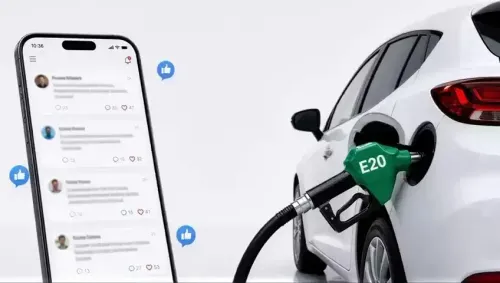
Shekhawat Makes Case for Ethanol Fuel Over Mileage Concerns
Synopsis
Union Minister Gajendra Singh Shekhawat reframes India's E20 mileage debate, arguing that better octane, cleaner combustion, and up to 40% lower lifecycle carbon emissions make ethanol-blended petrol the smarter consumer and environmental choice.
Key Takeaways
Union Minister Gajendra Singh Shekhawat posted on 6 August 2026 defending ethanol-blended petrol against common mileage concerns.
He concedes a 5% mileage difference but argues the trade-off delivers better acceleration, higher octane, anti-knocking properties, and smoother urban performance.
The post claims up to 40% reduction in lifecycle carbon emissions from ethanol-blended fuel compared to conventional petrol.
India's Ethanol Blended Petrol programme , anchored in the National Policy on Biofuels 2018 , targets energy security, farmer income, and emission cuts simultaneously.
The intervention signals an active government push to shift public perception on E20 petrol ahead of further infrastructure expansion.
The mileage debate around ethanol-blended petrol has a new, high-profile voice. Union Culture and Tourism Minister Gajendra Singh Shekhawat stepped into one of India's most common consumer fuel arguments on 6 August 2026, posting a direct rebuttal to the widespread worry that blended fuels hurt your mileage — and flipping the question entirely.
Shekhawat's post, written in a punchy mix of Hindi and English, opens with a challenge: 'Sawaal mileage ka nahin, value ka hai!' ('The question is not of mileage, it is of value!'). He concedes the mileage point — a 5% difference — and then immediately pivots to what he argues you get in return: better acceleration and pickup, higher octane rating, superior anti-knocking properties, cleaner combustion, and smoother performance even in stop-and-go city traffic. The kicker he leads with is environmental — a claimed reduction of up to 40% in lifecycle carbon emissions.
The E20 Debate Shekhawat Is Wading Into
This is not abstract advocacy. India has been rolling out E20 petrol — a blend of 20% ethanol and 80% conventional petrol — under the government's Ethanol Blended Petrol programme, itself rooted in the National Policy on Biofuels 2018. The policy was designed to serve three goals simultaneously: reduce India's crude oil import bill, create a demand channel for surplus agricultural produce (primarily sugarcane and foodgrain), and cut vehicular emissions. The mileage trade-off has been the single biggest friction point in public acceptance. Ethanol carries less energy per litre than pure petrol, so a straight blend does reduce fuel economy on older, uncalibrated engines. Shekhawat's post directly targets this consumer hesitation — reframing the conversation from 'how far does one litre take me' to 'what does one litre do to my engine and the air around me.'Octane, Engine Life, and the Value Argument
The minister's case rests on three pillars. First, higher octane in ethanol blends allows engines to run more efficiently and with less knocking — a real, measurable benefit that engine manufacturers acknowledge. Second, cleaner combustion means less carbon deposit buildup inside the engine, which can extend engine life over time. Third, and most consequentially for policy, the lifecycle emissions argument: ethanol derived from crops absorbs CO2 during growth, partially offsetting what is released during combustion — the basis for the claimed carbon reduction figure. Shekhawat closes with a consumer call-to-action: 'Drive Smart, Choose Better!' — positioning the choice of blended fuel not as a government mandate but as an informed personal decision. As India pushes E20 infrastructure deeper into the fuel retail network and vehicle manufacturers tune newer engines for blended compatibility, the minister's intervention signals that the government is now actively fighting the mileage narrative — one social media post at a time.Point of View
Not a policy announcement — it signals that the government recognises public resistance to E20 as a behavioural problem, not just an infrastructure one. By conceding the mileage point upfront rather than denying it, he adopts a more credible persuasion strategy than blanket promotion. The framing aligns with a broader BJP pattern of using ministers' personal social media presence to pre-empt criticism of flagship programmes. The real test will be whether the value argument lands with two-wheeler owners, who are the most mileage-sensitive segment and the largest user base of petrol in India.
NationPress
20 Sept 2026
Frequently Asked Questions
Does ethanol-blended petrol reduce mileage?
Ethanol contains less energy per litre than pure petrol, so a blend like E20 can reduce fuel economy by roughly 5% on engines not specifically tuned for it, though higher octane properties can partially offset this on compatible engines.
What is E20 petrol in India?
E20 is a blend of 20% ethanol and 80% conventional petrol being rolled out across India under the government's Ethanol Blended Petrol programme, which is rooted in the National Policy on Biofuels 2018 .
Why is the government promoting ethanol-blended fuel?
The government promotes ethanol blending to reduce India's crude oil import costs, create additional demand for agricultural produce like sugarcane, and cut vehicular carbon emissions over the fuel's lifecycle.
What did Gajendra Singh Shekhawat say about ethanol fuel?
Shekhawat argued that the question is 'not of mileage but of value,' saying ethanol blends offer better acceleration, higher octane, cleaner combustion, longer engine life, and up to 40% lower lifecycle carbon emissions.
Is ethanol fuel better for car engines?
Higher octane ethanol blends can reduce engine knocking and carbon deposit buildup, which proponents argue extends engine life — though the benefit is most pronounced in engines calibrated for higher ethanol content.