Shekhawat: BJP fulfilled MSP promise, earlier govts deceived farmers
Synopsis
Union Minister Gajendra Singh Shekhawat accused previous governments of deceiving farmers on MSP, asserting that the BJP-led government has fulfilled its promise. The statement reignites a long-running debate over agricultural pricing, procurement guarantees, and BJP's rural electoral narrative.
Key Takeaways
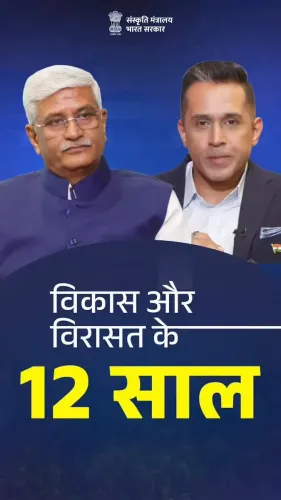
Gajendra Singh Shekhawat , Union Minister of Culture and Tourism and BJP MP from Jodhpur , accused earlier governments of deceiving farmers on MSP.
He claimed the current BJP-led government has fulfilled its Minimum Support Price promise to farmers.
The Swaminathan Commission (2006) had recommended MSP at 50% above comprehensive cost of production ; this was adopted as policy in 2018 at 1.5 times cost for 22 crops .
MSP remains politically contentious, with ongoing demands for a legal guarantee on procurement at floor prices.
The next Cabinet Committee on Economic Affairs MSP announcement and the forthcoming Union Budget will be key indicators of policy direction.
The debate over agricultural minimum support prices has a new flashpoint: Union Culture and Tourism Minister Gajendra Singh Shekhawat took to X on Friday, 30 October 2026, delivering a pointed broadside against previous governments — accusing them of betraying farmers on MSP (Minimum Support Price) while asserting that the current BJP-led dispensation has kept its word.
Posting in Hindi, the Jodhpur MP stated: 'पहले की सरकारें MSP को लेकर भी किसानों को धोखा ही दे रही थी, लेकिन यह हमारी सरकार है जिसने MSP का वादा पूरा किया है।' — 'The earlier governments were deceiving farmers even on MSP, but it is our government that has fulfilled the MSP promise.'What MSP means for India's farmers
Minimum Support Price is the government-declared floor rate at which designated agencies procure select crops, acting as a financial safety net for millions of cultivators. The mechanism covers 22 mandated crops and has long sat at the heart of rural policy debates. The landmark Swaminathan Commission report of 2006 called for MSP to be set at least 50 per cent above the comprehensive cost of production — a recommendation that gathered dust through successive administrations before becoming a formal policy target.The 2018 shift and BJP's electoral arithmetic
In 2018, the central government formally adopted the principle of MSP at 1.5 times the cost of production — effectively implementing the Swaminathan formula — for the 22 mandated crops. The BJP has since cited regular seasonal hikes as evidence of honouring electoral pledges made to India's vast rural electorate, drawing a sharp contrast with the preceding UPA era. Agricultural pricing carries outsized political weight in states with large farming communities, making MSP a perennial battleground in the run-up to every state and national election.A recurring charge, a live debate
Shekhawat's statement arrives in a political climate where the demand for a legal guarantee on MSP — ensuring farmers can sue for the floor price in court — remains unresolved. Critics of the government argue that high MSP announcements are meaningful only when backed by robust procurement; supporters counter that consistent rate hikes and expanded procurement outreach demonstrate genuine commitment. The next seasonal MSP announcement by the Cabinet Committee on Economic Affairs, and any related provisions in the forthcoming Union Budget, will be closely watched as a test of that commitment.The MSP argument is as old as Indian democracy itself — but with every election cycle, the stakes only rise.
Point of View
Which remains the sharpest critique farmers' groups level at the current government. By centering the 2018 adoption of the Swaminathan formula, the BJP attempts to claim a generational policy victory; opponents argue that announcements without statutory procurement obligations fall short of genuine protection. The MSP battlefield, in other words, is far from settled.
NationPress
30 Oct 2026
Frequently Asked Questions
What is MSP and why does it matter for Indian farmers?
MSP, or Minimum Support Price, is the government-declared floor price at which state agencies procure select crops, protecting farmers from market price crashes. It currently covers 22 mandated crops and is a critical income-security mechanism for millions of cultivators across India.
What did Gajendra Singh Shekhawat say about MSP?
Shekhawat said that previous governments had deceived farmers on MSP, but the current BJP-led government has fulfilled its MSP promise — a statement he made on X on 30 October 2026.
What was the Swaminathan Commission's recommendation on MSP?
The Swaminathan Commission's 2006 report recommended that MSP be set at a minimum of 50 per cent above the comprehensive cost of production. The central government formally adopted this principle — at 1.5 times the cost of production for 22 crops — in 2018.
Is MSP legally guaranteed for Indian farmers?
No. As of the available record, MSP is a policy-level announcement and not a statutory right. Farmers' groups and opposition parties have long demanded a legal guarantee ensuring procurement at or above the floor price, but this has not been enacted.
What is the difference between MSP announcement and MSP procurement?
An MSP announcement sets the government's declared floor price for a crop, while procurement refers to state agencies actually buying crops at that price. Critics argue that without robust procurement infrastructure, a high MSP announcement may not translate into real income gains for farmers.