Shekhawat Hails Camel as Cultural Symbol on World Camel Day
Synopsis
Union Culture and Tourism Minister Gajendra Singh Shekhawat marked World Camel Day on 22 June 2026, calling the camel a symbol of Rajasthan and Gujarat's heritage and urging citizens to see conservation as an extension of cultural attachment.
Key Takeaways
Gajendra Singh Shekhawat , Union Minister of Culture and Tourism, posted a World Camel Day greeting on 22 June 2026 .
He described the camel as a cultural and traditional symbol of Rajasthan and Gujarat , beyond its livelihood utility.
Rajasthan declared the camel its state animal in 2014 to support conservation and cultural recognition.
The message aligns with the Ek Bharat Shreshtha Bharat framework, which links intangible heritage to national cultural integration.
Camel herding communities in the Thar Desert belt stand to benefit from increased political visibility for conservation concerns.
Follow-up policy announcements on camel conservation or heritage tourism circuits are being watched for the next budget session.
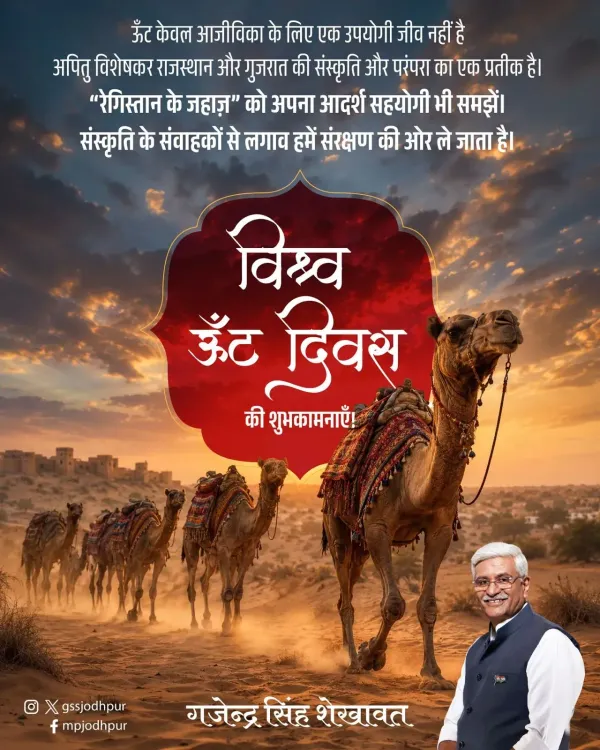
Union Culture and Tourism Minister Gajendra Singh Shekhawat on Sunday, 22 June 2026 greeted the nation on World Camel Day, calling the camel not merely a livelihood asset but a living symbol of the culture and traditions of Rajasthan and Gujarat.
Context
Posting in Hindi on X, Shekhawat wrote: 'ऊँट केवल आजीविका के लिए एक उपयोगी जीव नहीं है अपितु विशेषकर राजस्थान और गुजरात की संस्कृति और परंपरा का एक प्रतीक है' — 'The camel is not merely a useful creature for livelihood, but a symbol of the culture and traditions of Rajasthan and Gujarat in particular.' He urged people to regard the 'ship of the desert' as an ideal companion, adding that 'our attachment to the bearers of culture leads us towards conservation.'
World Camel Day is observed annually on 22 June to spotlight the ecological, economic, and cultural roles camels play in arid communities across the world. For desert states like Rajasthan, the occasion carries particular resonance: the state officially designated the camel its state animal in 2014, a move aimed at boosting both conservation efforts and cultural recognition.
Policy Backdrop
The minister's message aligns with the Culture Ministry's sustained emphasis on intangible heritage and traditional livelihoods under the Ek Bharat Shreshtha Bharat framework, which seeks to deepen cultural integration across Indian states. Successive governments have linked animal symbols — and the pastoral communities that depend on them — to broader tourism promotion and rural economy narratives in western India.
Camels remain central to the identity of desert districts across Rajasthan and parts of Gujarat, where herding communities have for generations relied on the animal for transport, dairy, and tourism. The creature's iconic status is reinforced annually at events such as the Pushkar Camel Fair, one of the largest livestock fairs in the world and a flagship draw on India's cultural tourism calendar.
Stakeholders and Impact
The minister's public affirmation carries symbolic weight for camel herders and pastoral communities in the Thar Desert belt, who have long sought stronger policy support for declining camel populations. Conservation advocates argue that cultural recognition by senior ministers can translate into greater political will for dedicated funding and protection schemes.
For the tourism sector in western India, the camel's continued prominence as a cultural icon underpins desert safari circuits, heritage festivals, and rural tourism products that attract both domestic and international visitors. Shekhawat, as an MP from Jodhpur — the gateway to the Thar Desert — has a direct constituency interest in the animal's welfare and visibility.
What's Next
Observers will watch whether the minister's remarks are followed by concrete announcements — such as camel conservation funding or new heritage tourism circuits — during the next budget session or upcoming state-level cultural festivals. The Ek Bharat Shreshtha Bharat programme and the Culture Ministry's broader intangible heritage agenda provide ready institutional channels for translating such symbolic gestures into policy action. Any follow-up scheme would likely target the pastoral communities of Rajasthan and Gujarat most directly.
Frequently Asked Questions
When is World Camel Day celebrated?
World Camel Day is observed every year on 22 June to highlight the ecological, economic, and cultural importance of camels in arid regions around the world.
Why is the camel important to Rajasthan?
The camel is Rajasthan's state animal , declared so in 2014 , and is central to the livelihoods, culture, and tourism of desert communities in the state, particularly in the Thar Desert belt.
What did Gajendra Singh Shekhawat say on World Camel Day 2026?
Shekhawat called the camel a symbol of the culture and traditions of Rajasthan and Gujarat , urged people to regard it as an ideal companion, and said attachment to cultural symbols naturally leads to conservation.
What is the Ek Bharat Shreshtha Bharat programme?
Ek Bharat Shreshtha Bharat is a central government initiative designed to deepen cultural integration across Indian states by promoting shared heritage, traditions, and languages.
What is Gajendra Singh Shekhawat's role in the Indian government?
Gajendra Singh Shekhawat is the Union Minister of Culture and Tourism, a senior BJP leader, and a Lok Sabha MP representing Jodhpur in Rajasthan.