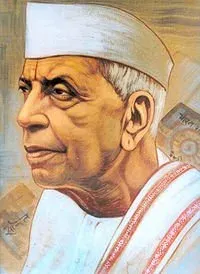
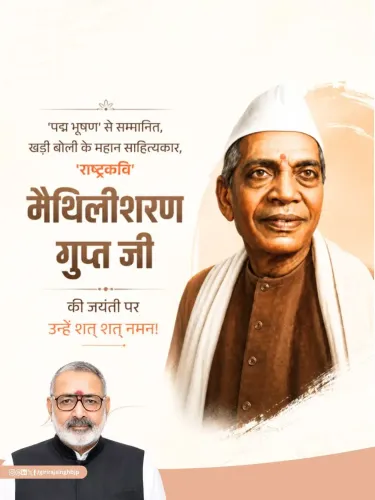
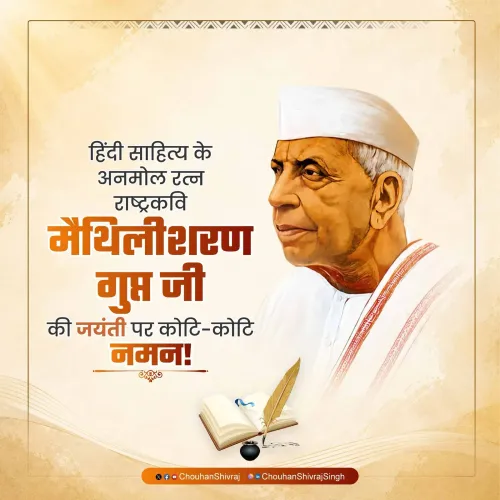
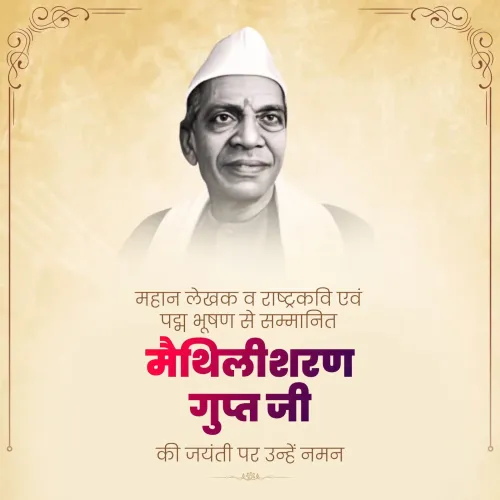
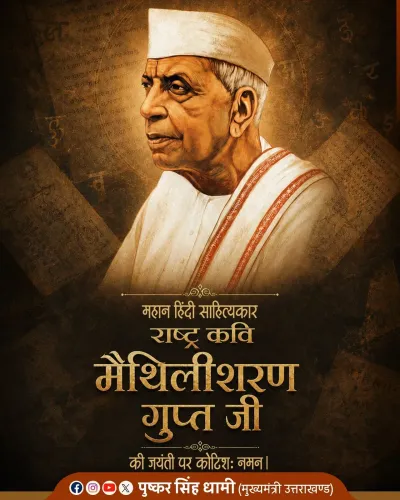
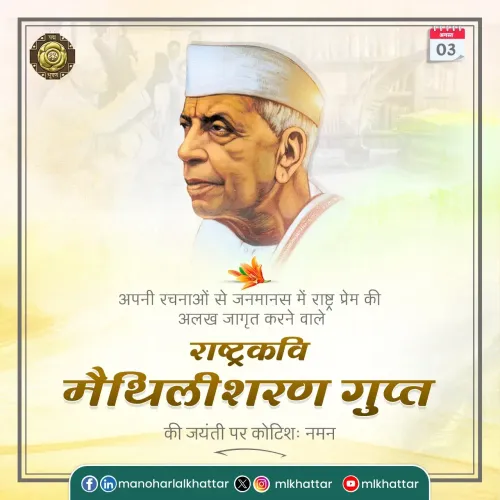
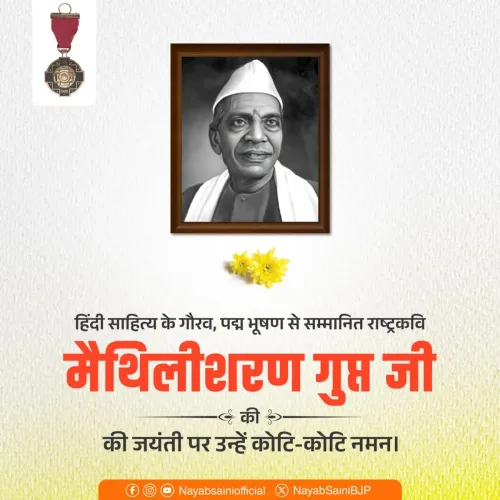
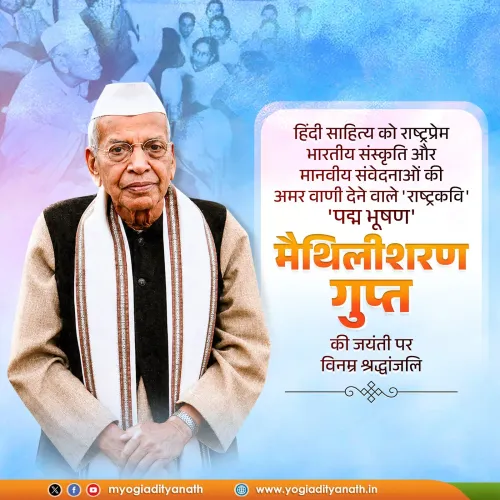
Shekhawat pays tribute to Rashtrakavi Maithili Sharan Gupt on birth anniversary
Synopsis
Union Culture and Tourism Minister Gajendra Singh Shekhawat marked the birth anniversary of Rashtrakavi Maithili Sharan Gupt on 3 August 2026, quoting the poet's iconic patriotic verse and calling Hindi literature incomplete without his name.
Key Takeaways
Union Minister Gajendra Singh Shekhawat paid tribute to Rashtrakavi Maithili Sharan Gupt on his birth anniversary on 3 August 2026 .
Shekhawat quoted Gupt's celebrated verse: 'That which holds no love for the homeland is not a heart, but stone.' Maithili Sharan Gupt (1886–1964) was conferred the title Rashtrakavi and is best known for Bharat Bharati , a landmark work of the national awakening era.
Shekhawat called Hindi literature 'incomplete' without Gupt's name.
The tribute reflects the Ministry of Culture's consistent practice of marking birth anniversaries of canonical Hindi literary figures.
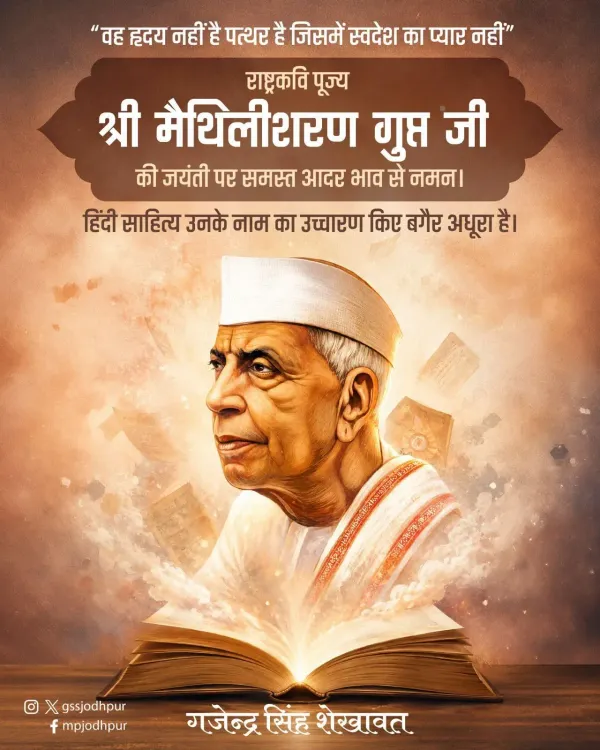
A heart without love for the motherland is not a heart — it is stone. With that line from the pen of Rashtrakavi Maithili Sharan Gupt, Union Culture and Tourism Minister Gajendra Singh Shekhawat opened his tribute on Monday, 3 August 2026, marking the poet's birth anniversary with a bow of reverence to one of Hindi literature's most defining voices.
Shekhawat quoted the iconic verse — 'वह हृदय नहीं है, पत्थर है जिसमें स्वदेश का प्यार नहीं' ('That which holds no love for the homeland is not a heart, but stone') — and added that Hindi literature remains incomplete without Gupt's name.
The poet who gave India its patriotic voice
Maithili Sharan Gupt (1886–1964) stands as one of the towering figures of modern Hindi literature. Conferred the title Rashtrakavi — National Poet — his most celebrated work, Bharat Bharati, became a clarion call for national awakening during the independence movement, stirring pride in India's civilisational heritage at a moment when the country was searching for its own reflection.
His verse moved beyond aesthetics into conscience — poetry as a civic act. That is precisely why a line like the one Shekhawat chose still lands with force more than a century after it was written.
Culture Ministry's pattern of literary remembrance
The tribute fits a consistent practice by central government ministers of publicly marking the birth anniversaries of canonical Hindi writers on social media. For the Ministry of Culture, such observances align directly with its mandate: to keep alive the figures who shaped India's literary and national identity. Gupt, who bridged the colonial era and independent India, sits at the very heart of that canon.
For a minister who oversees the country's cultural institutions, invoking Gupt's verse on his jayanti is both a personal salute and an institutional signal — that the state recognises literature not as ornament, but as the spine of national memory.
Hindi literature lost an irreplaceable voice when Gupt passed in 1964, but his lines have never stopped circulating. Today's tribute is a reminder that some poetry does not age — it only finds new occasions to be true.
Point of View
Not just literary heritage. It also fits a broader pattern in which the BJP-led government has foregrounded Hindi literary nationalism as part of its cultural outreach. The choice of verse, sharp and morally declarative, does the political work quietly.
NationPress
3 Aug 2026
Frequently Asked Questions
Who is Maithili Sharan Gupt?
Maithili Sharan Gupt (1886–1964) was a pioneering Hindi poet conferred the title Rashtrakavi (National Poet). His work Bharat Bharati became a defining text of India's national awakening movement.
What did Gajendra Singh Shekhawat say about Maithili Sharan Gupt?
Shekhawat quoted Gupt's iconic verse — 'That which holds no love for the homeland is not a heart, but stone' — and stated that Hindi literature remains incomplete without Gupt's name.
When is Maithili Sharan Gupt's birth anniversary?
Maithili Sharan Gupt's birth anniversary, known as his jayanti, falls on 3 August . In 2026, Union Minister Shekhawat marked the occasion publicly on social media.
What is Bharat Bharati?
Bharat Bharati is Maithili Sharan Gupt's most celebrated work, written during the colonial era. It engaged deeply with themes of India's civilisational pride and national awakening, and became widely read during the independence movement.
Who is Gajendra Singh Shekhawat?
Gajendra Singh Shekhawat is India's Union Minister of Culture and Tourism , a senior BJP leader, and a Lok Sabha MP from Jodhpur, Rajasthan .