Karnataka CM Shivakumar backs women's reservation, announces board appointments list
Synopsis
Karnataka CM D.K. Shivakumar used Children's Day to do double duty — pledging full state backing for a 150-plus-member women parliamentarians' conference in Bengaluru next week, while quietly announcing that a second round of Congress board appointments is days away. The dual messaging captures the Congress government's balancing act between political optics and party patronage.
Key Takeaways
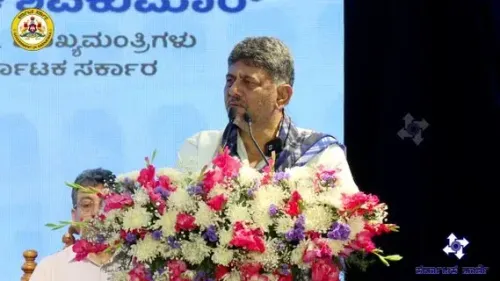
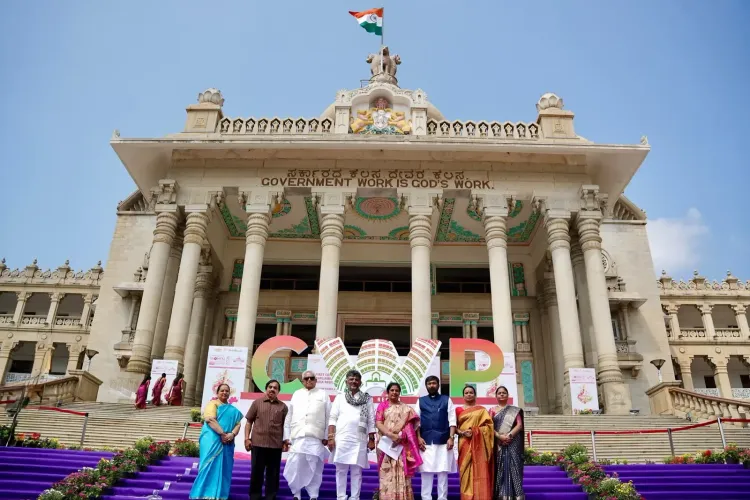
Shivakumar unveiled the logo of the CWP India Region Conference at Vidhana Soudha on 14 November 2026 .
The conference, on 17-18 November in Bengaluru , will host more than 150 women parliamentarians and legislators from India and abroad.
Shivakumar expressed confidence that the Women's Reservation Bill , passed by the Rajya Sabha, would be implemented in an upcoming Parliament session.
The second list of board and corporation appointments for Congress workers is expected within a day or two.
The state government has appointed 40,000 people to guarantee committees; another 20,000 appointments are in progress.
A sixth guarantee — a land guarantee — has been reiterated as part of the government's commitment to citizens.
Karnataka Chief Minister D.K. Shivakumar on Saturday, 14 November 2026, called for stronger political representation for women and pledged the state government's full support to the Commonwealth Women Parliamentarians (CWP) India Region Conference, scheduled in Bengaluru on 17 and 18 November. Speaking at the unveiling of the conference logo on the steps of Vidhana Soudha, Shivakumar emphasised that women must receive adequate representation in both Parliament and State Legislatures.
Women's Reservation and the CWP Conference
Shivakumar noted that the Women's Reservation Bill had already been passed by the Rajya Sabha and expressed confidence that it would be implemented in an upcoming Parliament session. He recalled that legislation introduced under former Prime Minister Rajiv Gandhi had earlier sought to provide 50 per cent reservation for women from the panchayat level to district administration. The Chief Minister said he believed all political parties supported greater reservation and representation for women.
He described the upcoming CWP India Region Conference as a historic milestone for Karnataka and assured full government backing. The conference, organised under the leadership of CWP India Region Chairperson D. Purandeswari, is expected to bring together more than 150 women parliamentarians, legislators, and presiding officers from India and abroad. Karnataka Legislative Assembly Speaker G.S. Patil and Legislative Council Chairman Saleem Ahmed will extend state government cooperation to ensure the event's success.
Women in Karnataka's Administration
Shivakumar highlighted that women in Karnataka currently hold key Constitutional and administrative positions, including those of Governor, Chief Secretary, Assembly Secretary, Legislative Council Secretary, and Deputy Chairperson — a fact he described as a matter of pride. He also cited the achievements of India's first woman Chief Minister Sucheta Kripalani, former Prime Minister Indira Gandhi, and President Droupadi Murmu as proof that determined women could reach any position.
'Women are the eyes of a family. When women are empowered, men too become stronger,' Shivakumar said.
Second List of Board Appointments Imminent
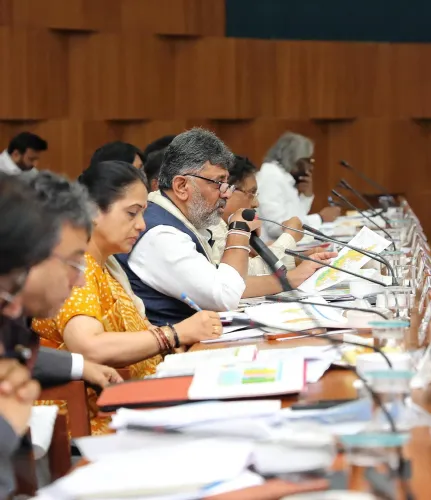
Separately, addressing a Children's Day programme at Bharat Jodo Hall in the Kerala Pradesh Congress Committee (KPCC) office — held to mark the birth anniversary of former Prime Minister Jawaharlal Nehru — Shivakumar announced that the second list of appointments to various boards and corporations would be released within the next couple of days. 'The first list has been announced to provide positions to party workers. The second list will be released in a day or two, following which the remaining positions will also be given to workers,' he said.
He also disclosed that the state government had appointed 40,000 people to guarantee committees, with the process to appoint another 20,000 members currently underway. Shivakumar called on party workers to strengthen Bharat Jodo organisations at the panchayat and ward levels.
Guarantees, Electoral Rolls, and Nehru's Legacy
The Chief Minister reaffirmed the importance of the state government's five guarantee schemes and indicated that a sixth — a land guarantee — was also part of its commitment to the people. On the Special Intensive Revision (SIR) of electoral rolls, Shivakumar said the Congress had developed an app and was exploring measures to reinstate the names of eligible voters removed from rolls, backed by public awareness programmes.
Paying tribute to Nehru on Children's Day, Shivakumar credited him with laying the foundation for India's industrial, green, and white revolutions and for his contributions to education, healthcare, and science. He noted that Nehru had laid the foundation stone for Vidhana Soudha and played a formative role in building institutions and public sector enterprises including HMT, ITI, and ISRO.
The second list of board appointments, once released, will be closely watched by Congress workers and political observers tracking the state government's patronage distribution ahead of local body elections.
Point of View
The imminent second appointments list signals that the government is still working through a large patronage backlog — the fact that 60,000 guarantee committee positions are being filled in tranches points to the scale of political obligation Congress is managing. Whether the land guarantee, flagged but not yet detailed, translates into actionable policy or remains a promise in circulation is the sharper question mainstream coverage is not yet pressing.
NationPress
14 Nov 2026
Frequently Asked Questions
What is the CWP India Region Conference in Bengaluru?
The Commonwealth Women Parliamentarians (CWP) India Region Conference is a two-day event scheduled for 17 and 18 November 2026 in Bengaluru, organised under the leadership of CWP India Region Chairperson D. Purandeswari. It is expected to bring together more than 150 women parliamentarians, legislators, and presiding officers from India and other countries.
What did CM Shivakumar say about the Women's Reservation Bill?
Chief Minister D.K. Shivakumar said the Women's Reservation Bill had been passed by the Rajya Sabha and expressed confidence it would be implemented in an upcoming Parliament session. He also recalled that earlier legislation under former PM Rajiv Gandhi had sought 50 per cent reservation for women from the panchayat level upward.
When will Karnataka's second list of board appointments be released?
CM Shivakumar announced on 14 November 2026 that the second list of appointments to various boards and corporations would be released within a day or two. The first list has already been issued to provide positions to Congress party workers, with remaining positions to follow thereafter.
What are Karnataka's guarantee schemes, and what is the land guarantee?
The Karnataka government has five flagship guarantee schemes for citizens. Shivakumar reiterated that a sixth initiative — the land guarantee — is also part of the government's commitment to the people, though detailed specifics were not outlined in his remarks.
What did Shivakumar say about electoral roll revisions?
On the Special Intensive Revision (SIR) of electoral rolls, Shivakumar said the Congress party had developed an app and was considering measures to ensure that eligible voters whose names had been removed could be reinstated. The government has also organised public awareness programmes on the issue.