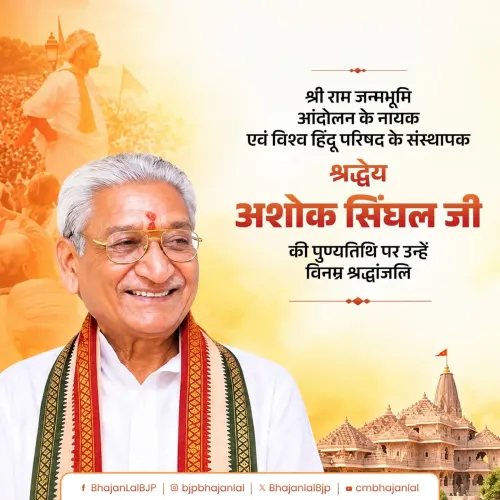
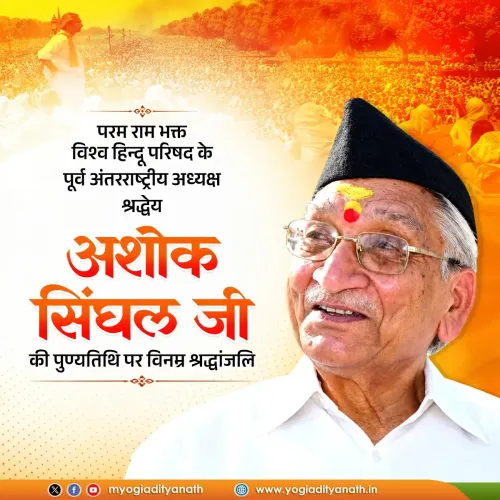
Shivraj pays tribute to Ashok Singhal on death anniversary
Synopsis
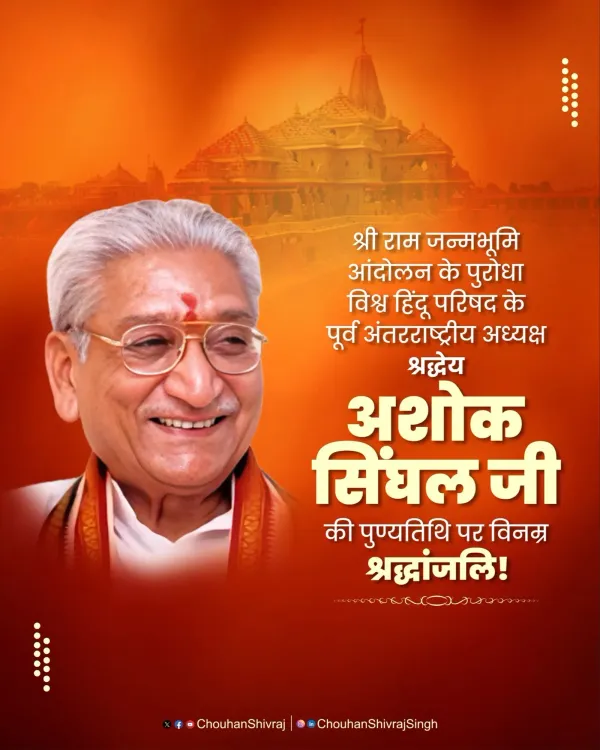
Union Agriculture Minister Shivraj Singh Chouhan marked the death anniversary of Ashok Singhal, former VHP international president and Ram Janmabhoomi movement pioneer, calling him a 'true guardian of dharma and the nation' in a Hindi tribute posted on 17 November 2026.
Key Takeaways
Shivraj Singh Chouhan paid tribute to Ashok Singhal on his death anniversary on 17 November 2026 .
Singhal served as former international president of the Vishva Hindu Parishad (VHP) , founded in 1964 .
He is remembered as a central figure and pioneer of the Ram Janmabhoomi movement for a temple in Ayodhya .
Chouhan described Singhal as a 'true guardian of dharma and the nation,' pledging he would be remembered 'across ages.' Senior BJP leaders regularly commemorate death anniversaries of Ayodhya movement figures, reflecting the movement's enduring role in the party's identity.
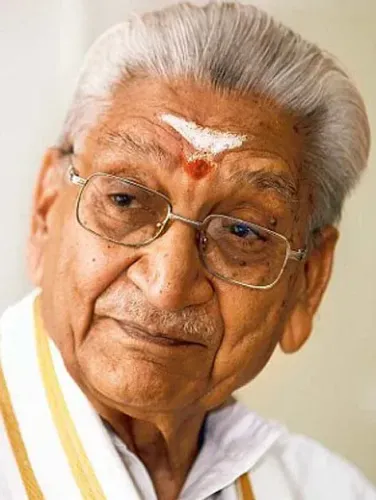
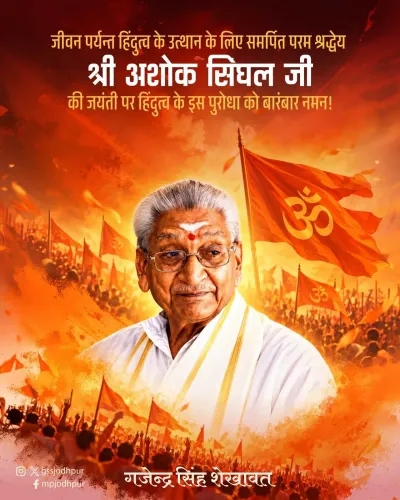
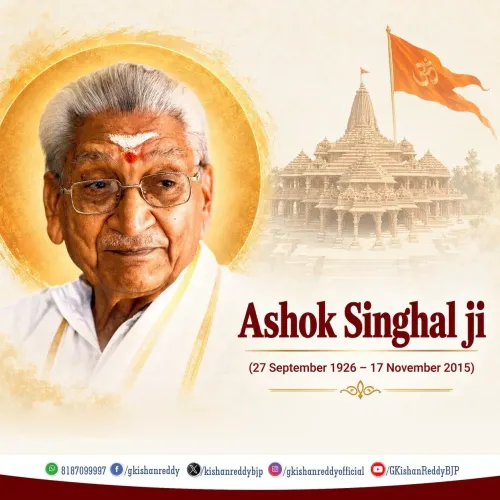
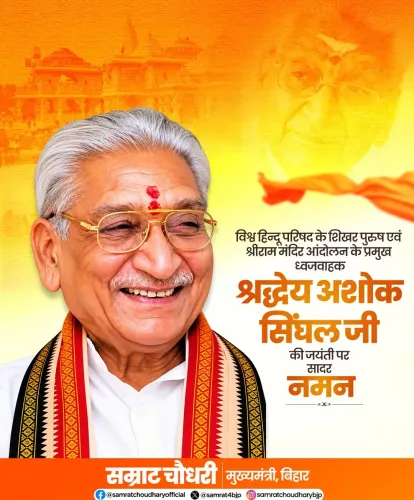
A quiet but pointed act of remembrance from the heart of the ruling establishment — Union Agriculture Minister Shivraj Singh Chouhan paid tribute on Tuesday, 17 November 2026, to Ashok Singhal, the late international president of the Vishva Hindu Parishad (VHP) and a towering figure in the Ram Janmabhoomi movement, on his death anniversary.
Writing in Hindi, Chouhan described Singhal as the 'praneta' (pioneer) of the Ram Janmabhoomi movement and offered what he called a humble homage — 'vinarm shraddhanjali'. He said Singhal would be remembered across ages for his 'unparalleled works and efforts in the service of the motherland and protection of dharma,' closing with a salutation: 'Homage at the feet of a true guardian of dharma and the nation.'
Who was Ashok Singhal and why he is remembered
Ashok Singhal served as the international president of the Vishva Hindu Parishad, the Hindu nationalist organisation founded in 1964 with a mandate to consolidate and promote Hindu culture and religion. He became the most prominent public face of the decades-long campaign to construct a temple at Ayodhya, believed by millions of Hindus to be the birthplace of Lord Rama — a movement that defined Indian politics across the late twentieth and early twenty-first centuries.
Singhal's advocacy helped transform what was largely a religious aspiration into one of the most consequential socio-political campaigns in modern Indian history. The Ram Janmabhoomi movement shaped electoral outcomes, influenced constitutional debates, and ultimately culminated in the Supreme Court's 2019 verdict clearing the path for temple construction, and the consecration of the Ram Mandir in Ayodhya in January 2024 — an event Singhal did not live to witness.
BJP's tradition of honouring Ayodhya movement figures
Chouhan's tribute follows a well-established pattern among senior BJP leaders of publicly commemorating deaths anniversaries of figures central to the Ram Janmabhoomi agitation. For the BJP, the movement is not merely historical memory — it remains a living strand of the party's political identity and an article of mass faith for a significant portion of its support base.
Chouhan himself, as a four-term Chief Minister of Madhya Pradesh and one of the BJP's most senior mass leaders, carries particular weight when he speaks in this register. His tribute signals continuity — a reminder that even with the Ram Mandir now consecrated, the architects of that journey are not to be forgotten.
The VHP continues to function as a significant actor in Hindu cultural and religious mobilisation, and annual commemorations like this one reinforce the institutional memory linking the organisation to the ruling party's core narrative.
The Ayodhya chapter may be formally closed, but its principal figures are being written, one death anniversary at a time, into the permanent ledger of the movement's legacy.
Point of View
Such commemorations increasingly serve a consolidating function: cementing the movement's key personalities in the party's official pantheon. For a mass leader like Chouhan, who commands a large Hindu-majority constituency, the tribute also carries a grassroots signal — the ideology that animated decades of mobilisation is treated as heritage, not mere history.
NationPress
17 Nov 2026
Frequently Asked Questions
Who was Ashok Singhal?
Ashok Singhal was the former international president of the Vishva Hindu Parishad (VHP) and one of the most prominent leaders of the Ram Janmabhoomi movement that campaigned for a Hindu temple at Ayodhya.
What is the Vishva Hindu Parishad (VHP)?
The Vishva Hindu Parishad is a Hindu nationalist organisation founded in 1964, focused on consolidating and promoting Hindu culture and religious identity, and was a central force in the Ram Janmabhoomi agitation.
Why did Shivraj Singh Chouhan pay tribute to Ashok Singhal?
Chouhan paid tribute on Singhal's death anniversary, honouring him as the pioneer of the Ram Janmabhoomi movement and a guardian of dharma and the nation.
What was the Ram Janmabhoomi movement?
The Ram Janmabhoomi movement was a long-running campaign by Hindu groups, led prominently by the VHP, to construct a temple at Ayodhya — believed to be the birthplace of Lord Rama — which culminated in a Supreme Court verdict in 2019 and the consecration of the Ram Mandir in January 2024.
Do BJP leaders regularly remember Ashok Singhal?
Yes, senior BJP leaders periodically issue public tributes to Ashok Singhal and other figures from the Ram Janmabhoomi agitation on their death anniversaries, reflecting the movement's continuing importance to the party's political identity.