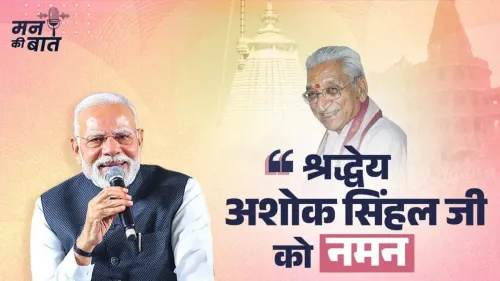
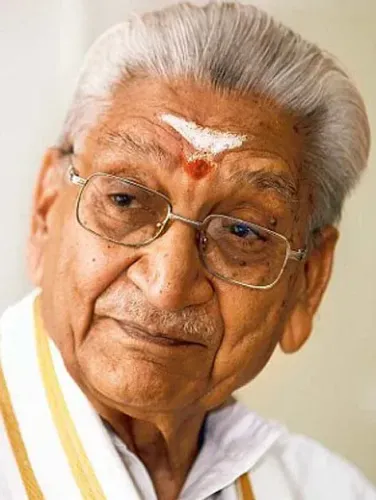
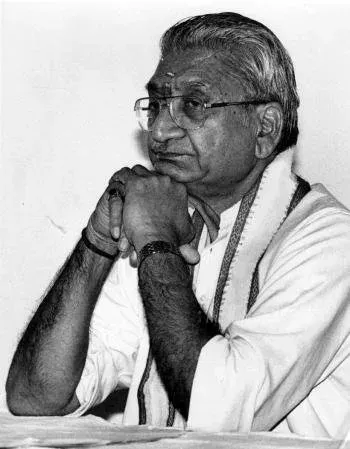
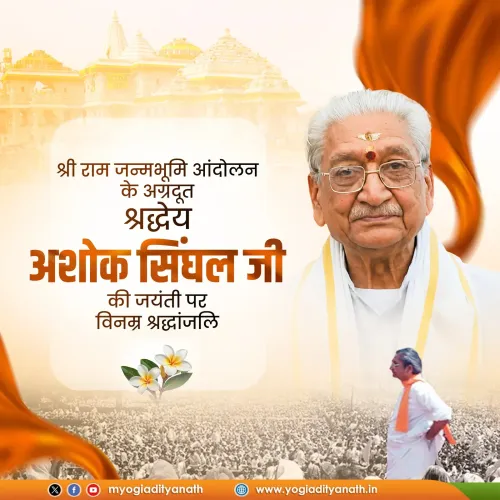
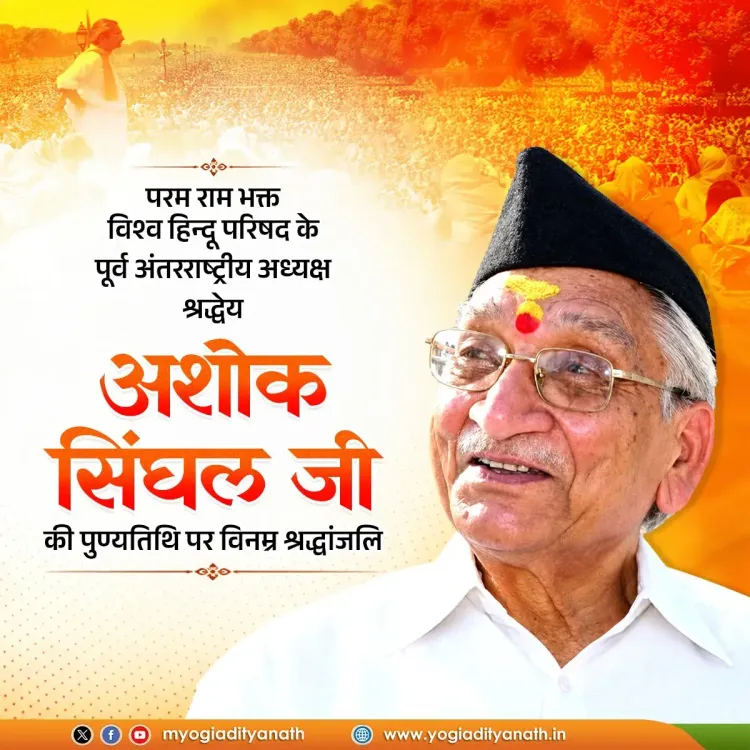
CM Yogi pays tribute to Ashok Singhal on his death anniversary
Synopsis
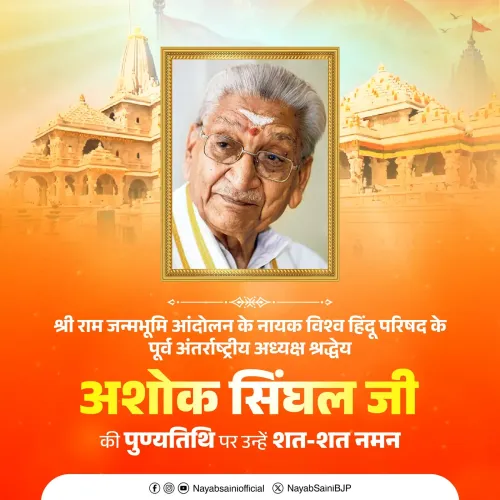
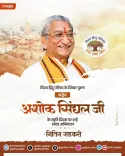
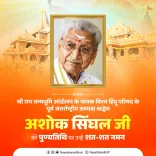
On Ashok Singhal's eleventh death anniversary, UP Chief Minister Yogi Adityanath honoured the VHP's former international president as the principal architect of the Ram Janmabhoomi movement, calling the Ayodhya temple his immortal memorial.
Key Takeaways
CM Yogi Adityanath paid tribute to Ashok Singhal on his death anniversary, 17 November 2026 .
Singhal served as international president of the Vishwa Hindu Parishad (VHP) and was a central figure in the Ram Janmabhoomi movement.
CM Yogi invoked the Ramcharitmanas verse 'Ram kaaju keenh̐e binu mohi kahāṃ bishram' to describe Singhal's lifelong vow.
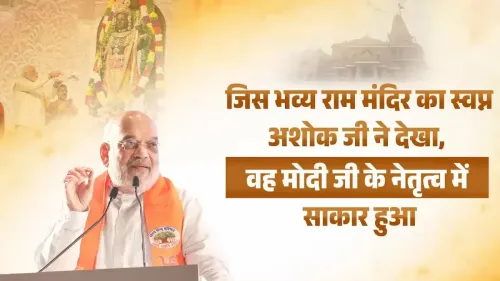
The Ram Mandir at Shri Ayodhya Dham was described as an immortal testament to Singhal's resolve, struggle, and dedication.
Singhal passed away on 17 November 2015 , before the 2019 Supreme Court verdict and the January 2024 consecration he had worked toward.
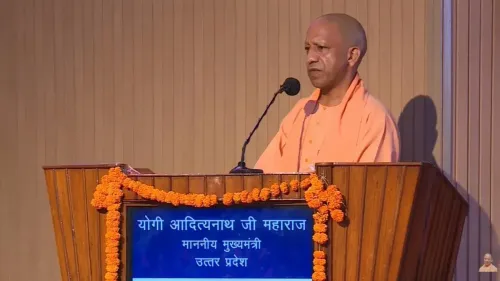
On the death anniversary of Ashok Singhal, one of the most defining figures in the decades-long movement to build a Ram temple at Ayodhya, Uttar Pradesh Chief Minister Yogi Adityanath offered a solemn tribute on Tuesday, 17 November 2026, calling the now-consecrated temple at Shri Ayodhya Dham an immortal testament to Singhal's resolve, struggle, and sacrifice.
Posting in Hindi, CM Yogi described Singhal as the 'principal architect of the Shri Ram Janmabhoomi movement, a fervent carrier of Sanatan culture, and former international president of the Vishwa Hindu Parishad (VHP).' He invoked a verse from the Ramcharitmanas — 'Ram kaaju keenh̐e binu mohi kahāṃ bishram' (Without completing the work of Ram, where is rest for me?) — to frame Singhal's lifelong dedication as a living vow rather than a political programme.
A life defined by the Ram Janmabhoomi cause
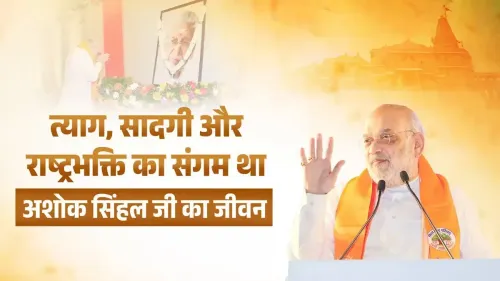
Ashok Singhal served as the VHP's international working president and later as its president, and was widely regarded as the ideological and organisational backbone of the Ram Janmabhoomi movement through its most turbulent decades. He championed the construction of a grand Ram temple at the site in Ayodhya, treating it as a civilisational mission rather than a legal or political dispute.
Singhal passed away on 17 November 2015, and did not live to see the Supreme Court verdict of November 2019 that cleared the way for temple construction, nor the consecration ceremony of January 2024 at which the idol of Shri Ramlala was formally installed in the new temple. CM Yogi's tribute places that completed temple squarely within Singhal's unfinished legacy — now finished.
The Ayodhya temple as Singhal's living memorial
CM Yogi's post makes the symbolism explicit: the Ram Mandir at Shri Ayodhya Dham is not merely a religious structure but, in his framing, 'an immortal memory of Singhal's sankalp (resolve), sangharsh (struggle), and samarpan (dedication).' That three-word formulation — resolve, struggle, dedication — maps directly onto the decades Singhal spent mobilising communities, navigating legal battles, and sustaining a mass movement through periods of intense communal and political tension.
For BJP-aligned leaders such as CM Yogi, marking Singhal's death anniversary publicly is also a reaffirmation of the ideological lineage that connects the VHP's grassroots campaigns of the 1980s and 1990s to the governing priorities of today's UP administration.
Point of View
And a restatement of the BJP-VHP civilisational narrative that the Ram Mandir represents a historical righting of wrongs. By framing the completed temple as Singhal's living memorial, Yogi links the current UP government's cultural identity directly to the mass-movement politics of the 1980s and 1990s. For the BJP's core constituency, this language of sankalp-sangharsh-samarpan is not rhetorical — it is the founding grammar of the party's decades-long journey to power. Such tributes also remind observers that the Ram Mandir, now consecrated, continues to function as active political capital well beyond its inauguration.
NationPress
17 Nov 2026
Frequently Asked Questions
Who was Ashok Singhal and why is he important?
Ashok Singhal was the former international president of the Vishwa Hindu Parishad (VHP) and the most prominent leader of the Ram Janmabhoomi movement that campaigned for a Ram temple in Ayodhya. He is widely credited as the principal organiser of that decades-long effort. He passed away on 17 November 2015.
What did CM Yogi Adityanath say about Ashok Singhal?
CM Yogi described Singhal as the 'principal architect of the Ram Janmabhoomi movement' and a 'fervent carrier of Sanatan culture.' He said Singhal dedicated his entire life to religion, culture, and the awakening of society, and called the Ram Mandir at Ayodhya his immortal memorial.
What is the verse 'Ram kaaju keenh̐e binu mohi kahāṃ bishram' that CM Yogi quoted?
It is a line from Tulsidas's Ramcharitmanas, spoken by Hanuman, meaning 'Without completing the work of Ram, where is rest for me?' CM Yogi used it to describe Singhal's total commitment to the Ram temple cause as a lifelong vow.
Did Ashok Singhal live to see the Ram Mandir built?
No. Ashok Singhal passed away on 17 November 2015, before the Supreme Court's landmark verdict in November 2019 that cleared the way for temple construction, and well before the consecration of Shri Ramlala in January 2024.
What is the Vishwa Hindu Parishad (VHP)?
The Vishwa Hindu Parishad is a Hindu nationalist organisation founded in 1964 that has been a central force in promoting Hindu cultural and religious causes in India and globally. It played a leading organisational role in the Ram Janmabhoomi movement alongside the RSS and BJP.