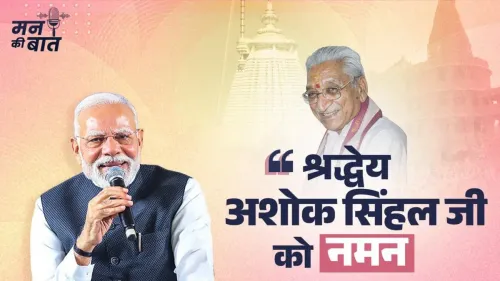
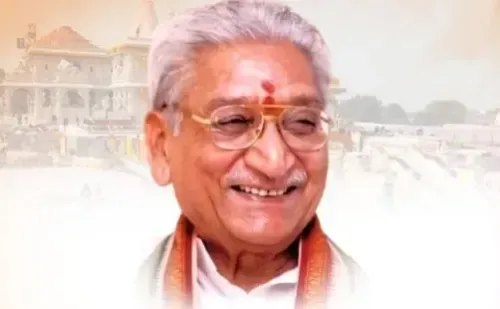
Amit Shah Pays Tribute to Ashok Singhal on Ram Temple Dream
Synopsis
Union Home Minister Amit Shah paid tribute to VHP stalwart Ashok Singhal on September 27, 2026, crediting PM Modi's tenure with fulfilling Singhal's lifelong mission of building a grand Ram Temple in Ayodhya following the Supreme Court's landmark 2019 verdict.
Key Takeaways
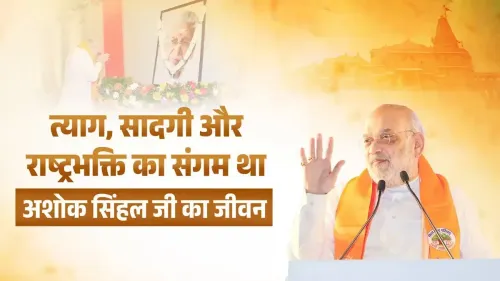
Amit Shah posted a tribute to Ashok Singhal , long-serving VHP leader and face of the Ram Janmabhoomi movement, who died in November 2015 .
Shah stated the Ram Temple Singhal fought for was realised within five years of PM Modi taking office in 2014 .
The Supreme Court of India cleared the path for temple construction on 9 November 2019 .
The Shri Ram Janmabhoomi Teerth Kshetra Trust was constituted in February 2020 ; PM Modi laid the foundation stone on 5 August 2020 .
The tribute reinforces the BJP's framing of the Ram Temple as a delivered electoral and cultural promise.
A lifelong struggle met its resolution — and Union Home Minister Amit Shah marked that convergence on Sunday, September 27, 2026, with a tribute to Ashok Singhal, the veteran Vishva Hindu Parishad (VHP) leader who spent decades championing the cause of a grand Ram Temple in Ayodhya.
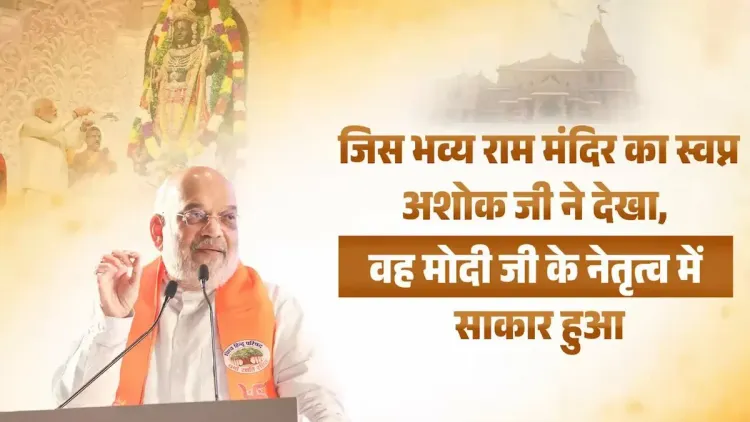
Shah wrote in Hindi: 'Ashok ji ne jeevanabhar jis bhavy Ram Mandir ke liye sangharsh kiya, Modi ji ke Pradhanmantri banne ke maatra paanch varshon mein vah svapna saakar ho gaya' — 'The magnificent Ram Temple for which Ashok ji struggled all his life became a reality within just five years of Modi ji becoming Prime Minister.'
Ashok Singhal's Decades-Long Ram Janmabhoomi Campaign
Ashok Singhal, who led the VHP for decades, was the central organisational face of the Ram Janmabhoomi movement from the 1980s onward. The movement sought the construction of a temple at Ram Janmabhoomi — the site in Ayodhya regarded by millions of Hindus as Lord Rama's birthplace — and became one of the most defining and contested issues in post-independence Indian political and social life. Singhal passed away in November 2015, before seeing the legal and administrative resolution he had worked toward.
Shah's tribute frames Singhal's decades of effort as a mission fulfilled posthumously — a movement that outlived its most prominent foot soldier, only to reach its conclusion within a compressed political timeline.
The 2019 Verdict and the Temple That Followed
The chain of events Shah alludes to began with a landmark ruling. The Supreme Court of India delivered its verdict on 9 November 2019, allocating the disputed site to a Hindu trust and clearing the legal path for construction. The government constituted the Shri Ram Janmabhoomi Teerth Kshetra Trust in February 2020 to oversee temple affairs. Prime Minister Narendra Modi then laid the foundation stone on 5 August 2020, with the consecration ceremony completing a journey that had run through courts, campaigns, and communal flashpoints for over three decades.
Shah's 'five years' reference maps directly onto this sequence — from Modi's return to power in 2014 to the apex court's 2019 ruling — compressing a generational struggle into a single political tenure's landmark.
The BJP's Cultural Pivot and Singhal's Place in That Story
The Ram Temple cause was never purely a legal or administrative matter. Since the late 1980s, it sat at the intersection of Hindu religious sentiment, mass mobilisation, and electoral politics. The BJP's rise as a national force through the early 1990s was inseparably tied to the energy the Ram Janmabhoomi movement generated. Singhal, as VHP chief, was a key architect of that mobilisation — and Shah's tribute places him squarely at the centre of a founding narrative the BJP continues to invoke.
Tributes of this kind serve a dual function: they honour a departed leader's personal mission while reinforcing the governing party's claim to have delivered on a promise its base had held for over a generation. Shah's phrasing — underscoring Prime Minister Modi's role in realising the dream — makes both moves simultaneously, and without ambiguity.
Point of View
Shah places the temple's construction as a flagship governance achievement rather than merely a legal outcome. The tribute also signals that the BJP's cultural identity politics remain central to its self-narration even years after the temple's consecration. For the party's base, invoking Singhal keeps the emotional stakes of the Ram Mandir alive as a symbol of promises kept.
NationPress
28 Sept 2026
Frequently Asked Questions
Who was Ashok Singhal and what was his role in the Ram Temple movement?
Ashok Singhal was a senior leader of the Vishva Hindu Parishad (VHP) who led the Ram Janmabhoomi movement for decades, advocating for the construction of a Ram Temple in Ayodhya. He passed away in November 2015, before the Supreme Court's landmark 2019 verdict enabled temple construction.
When did the Supreme Court clear the way for the Ayodhya Ram Temple?
The Supreme Court of India delivered its Ayodhya verdict on 9 November 2019, allocating the disputed Ram Janmabhoomi site to a Hindu trust and clearing the legal path for temple construction.
Why did Amit Shah say the Ram Temple dream was fulfilled in five years?
Shah's reference to five years maps from PM Modi's election in 2014 to the Supreme Court's 2019 verdict and subsequent executive actions — including the formation of the Shri Ram Janmabhoomi Teerth Kshetra Trust and PM Modi laying the foundation stone on 5 August 2020.
What is the Shri Ram Janmabhoomi Teerth Kshetra Trust?
The Shri Ram Janmabhoomi Teerth Kshetra Trust is a trust constituted by the Indian government in February 2020 to manage the construction and affairs of the Ram Temple in Ayodhya following the Supreme Court's 2019 verdict.
What did PM Modi do for the Ram Temple in Ayodhya?
PM Narendra Modi laid the foundation stone of the Ram Temple in Ayodhya on 5 August 2020, following the Supreme Court's November 2019 ruling and the government's formation of the Shri Ram Janmabhoomi Teerth Kshetra Trust in February 2020.