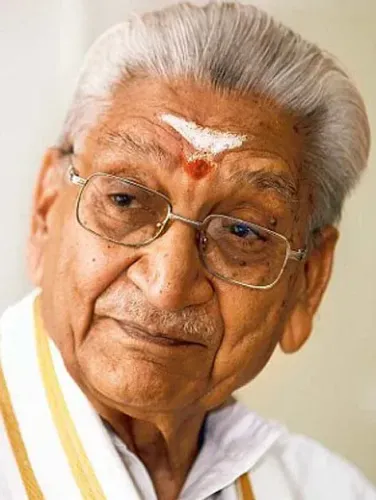
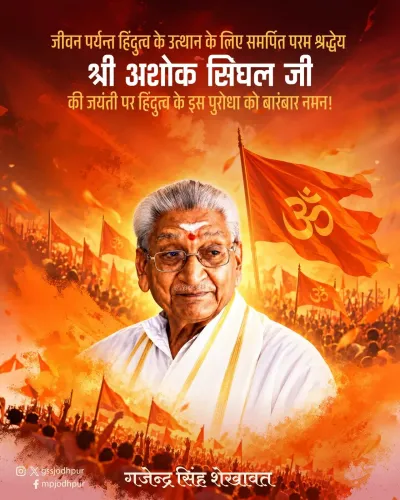
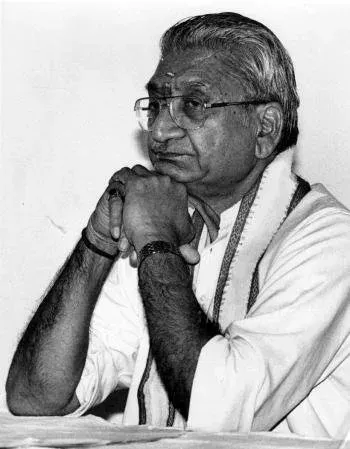
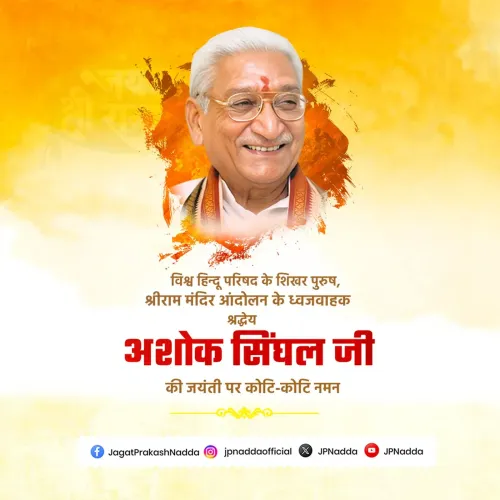
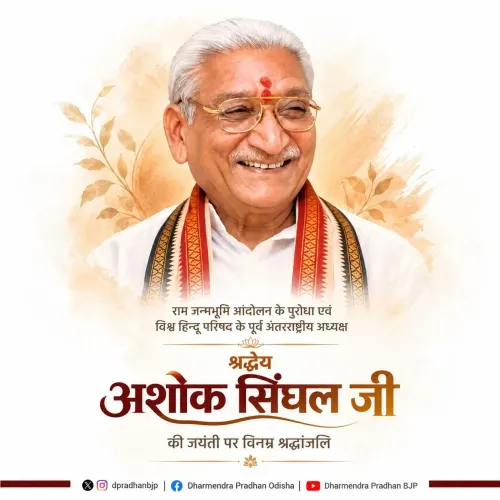
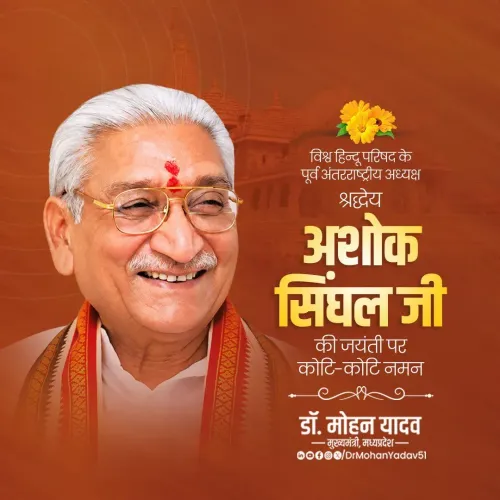
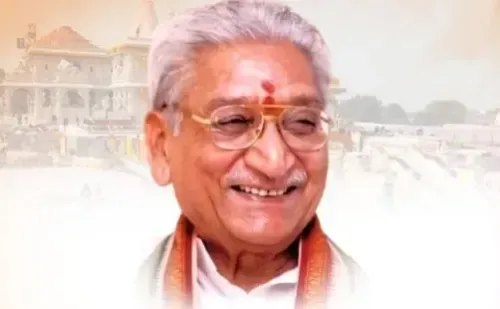
Amit Shah pays tribute to VHP's Ashok Singhal on birth anniversary
Synopsis
Union Home Minister Amit Shah honoured late VHP former international president Ashok Singhal on his birth anniversary, praising his selfless devotion, opposition to the 1975 Emergency, and pivotal role in the Ram Janmabhoomi movement.
Key Takeaways
Amit Shah paid tribute to Ashok Singhal , late former international president of the Vishwa Hindu Parishad , on his birth anniversary on September 27 .
Shah praised Singhal as a symbol of 'simplicity and piety' who renounced personal comforts for nation, culture and ideology.
Singhal is credited with opposing the Emergency of 1975–1977 and driving momentum behind the Ram Janmabhoomi movement .
The Supreme Court ruled in November 2019 in favour of temple construction at Ayodhya — a cause Singhal championed for decades before his death in 2015 .
The tribute reflects a consistent BJP practice of linking the party's ideological lineage to Sangh Parivar figures who resisted the Emergency and led the Ayodhya campaign.
A figure who renounced personal comfort to champion a cause he believed in with absolute conviction — that is how Union Home Minister Amit Shah remembers Ashok Singhal, the late former international president of the Vishwa Hindu Parishad (VHP), on his birth anniversary on Sunday, September 27.
In a post in Hindi on X, Shah wrote: 'Vishwa Hindu Parishad ke poorv antarrashtriya adhyaksh, sadagi aur dharmanishtha ke pratik shraddhey Ashok Singhal ji ki jayanti par unhe naman karta hoon' — ('I bow in reverence to the respected Ashok Singhal ji, former international president of the Vishwa Hindu Parishad and a symbol of simplicity and piety, on his birth anniversary.')
Shah described the standard Singhal set as rare: 'abandoning all comforts and, with selfless spirit, dedicating one's life to the nation, culture and ideology' — an ideal, Shah wrote, that is seldom witnessed. He specifically highlighted two defining chapters of Singhal's public life: his vocal opposition to the Emergency of 1975–1977 and his role in accelerating the Ram Janmabhoomi movement in Ayodhya.
From Emergency resistance to Ayodhya — the arc of Singhal's activism
Ashok Singhal rose within the VHP, an organisation founded in 1964 and affiliated with the Rashtriya Swayamsevak Sangh (RSS), which focuses on Hindu cultural and religious mobilisation. His leadership coincided with two of the most charged episodes in post-independence India.
When Prime Minister Indira Gandhi suspended civil liberties during the Emergency (1975–1977), activists across the Sangh ecosystem — Singhal among them — pushed back publicly at considerable personal risk. That resistance has since become a foundational narrative for BJP and VHP leaders in asserting a democratic credential rooted in lived sacrifice.
The Ram Janmabhoomi campaign, which Singhal helped drive through decades of mobilisation, finally reached legal closure when the Supreme Court delivered its verdict in November 2019, clearing the path for construction of a temple at the disputed site in Ayodhya, Uttar Pradesh. Singhal did not live to see the verdict — he passed away in November 2015 — but his name remains synonymous with the movement's most intense years of agitation.
A ritual of remembrance with ideological weight
Shah's tribute is part of a consistent BJP practice: senior leaders mark the birth and death anniversaries of towering VHP and RSS figures, weaving personal biography into a broader narrative of ideological continuity. The messages routinely anchor two reference points — Emergency resistance and the Ayodhya campaign — as twin pillars of the Sangh Parivar's moral and political self-image.
By invoking both in a single tribute, Shah reinforces that lineage in the same breath as honouring the man — connecting the party's present leadership to a generation of activists who, in the BJP's telling, paid a personal price for convictions that eventually shaped modern India.
Singhal's legacy, Shah concluded, will 'always provide guidance' — a closing note that frames the tribute not as backward-looking nostalgia but as a living instruction for the next generation of ideological workers.
Point of View
Which gives the Sangh a democratic credential, and the Ram Janmabhoomi movement, which is the BJP's most consequential cultural victory. By publicly honouring that lineage on a birth anniversary, senior leaders signal to the party's ideological base that the founding struggles have not been consigned to history — they remain active reference points for governance and mobilisation. It is quiet but deliberate positioning.
NationPress
27 Sept 2026
Frequently Asked Questions
Who was Ashok Singhal?
Ashok Singhal was the former international president of the Vishwa Hindu Parishad (VHP), known for opposing the 1975 Emergency and playing a leading role in the Ram Janmabhoomi movement in Ayodhya. He passed away in November 2015.
What is the Vishwa Hindu Parishad (VHP)?
The Vishwa Hindu Parishad is a Hindu nationalist organisation founded in 1964 and affiliated with the RSS. It focuses on Hindu cultural and religious mobilisation and was closely involved in the decades-long Ram Janmabhoomi campaign.
What was the Ram Janmabhoomi movement?
The Ram Janmabhoomi movement was a long-running campaign to build a Hindu temple at the disputed site in Ayodhya, Uttar Pradesh, believed by many Hindus to be the birthplace of Lord Ram. The Supreme Court delivered a verdict in November 2019 clearing the way for temple construction.
Why does Amit Shah mention the Emergency in his tribute to Ashok Singhal?
Singhal was among the activists from Sangh-affiliated organisations who publicly opposed Prime Minister Indira Gandhi's suspension of civil liberties during the Emergency of 1975–1977. BJP leaders routinely highlight this resistance as evidence of the broader Hindu nationalist movement's democratic and sacrificial credentials.
When did Amit Shah post the tribute to Ashok Singhal?
Union Home Minister Amit Shah posted the tribute on X on Sunday, September 27, 2026, on the occasion of Ashok Singhal's birth anniversary.