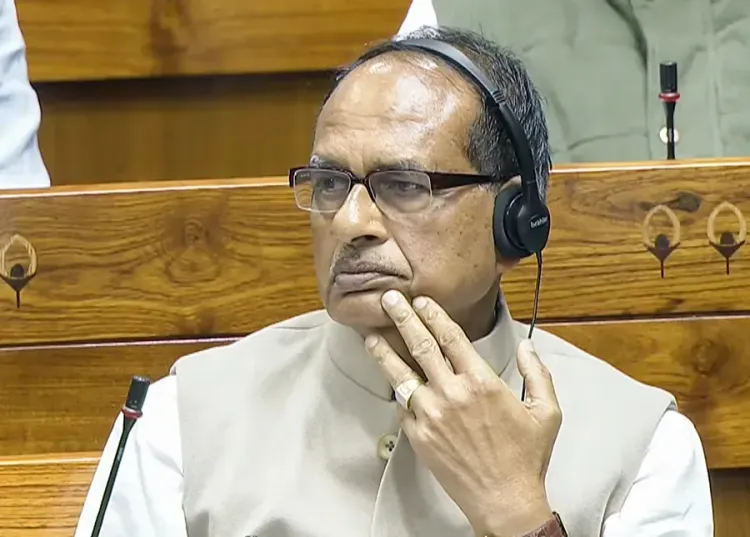
Will Shivraj Singh Chouhan Respond to the G Ram G Bill in LS Today?
Click to start listening
Synopsis
In a pivotal session, Union Minister Shivraj Singh Chouhan is poised to address the Viksit Bharat Bill aimed at transforming rural employment. With debates on air pollution and significant legislative progress, this moment marks a crucial juncture in India's legislative landscape.
Key Takeaways
- Shivraj Singh Chouhan to respond to the VB-G RAM-G Bill.
- The Bill guarantees 125 days of wage employment for rural families.
- Opposition raises concerns about job security.
- Discussion on air pollution in Delhi-NCR is underway.
- Significant bills passed in nuclear energy and insurance sectors.
New Delhi, Dec 18 (NationPress) Union Minister for Agriculture and Rural Development Shivraj Singh Chouhan is scheduled to present the government's response regarding the Viksit Bharat - Guarantee for Rozgar and Ajeevika Mission (Gramin) Bill, 2025 (VB-G RAM-G Bill) today. This proposed legislation aims to replace the long-standing Mahatma Gandhi National Rural Employment Guarantee Act (MGNREGA) with a new structure that guarantees 125 days of wage employment per year to rural families. The discussion phase of this Bill wrapped up on Wednesday.
Opposition critics have raised concerns, suggesting that it may diminish job guarantees driven by demand and shift financial responsibilities onto states. Conversely, supporters view it as a contemporary, convergence-oriented strategy that aligns with the 'Viksit Bharat @2047' vision, focusing on critical infrastructure such as water security and enhancing rural livelihoods.
The Lower House will also engage in a focused discussion under Rule 193 regarding the worsening air pollution crisis in Delhi-NCR, a matter brought up by several MPs including Priyanka Gandhi Vadra (Congress), Kanimozhi Karunanidhi (DMK), and Bansuri Swaraj (BJP).
This winter, Delhi's air quality has frequently plunged into hazardous conditions, prompting lawmakers to deliberate on mitigation strategies, public health ramifications, and inter-state collaboration.
Significant developments occurred on other fronts as well: the Lok Sabha approved the Sustainable Harnessing and Advancement of Nuclear Energy for Transforming India (SHANTI) Bill, 2025, introduced by Minister Jitendra Singh. This legislation facilitates private sector involvement in nuclear energy generation, establishes a pragmatic civil liability framework, and confers statutory recognition to the Atomic Energy Regulatory Board.
Advocates argue that this will expedite India's ambition of achieving 100 GW nuclear capacity by 2047, enhancing clean energy security amidst increasing demands from data centers and industries.
Additionally, in the Rajya Sabha, the Sabka Bima Sabki Raksha (Amendment of Insurance Laws) Bill, 2025 was cleared, permitting 100% Foreign Direct Investment in the insurance sector, an increase from the previous 74%.
The Upper House also approved the Repealing and Amending Bill, which abolishes 71 outdated laws. These actions are expected to attract international investments, improve insurance penetration, and strive for 'Insurance for All' by 2047.
Point of View
It’s essential to reflect on the potential implications of the Viksit Bharat Bill and other significant legislative actions. Our commitment remains to keep citizens informed while fostering a robust dialogue around these pivotal topics.
NationPress
20/12/2025
Frequently Asked Questions
What is the Viksit Bharat Bill?
The Viksit Bharat - Guarantee for Rozgar and Ajeevika Mission (Gramin) Bill, 2025 aims to replace MGNREGA and guarantees 125 days of wage employment annually to rural households.
Who is Shivraj Singh Chouhan?
Shivraj Singh Chouhan is the Union Minister for Agriculture and Rural Development in India.
What are the key criticisms of the Bill?
Critics argue that the Bill may weaken job guarantees and shift financial burdens to state governments.
What is the significance of the SHANTI Bill?
The SHANTI Bill promotes private sector participation in nuclear energy, aiming to bolster India's clean energy capacity.
What changes does the Insurance Laws Amendment introduce?
The amendment allows 100% Foreign Direct Investment in the insurance sector, increasing investment potential.