CM Siddaramaiah Pays Tribute to APJ Abdul Kalam on Death Anniversary
Synopsis
Karnataka Chief Minister Siddaramaiah paid tribute to Dr. APJ Abdul Kalam on his death anniversary, honouring the scientist-President's foundational contributions to India's missile systems, indigenous satellite launch vehicles, and nuclear capability.
Key Takeaways
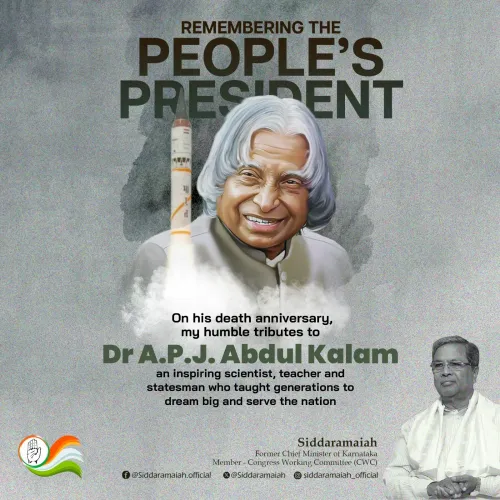
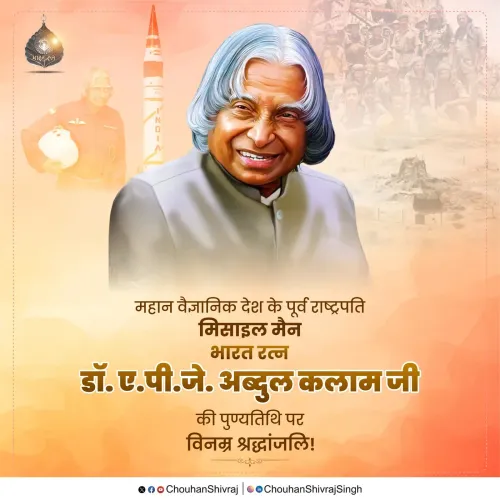
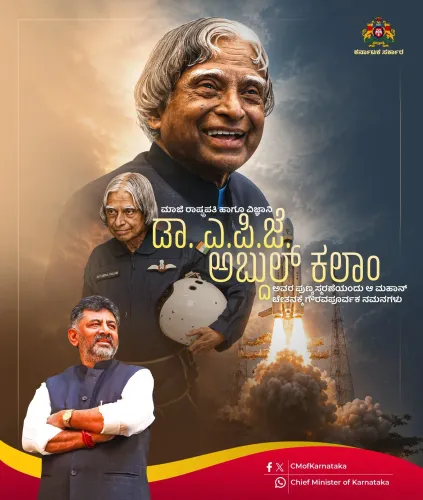
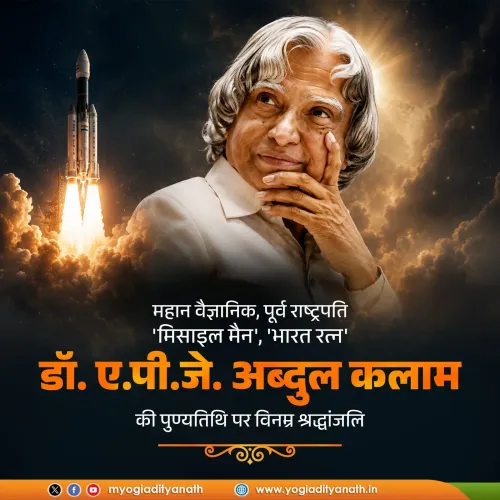
Karnataka Chief Minister Siddaramaiah paid tribute to Dr.
APJ Abdul Kalam on his death anniversary on 27 July 2026 .
Siddaramaiah described Kalam as foremost among those who built a 'strong and armed India,' citing his work in missile systems, satellite launch vehicles, and nuclear capability.
Kalam directed the Integrated Guided Missile Development Programme (IGMDP) from 1983 , producing the Prithvi and Agni missile systems under DRDO .
He was a key scientific coordinator for the Pokhran-II nuclear tests of May 1998 , which made India a nuclear weapons state.
Kalam served as President of India from 2002 to 2007 and used the office to promote science education and youth development.
The tribute reflects a broader national pattern of invoking Kalam's legacy to reinforce India's goals of strategic autonomy and defence indigenisation.
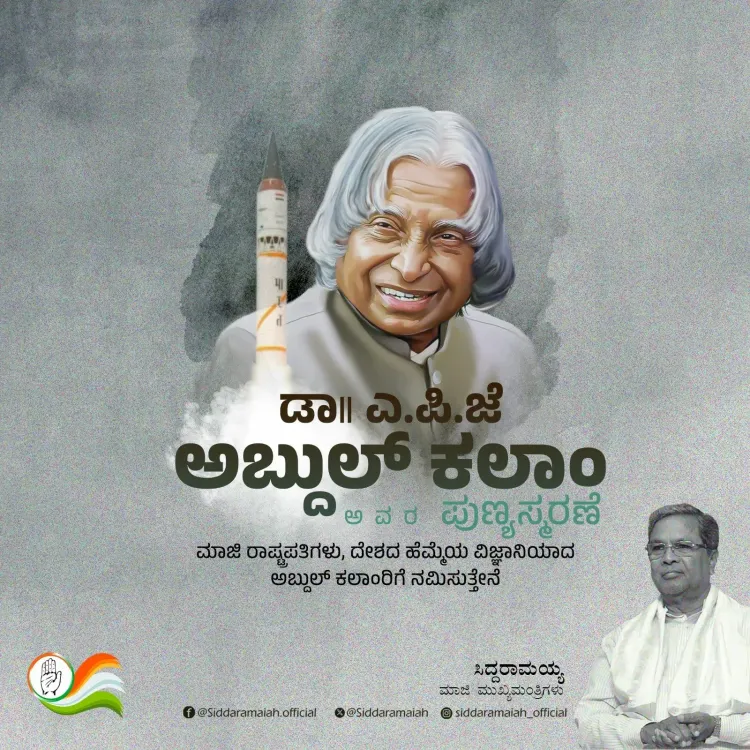
Karnataka Chief Minister Siddaramaiah on Monday, 27 July 2026, paid tribute to former President and scientist Dr. A.P.J. Abdul Kalam, honouring his legacy as a pioneer of India's missile, space, and nuclear programmes. The Chief Minister posted a heartfelt message in Kannada on X, describing Kalam as one of the foremost contributors to building a 'strong and armed India.'
Context
In his post, Siddaramaiah wrote — 'ಸಶಕ್ತ ಭಾರತವನ್ನು ಸಶಸ್ತ್ರ ಭಾರತವಾಗಿ ಕಟ್ಟಿ ಬೆಳೆಸಲು ಶ್ರಮಿಸಿದವರಲ್ಲಿ ಡಾ|| ಎ.ಪಿ.ಜೆ.ಅಬ್ದುಲ್ ಕಲಾಂ ಅವರು ಅಗ್ರಗಣ್ಯರು' — meaning, 'Among those who worked to build a strong and armed India, Dr. A.P.J. Abdul Kalam stands foremost.' The Chief Minister noted that Kalam's service as the nation's pride — both as a scientist and as President — continues to keep him alive in public memory. 27 July marks the anniversary of Kalam's passing, when political and scientific communities across India customarily reflect on his contributions.
Siddaramaiah specifically acknowledged Kalam's role in developing a new generation of missile systems, indigenous satellite launch vehicles, and in shaping India into a nuclear-capable state. He described Kalam as a 'great soul' who accepted every opportunity for national service with dedication and gave more than his capacity.
Policy Backdrop
Dr. Kalam directed the Integrated Guided Missile Development Programme (IGMDP) launched in 1983 under the Defence Research and Development Organisation (DRDO), which produced the Prithvi and Agni missile systems. His work earned him the popular title 'Missile Man of India.' Alongside his contributions at DRDO, Kalam was closely associated with ISRO's early efforts to develop indigenous satellite launch vehicles, strengthening India's self-reliance in space technology.
Kalam played a key scientific coordination role in the Pokhran-II nuclear tests of May 1998, which established India as a nuclear weapons state. He subsequently served as the 11th President of India from 2002 to 2007, using the office to champion science education and inspire youth across the country.
Stakeholders and Impact
Kalam's legacy is deeply embedded in India's defence and space establishments. The DRDO and ISRO communities regard him as a foundational figure whose institutional work underpins current indigenisation programmes in missiles and launch vehicles. His emphasis on youth and scientific temperament has made him a reference point in education policy discussions as well.
Political tributes on his death anniversary have become a recurring occasion for leaders across party lines to link Kalam's scientific achievements to contemporary goals of strategic autonomy and self-reliance in defence manufacturing. Chief Minister Siddaramaiah's tribute follows this broader national pattern.
What's Next
Observers will watch for central and state government announcements on new missile, space, or defence indigenisation projects timed around Kalam-related commemorations. Parliamentary debates on defence budget allocations have previously invoked Kalam's legacy to build cross-party consensus for increased DRDO and ISRO funding. His death anniversary continues to serve as a moment for reaffirming India's long-term commitment to scientific self-reliance.
Point of View
Posted in Kannada on Kalam's death anniversary, is part of a well-established political ritual across party lines — but the specific framing of a 'strong and armed India' is notable, connecting Kalam's scientific legacy directly to contemporary defence self-reliance discourse. The reference to missile systems, indigenous launch vehicles, and nuclear capability signals alignment with the broader national consensus on strategic autonomy, even from a Congress leader whose party has at times differed with the ruling dispensation on defence policy. Such tributes also serve a domestic constituency purpose, reinforcing the Congress's claim to a patriotic, science-forward identity. Over time, how state governments translate this rhetorical commitment into concrete support for DRDO and ISRO facilities in their states will be the more consequential measure.
NationPress
25 Oct 2026
Frequently Asked Questions
Why is APJ Abdul Kalam remembered on 27 July?
27 July marks the death anniversary of Dr. APJ Abdul Kalam , who passed away on that date in 2015. It is observed annually as a day of national remembrance for the scientist and former President.
What did APJ Abdul Kalam contribute to India's missile programme?
Dr. Kalam led the Integrated Guided Missile Development Programme (IGMDP) at DRDO from 1983 , overseeing the development of the Prithvi and Agni missile systems, which earned him the title 'Missile Man of India.'
What was Kalam's role in the Pokhran nuclear tests?
Dr. Kalam served as a key scientific coordinator for the Pokhran-II nuclear tests in May 1998 , which established India as a nuclear weapons state and significantly advanced the country's strategic deterrent.
Why did Karnataka CM Siddaramaiah post a tribute to Kalam?
Karnataka Chief Minister Siddaramaiah posted the tribute in Kannada on 27 July 2026 to mark Kalam's death anniversary, honouring his contributions to India's defence, space, and nuclear programmes.
Was APJ Abdul Kalam the President of India?
Yes. Dr. APJ Abdul Kalam served as the 11th President of India from 2002 to 2007 , during which he promoted science education and inspired youth across the country.