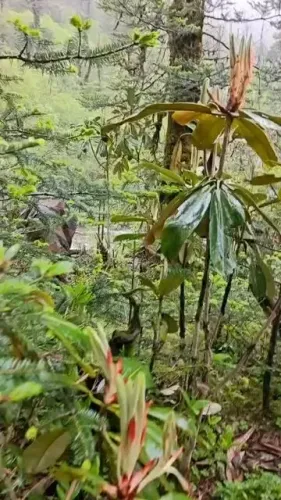
Sikkim CM Tamang hails first-ever Mishmi Takin sighting

Synopsis
Sikkim Chief Minister Prem Singh Tamang announced on 17 June 2026 that forest officials recorded the first-ever video sighting of the rare Mishmi Takin in the state, marking a significant milestone for Himalayan biodiversity conservation and prompting outreach to the Union Environment Ministry.
Key Takeaways
Sikkim's forest department officials documented the Mishmi Takin ( Budorcas taxicolor ) on video during a routine patrol — claimed to be the first such video record from the state.
CM Prem Singh Tamang announced the find on 17 June 2026 and tagged Union Environment Minister Bhupender Yadav and MoEFCC .
The Mishmi Takin is classified as 'Vulnerable' on the IUCN Red List and is native to high-altitude forests of the Eastern Himalayas.
The find aligns with the National Wildlife Action Plan (2017–2031) , which prioritises monitoring of lesser-known ungulates in the Eastern Himalayas.
The documentation strengthens Sikkim's case for expanded protected areas and may inform future species recovery plans at the national level.
Sikkim Chief Minister Prem Singh Tamang on Wednesday, 17 June 2026 announced the successful sighting and video documentation of the rare Mishmi Takin (Budorcas taxicolor) in Sikkim, describing it as the first-ever video record from the area and a milestone for the state's conservation efforts.
Context
The sighting was made during a routine forest patrol by Sikkim's forest department officials. In his post, CM Tamang called the documentation 'a proud milestone' that 'reflects the resilience of Sikkim's fragile Himalayan ecosystems and rich biodiversity.' He also tagged Union Environment Minister Bhupender Yadav and the Ministry of Environment, Forest and Climate Change (MoEFCC), signalling a push for central acknowledgement of the find.
The Mishmi Takin is a large bovid native to the high-altitude forests of the Eastern Himalayas and is listed as 'Vulnerable' on the IUCN Red List. Its confirmed presence in Sikkim through video evidence is significant for updating the species' known distribution range in India.
Policy Backdrop
India's Wildlife (Protection) Act, 1972 provides the foundational legal framework for protecting rare high-altitude species such as the Mishmi Takin. The National Wildlife Action Plan (2017–2031) specifically prioritises survey and monitoring of lesser-known ungulates across the Eastern Himalayas, making this documentation directly relevant to ongoing national conservation targets.
Sikkim has long maintained state-level policies for forest and wildlife conservation, operating multiple protected areas across its Himalayan terrain. The state's forest department has increasingly adopted patrol-based and camera-trap documentation methods to track elusive species and contribute to national biodiversity databases.
Stakeholders and Impact
The most immediate stakeholders are Sikkim's forest officials whose patrol work yielded the record, and the broader community of Himalayan biodiversity researchers who rely on such ground-level documentation to refine distribution maps and support species assessments. A confirmed video record from a new locality strengthens the data available for future IUCN Red List reviews and any potential expansion of protected habitats.
Across Indian Himalayan states, intensified patrol-based documentation of elusive species has become part of a wider pattern of state–centre collaboration under central schemes for high-altitude ecosystem monitoring. Sikkim's find fits squarely within this trend, and the direct tagging of MoEFCC by CM Tamang suggests the state is keen to integrate this record into national conservation planning.
What's Next
Attention will now turn to whether MoEFCC formally acknowledges the sighting and whether it informs any revision of species recovery plans or expansion of protected areas in Sikkim. The next edition of the Sikkim State of the Environment report is expected to incorporate this documentation as evidence of the state's biodiversity health.
Researchers and conservationists will also watch for peer-reviewed follow-up studies that could confirm the ecological significance of the record and guide habitat protection measures for the Mishmi Takin in the Eastern Himalayas for generations to come.
Point of View
The Sikkim government is actively positioning itself as a proactive partner in India's national biodiversity agenda. This fits a broader pattern of Himalayan state governments using high-profile wildlife discoveries to strengthen their case for greater central funding and protected-area expansion. For a small state like Sikkim, whose ecological identity is central to its political brand, a first-ever species video record carries significant soft-power value. The move also subtly pressures the Centre to respond with tangible policy action, whether through updated species recovery plans or enhanced conservation grants.
NationPress
17 Sept 2026
Frequently Asked Questions
What is the Mishmi Takin and why is it significant?
The Mishmi Takin ( Budorcas taxicolor ) is a large, stocky bovid found in the high-altitude forests of the Eastern Himalayas. It is listed as 'Vulnerable' on the IUCN Red List, making any confirmed sighting — especially a first-ever video record from a new location like Sikkim — significant for conservation science and species distribution mapping.
Where exactly was the Mishmi Takin spotted in Sikkim?
The exact patrol location has not been officially disclosed. CM Tamang's announcement confirmed the sighting occurred during a routine forest patrol in Sikkim, but specific coordinates or forest divisions were not mentioned in the post.
What did Sikkim CM Prem Singh Tamang say about the sighting?
CM Tamang called it 'a proud milestone' for Sikkim's conservation efforts, saying the sighting 'reflects the resilience of Sikkim's fragile Himalayan ecosystems and rich biodiversity.' He also reaffirmed the state government's commitment to protecting Sikkim's natural heritage.
Which central ministry was tagged by CM Tamang in his post?
CM Tamang tagged the Ministry of Environment, Forest and Climate Change (MoEFCC) and Union Environment Minister Bhupender Yadav, signalling that the state wants the Centre to take note of the discovery for national conservation planning.
How does this sighting fit into India's wildlife conservation policy?
The National Wildlife Action Plan (2017–2031) specifically prioritises survey and monitoring of lesser-known ungulates in the Eastern Himalayas. The Sikkim sighting directly supports these objectives and could inform future IUCN assessments and protected-area decisions under the Wildlife (Protection) Act, 1972.