Sikkim CM Tamang hails state's first-ever kidney transplant
Synopsis
Sikkim Chief Minister Prem Singh Tamang announced on Independence Day 2026 that the state had successfully performed its first-ever kidney transplant, marking a historic leap in local healthcare capacity and reducing the need for patients to travel outside the state for critical treatment.
Key Takeaways
Sikkim performed its first-ever renal (kidney) transplant , announced by CM Prem Singh Tamang on 15 August 2026 .
Health Minister G.T.
Dhungel , the Health Department, and a specialist team from Kolkata were credited for making the procedure possible.
The transplant directly addresses a longstanding gap: Sikkim residents previously had to travel to Kolkata or Delhi for such advanced procedures.
CM Tamang described the milestone as 'only the beginning,' reaffirming the state's 'Health First, Life Foremost' governance commitment.
The success signals a category shift for northeastern India's tertiary-care landscape, where building local transplant capacity has historically been a major challenge.
A mountain state just rewrote its own medical history. On Independence Day, 15 August 2026, Sikkim Chief Minister Prem Singh Tamang announced that the state had successfully performed its first-ever renal (kidney) transplant — a procedure that, until now, would have forced any Sikkimese patient to pack their bags and travel hundreds of kilometres to Kolkata or Delhi for a chance at survival.
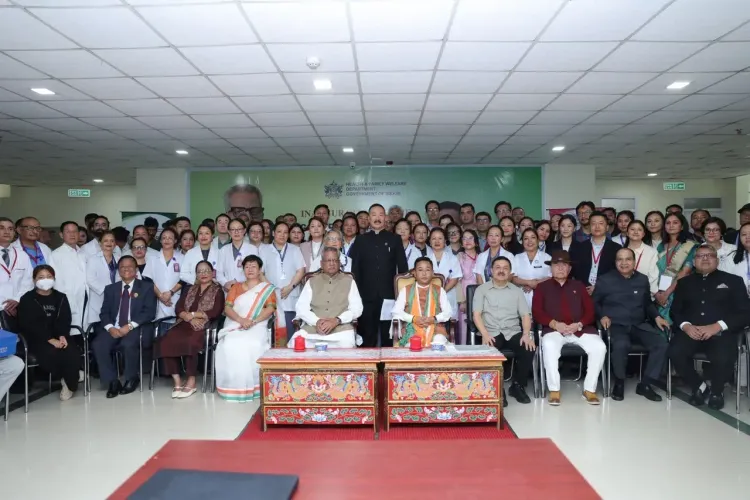
In a post on X, CM Tamang called it 'a historic milestone for our State and a significant step forward in our continued efforts to strengthen healthcare infrastructure.' He extended congratulations to Health Minister G.T. Dhungel, the Health Department secretary, and the full departmental team, while also acknowledging the specialist doctors and supporting medical team from Kolkata who joined Sikkim's own nurses, attendants, and medical staff to make the procedure possible.
What this transplant means for a state that always had to look outward
Sikkim, India's smallest northeastern state by area, has long sat near the bottom of the tertiary-care ladder. Residents needing complex procedures — organ transplants, advanced cardiac interventions, neurosurgery — had little choice but to travel to Kolkata or beyond, shouldering the financial and emotional weight of being far from home during a medical crisis. That reality has shaped health policy in the region for decades.
Successive northeastern state governments have poured resources into upgrading district hospitals and coaxing specialist teams to build local capacity, but a kidney transplant — requiring a multidisciplinary surgical team, an organ-procurement framework, specialised post-operative care, and immunosuppression management — is among the hardest milestones to cross. Sikkim crossing it is not a routine upgrade; it is a category shift.
CM Tamang's 'Health First, Life Foremost' governance pledge
Tamang, who has led Sikkim since 2019 as founder-president of the Sikkim Krantikari Morcha, has framed healthcare access as a central pillar of his administration's identity. His post closed with a phrase that reads less like a slogan and more like a standing order: 'Health First, Life Foremost' — health first, life foremost. 'This is only the beginning,' he wrote, signalling that the transplant programme is intended as a launchpad, not a one-off.
The government's resolve, he said, is to ensure that people of Sikkim 'have access to advanced and quality healthcare within the State, reducing the need to travel outside Sikkim for critical treatments.' He also wished the patient — whose identity was not disclosed — 'a healthy and speedy recovery.'
The Kolkata connection and what comes next
That a specialist team from Kolkata was part of the procedure underscores both the achievement and the road still ahead. Building a self-sufficient transplant programme requires training local surgeons, establishing a reliable organ-procurement network, and sustaining the infrastructure for long-term patient follow-up. Sikkim's health budget allocations for tertiary-care equipment and specialist training will be the real measure of whether this milestone becomes a durable programme or remains a landmark moment.
For now, a state of roughly 650,000 people nestled in the eastern Himalayas has proved that geography need not be destiny in healthcare. The operating theatre has spoken; the policy work begins.
Point of View
The announcement on Independence Day is a deliberate framing: healthcare sovereignty as a dimension of national progress. The reliance on a Kolkata-based specialist team, however, reveals that the milestone is a proof-of-concept, not yet a self-sustaining programme; the harder governance test will be whether budget allocations and training pipelines follow. If they do, Sikkim could become a template for other small hill states still sending their sickest citizens hundreds of kilometres away for critical care.
NationPress
15 Aug 2026
Frequently Asked Questions
Has Sikkim ever done a kidney transplant before?
No. The procedure announced by CM Prem Singh Tamang on 15 August 2026 is Sikkim's first-ever renal (kidney) transplant, marking a historic first for the state's healthcare system.
Which hospital in Sikkim performed the kidney transplant?
The specific hospital was not named in CM Tamang's announcement. The procedure involved Sikkim's own medical staff alongside a specialist team from Kolkata.
Who is G.T. Dhungel?
G.T. Dhungel is the Health Minister of Sikkim. CM Tamang specifically credited him and the Health Department for their role in enabling the state's first kidney transplant.
Why did Sikkim patients have to travel outside the state for kidney transplants before?
Sikkim, like many small northeastern states, historically lacked the tertiary-care infrastructure — specialist surgeons, organ-procurement systems, and post-operative facilities — needed for complex procedures like transplants, forcing patients to travel to Kolkata or Delhi.
What is Sikkim's 'Health First, Life Foremost' policy?
'Health First, Life Foremost' is the healthcare governance motto of CM Prem Singh Tamang's administration, centred on expanding advanced medical services within Sikkim so residents do not need to seek critical care outside the state.