Dr. Jitendra Singh: India's posture on PoJK is unfinished agenda
Synopsis
At a Kargil Vijay Diwas programme in New Delhi on 26 July 2026, Union Minister Dr. Jitendra Singh declared PoJK retrieval the only pending India-Pakistan issue and said India's security posture has shifted from reactive to proactive under PM Modi's zero-tolerance doctrine.
Key Takeaways
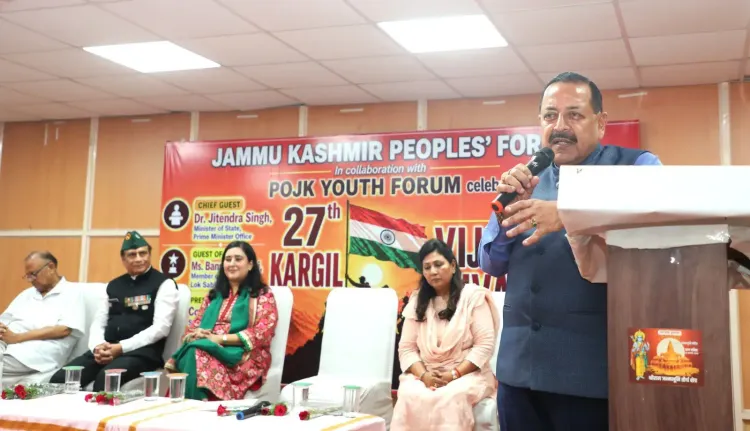
Jitendra Singh addressed the Kargil Vijay Diwas programme organised by the Jammu & Kashmir People's Forum in New Delhi on 26 July 2026 .
He stated that retrieval of Pakistan-occupied Jammu & Kashmir (PoJK) is 'the only pending issue between India and Pakistan.' The minister credited PM Narendra Modi 's 'zero tolerance' towards terrorism for a decisive transformation in India's security landscape.
He described India's defence posture as having evolved 'from a reactive approach to a proactive, decisive action.' Dr.
Singh called India's Partition 'the greatest blunder of history,' framing PoJK reclamation as an unfinished historical obligation.
Strengthened border management and strategic defence shifts were cited as factors enhancing India's ability to safeguard territorial integrity .
Union Science and Technology Minister Dr. Jitendra Singh addressed the Kargil Vijay Diwas programme organised by the Jammu & Kashmir People's Forum in New Delhi on Sunday, 26 July 2026, asserting that the retrieval of Pakistan-occupied Jammu & Kashmir (PoJK) remains the only pending issue between India and Pakistan, and that India's security posture has shifted decisively from reactive to proactive.
Context
Kargil Vijay Diwas, observed every 26 July, marks India's victory in the 1999 Kargil War, when Indian forces evicted Pakistani intruders who had crossed the Line of Control into the Kargil sector of Jammu and Kashmir. The annual commemoration draws political leaders, defence officials, and civil society groups who use the occasion to reflect on national security lessons. This year's event, hosted by the Jammu & Kashmir People's Forum, saw Dr. Singh deliver a pointed address linking the war's legacy to present-day doctrine.
In his address, the minister stated that 'the lessons of Kargil remain relevant even today as the external challenges confronting the country continue to demand constant vigil.' He added that 'India's partition was the greatest blunder of history, and now, the retrieval of PoJK remains the only pending issue between India and Pakistan' — framing territorial reclamation as an active policy objective rather than a rhetorical aspiration.
Policy Backdrop
Dr. Singh credited Prime Minister Narendra Modi's declaration of 'zero tolerance' towards terrorism as a cornerstone of the shift in India's security calculus. He cited strengthened border management and a 'strategic defence shift' as factors that have 'significantly enhanced national confidence and India's ability to safeguard its territorial integrity.' The remarks align with a broader official narrative that has developed since 2014, positioning India's western-border posture as increasingly assertive rather than defensive.
The policy lineage the minister invoked includes the 2016 surgical strikes across the Line of Control and the 2019 Balakot airstrike, both of which were presented by the government as evidence of a proactive doctrine. The August 2019 abrogation of Article 370 and the bifurcation of Jammu & Kashmir into two Union Territories further cemented the administrative dimension of that posture, and Dr. Singh's remarks on PoJK extend the argument into unresolved territorial claims.
Stakeholders and Impact
The statement carries significance for multiple constituencies. For the defence establishment and the families of Kargil veterans, the minister's framing reinforces the idea that the sacrifices of 1999 are embedded in an evolving, forward-looking security doctrine rather than a closed historical chapter. For residents of Jammu and Kashmir, the explicit mention of PoJK retrieval as 'the only pending issue' with Pakistan signals continued official prioritisation of the region's full integration.
Diplomatically, such statements — made by a senior Union minister at a public forum — add to the accumulated record of Indian government positions on PoJK, a territory administered by Pakistan since the 1947-48 war. Pakistan contests India's characterisation; the international community has generally treated the Line of Control as a de facto boundary. The minister's remarks are therefore likely to draw attention in bilateral and multilateral diplomatic circles.
What's Next
Parliamentary statements and subsequent Kargil Vijay Diwas commemorations will be watched for whether the PoJK framing hardens into formal policy language. Observers will also monitor defence procurement decisions, border infrastructure upgrades, and diplomatic signalling toward Pakistan for evidence that the 'proactive, decisive action' doctrine the minister described is being operationalised beyond rhetoric. Any fresh cross-border incident or security development along the western frontier would immediately test the doctrine's practical contours.
Point of View
Near-term policy framing — 'the only pending issue' — at a high-visibility national commemoration. By anchoring the statement in the Kargil legacy, the minister connects historical sacrifice to present doctrine, lending moral weight to what is essentially a territorial claim. The framing also serves a domestic political function: it reinforces the BJP government's narrative of muscular nationalism ahead of any future electoral cycle. Internationally, repeated ministerial-level articulation of PoJK retrieval as policy, rather than aspiration, incrementally raises the diplomatic stakes with Pakistan and complicates back-channel engagement.
NationPress
25 Oct 2026
Frequently Asked Questions
What did Dr. Jitendra Singh say about PoJK on Kargil Vijay Diwas 2026?
Dr. Jitendra Singh declared that the retrieval of Pakistan-occupied Jammu & Kashmir (PoJK) is 'the only pending issue between India and Pakistan,' speaking at a Kargil Vijay Diwas event in New Delhi on 26 July 2026.
What is Kargil Vijay Diwas and why is it observed on 26 July?
Kargil Vijay Diwas is observed every 26 July to mark India's victory in the 1999 Kargil War, when Indian forces successfully evicted Pakistani intruders who had crossed the Line of Control into the Kargil sector of Jammu and Kashmir.
What is Pakistan-occupied Jammu & Kashmir (PoJK)?
PoJK refers to the portion of the erstwhile princely state of Jammu & Kashmir administered by Pakistan since the 1947-48 war. India considers it illegally occupied territory and an integral part of the country.
How has India's defence posture changed under PM Modi according to the minister?
According to Dr. Jitendra Singh, India's security posture has shifted from a reactive approach to proactive, decisive action, supported by PM Modi's zero-tolerance policy on terrorism, strengthened border management, and a strategic defence realignment.
Who organised the Kargil Vijay Diwas 2026 event where Dr. Jitendra Singh spoke?
The event was organised by the Jammu & Kashmir People's Forum and held in New Delhi on 26 July 2026.