Giriraj Singh flags SIP inflows at 3-month high of ₹31,781 cr
Synopsis
Union Textiles Minister Giriraj Singh highlighted a rise in mutual fund SIP inflows to ₹31,781 crore in June 2026 — a three-month high — sharing the AMFI data via the NaMo App, underscoring the government's narrative of growing retail participation in India's capital markets.
Key Takeaways
Mutual fund SIP inflows rose by ₹827 crore in June 2026 to reach ₹31,781 crore , a three-month high.
Union Textiles Minister Giriraj Singh shared the data on 11 July 2026 via the NaMo App on his X account.
SIP inflows crossing ₹30,000 crore consistently signals a structural shift in Indian household savings toward financial assets.
The growth is underpinned by SEBI investor education drives since 2015–2017 and digital payment infrastructure enabling UPI-based mandates.
AMFI will release subsequent monthly data that will confirm whether the June uptick is a sustained trend.
Future SEBI or Union Budget proposals on mutual fund taxation could materially affect SIP momentum.
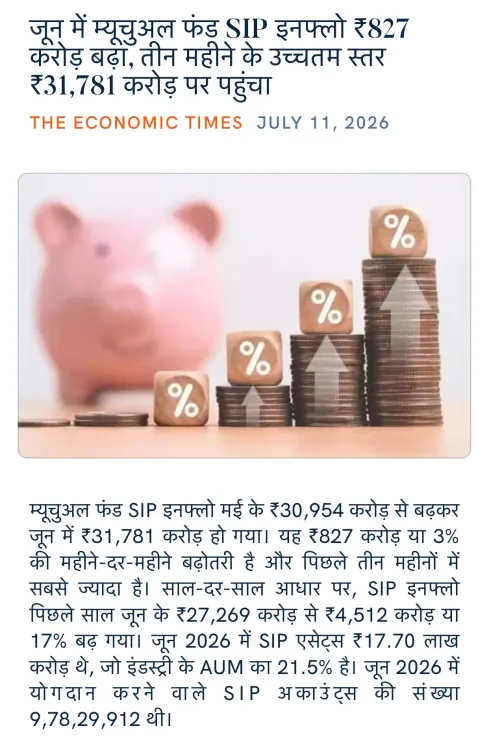
Union Textiles Minister Giriraj Singh on Saturday, 11 July 2026, shared data showing that mutual fund Systematic Investment Plan (SIP) inflows rose by ₹827 crore in June 2026 to reach a three-month high of ₹31,781 crore, amplifying the figures via the NaMo App on his official X account.
The post, shared in Hindi, stated: 'जून में म्यूचुअल फंड SIP इनफ्लो ₹827 करोड़ बढ़ा, तीन महीने के उच्चतम स्तर ₹31,781 करोड़ पर पहुंचा' — ('Mutual fund SIP inflow rose by ₹827 crore in June, reaching a three-month high of ₹31,781 crore'). The data originates from the Association of Mutual Funds in India (AMFI), which publishes monthly SIP flow figures.
Context
SIPs allow retail investors to invest fixed sums in mutual funds at regular intervals, typically monthly, and are regulated by the Securities and Exchange Board of India (SEBI). The instrument has become a primary vehicle for household participation in India's equity and debt markets over the past decade. A month-on-month rise of ₹827 crore — reaching ₹31,781 crore — signals continued momentum in retail investor appetite even amid broader global market uncertainties.
Minister Giriraj Singh, whose primary portfolio covers the textiles sector, shared the data through the NaMo App — a platform associated with Prime Minister Narendra Modi and the BJP used to disseminate policy-aligned news and government achievements to party workers and the public.
Policy Backdrop
The sustained rise in SIP inflows is rooted in a decade-long regulatory push. SEBI's investor education campaigns between 2015 and 2017 and the rollout of direct mutual fund platforms significantly lowered the barrier for first-time investors. Digital payment infrastructure, including UPI-based SIP mandates, further accelerated adoption among younger and semi-urban investors.
The BJP-led government has consistently cited rising SIP figures as evidence of a structural shift in Indian household savings — from physical assets such as gold and real estate toward financial instruments. Senior party leaders sharing such data on social media forms part of a broader communications strategy to highlight economic confidence under the current administration.
Stakeholders and Impact
The primary beneficiaries of rising SIP inflows are retail investors and asset management companies (AMCs), which see increased assets under management (AUM) and recurring fee income. A sustained inflow at this level also provides domestic institutional investors with a steady pool of capital, which can act as a counterweight to foreign portfolio investor (FPI) volatility in Indian equity markets.
For the broader economy, high SIP participation reflects growing financial literacy and trust in regulated capital markets. Analysts have noted that monthly SIP flows crossing the ₹30,000 crore threshold on a consistent basis marks a qualitative shift in how Indian households manage long-term wealth.
What's Next
AMFI is expected to release subsequent monthly SIP data, which will indicate whether the June 2026 uptick represents a durable trend or a seasonal correction. Any proposals in the upcoming Union Budget or from SEBI regarding mutual fund taxation, expense ratios, or new investor incentive schemes could significantly influence SIP trajectory in the second half of the financial year. Market observers will also watch for SEBI guidance on expanding SIP access to new asset classes and investor categories.
Point of View
781 crore figure, if sustained, would reinforce the government's 'financialisation of savings' narrative ahead of any budget cycle. However, the choice of the NaMo App as the sharing vehicle underlines that this is as much political communication as economic reportage. The broader trend of retail investors deepening capital market participation is structurally significant regardless of the political framing around it.
NationPress
10 Oct 2026
Frequently Asked Questions
What was the mutual fund SIP inflow in June 2026?
Mutual fund SIP inflows in June 2026 reached ₹31,781 crore, a rise of ₹827 crore from the previous month and the highest level in three months, according to AMFI data shared by Minister Giriraj Singh.
Why did Giriraj Singh share mutual fund SIP data?
Giriraj Singh, a senior BJP leader and Union Textiles Minister, shared the data via the NaMo App as part of the ruling party's broader communication effort to highlight positive economic indicators under the current government.
What is a SIP in mutual funds?
A Systematic Investment Plan (SIP) is a method that allows retail investors to invest a fixed amount in mutual funds at regular intervals, typically monthly. It is regulated by SEBI and has become one of the most popular retail investment tools in India.
What does a three-month high in SIP inflows mean for Indian investors?
A three-month high signals renewed or sustained confidence among retail investors in equity and debt markets. Consistent SIP flows above ₹30,000 crore are seen as evidence of a structural shift in household savings from physical to financial assets.
What is the NaMo App?
The NaMo App is a mobile application linked to Prime Minister Narendra Modi and the BJP, used to share government achievements, policy updates, and curated news with party workers and the general public.