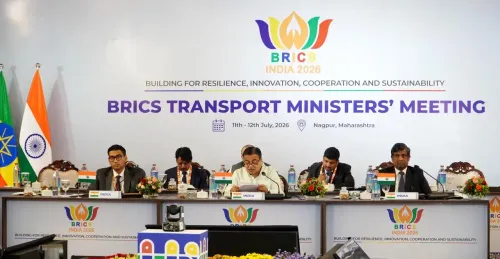
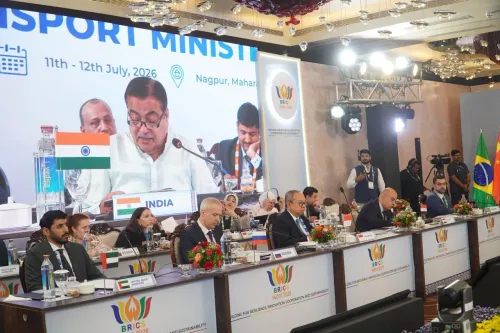
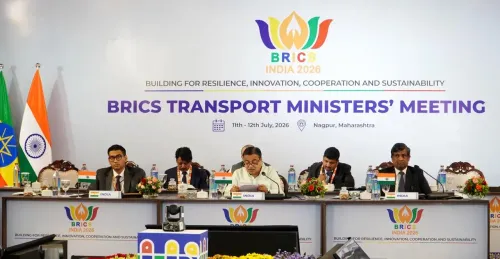
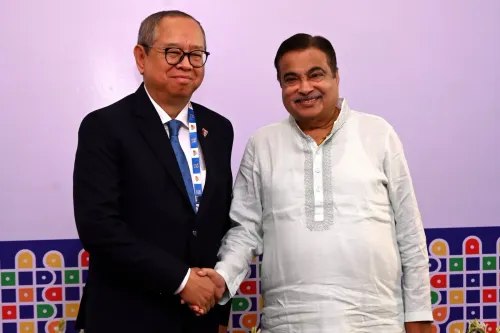
Gadkari chairs 3rd BRICS Transport Ministers' Meet in Nagpur
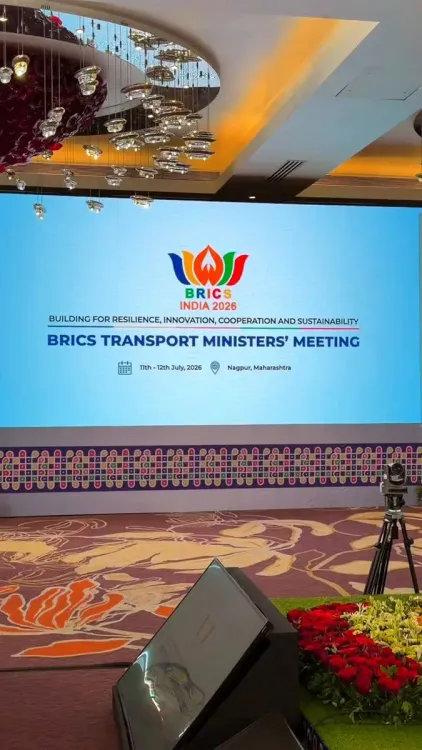
Synopsis
Union Minister Nitin Gadkari chaired the 3rd BRICS Transport Ministers' Meeting in Nagpur on 11 July 2026, marking India's push under its BRICS Chairmanship to convert multilateral dialogue on resilient, innovative, and sustainable transport into concrete cross-border cooperation frameworks.
Key Takeaways
Nitin Gadkari chaired the 3rd BRICS Transport Ministers' Meeting in Nagpur on 11 July 2026 .
The meeting was held under India's 2026 BRICS Chairmanship , with Gadkari describing it as a move 'from dialogue to action.' Focus areas included resilient, innovative, and sustainable transport systems for greater cross-border connectivity.
The expanded BRICS membership since 2024 broadens the potential scope of any agreed transport standards or corridor frameworks.
Outcomes align with India's domestic National Logistics Policy (2022) and the PM Gati Shakti framework.
Follow-up working groups and potential memoranda ahead of the 2026 BRICS Summit will be closely watched.
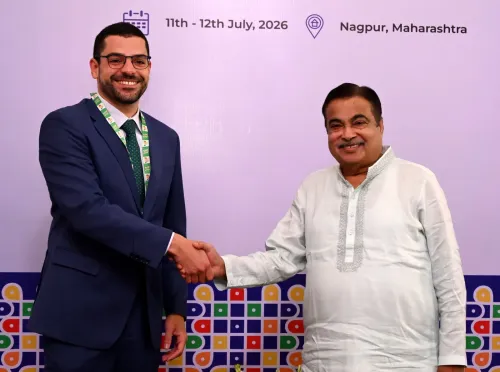
Union Road Transport and Highways Minister Nitin Gadkari on Saturday, 11 July 2026, chaired the 3rd BRICS Transport Ministers' Meeting in Nagpur, calling it a demonstration of the grouping's collective commitment to building resilient, innovative, and sustainable transport systems. The meeting, held under India's 2026 BRICS Chairmanship, brought together transport ministers from across the BRICS grouping to advance a shared vision for greater cross-border connectivity.
Context
Posting on X, Gadkari described the gathering as a move 'from dialogue to action,' signalling that discussions at earlier ministerial-level meetings are now translating into concrete cooperative frameworks. Nagpur, Gadkari's political base in Maharashtra, served as the venue — underscoring the minister's personal investment in positioning India as a proactive host of high-level multilateral transport forums.
The BRICS grouping, which expanded its membership in 2024 to include new partner nations beyond the original five — Brazil, Russia, India, China, and South Africa — now commands a wider geographic footprint, making transport cooperation agreements potentially more consequential for global logistics and supply chains.
Policy Backdrop
India has used successive BRICS transport ministerials to align its domestic infrastructure ambitions with South-South connectivity goals. The National Logistics Policy (2022) set explicit targets for reducing logistics costs and deepening multimodal transport integration — themes that resonate directly with the language of 'resilient and innovative' systems invoked at the Nagpur meeting.
The emphasis on sustainability also mirrors the outcomes of India's G20 Presidency and the PM Gati Shakti National Master Plan, both of which prioritised seamless, technology-driven infrastructure planning. The 2nd BRICS Transport Ministers' Meeting in 2020 had produced a joint statement on road safety and sustainable urban mobility, establishing a precedent for outcome-oriented ministerial dialogue.
India chaired BRICS previously in 2021, when the 13th BRICS Summit highlighted supply-chain resilience and digital infrastructure — threads that the 2026 transport ministerial appears to carry forward with renewed urgency.
Stakeholders and Impact
The meeting's outcomes are of direct relevance to BRICS transport ministries, logistics operators, infrastructure developers, and multilateral financing institutions that fund cross-border corridor projects. An expanded BRICS membership means that any agreed standards or pilot corridor frameworks could now cover a broader swathe of trade routes across Asia, Africa, Latin America, and Eastern Europe.
For India specifically, the forum provides an opportunity to showcase its highway and port modernisation programmes — including national highway expansion under the Bharatmala Pariyojana — as models for emerging-economy infrastructure development. Domestic logistics firms and multimodal operators stand to benefit if BRICS partners align on common technical standards or fast-track border-crossing protocols.
What's Next
Attention will now turn to follow-up working groups and any memoranda of understanding or joint declarations that emerge from the Nagpur meeting ahead of the broader 2026 BRICS Summit in India. Progress on joint pilot transport corridors and harmonised technology standards — areas flagged as priorities in the ministerial discussions — will be the key metrics by which the 'dialogue to action' pledge is measured.
As India steers the BRICS agenda through 2026, the transport sector is shaping up as one of the most tangible arenas where the grouping's expanded membership could yield concrete, on-the-ground cooperation.
Point of View
Using the transport sector as a tangible deliverable in an otherwise diffuse multilateral agenda. Gadkari's 'from dialogue to action' framing is politically significant — it signals impatience with process and pressure on partner nations to move toward binding standards or corridor commitments. This fits a broader pattern in which India has leveraged multilateral presidencies (G20, now BRICS) to internationalise its domestic infrastructure narrative, from Bharatmala to Gati Shakti. The expanded BRICS membership adds both opportunity and complexity, as aligning diverse new members on technical transport standards will test India's diplomatic bandwidth through the rest of 2026.
NationPress
11 Jul 2026
Frequently Asked Questions
What is the BRICS Transport Ministers' Meeting?
The BRICS Transport Ministers' Meeting is a periodic multilateral forum where transport ministers from BRICS member nations discuss cross-border connectivity, logistics standards, road safety, and sustainable mobility cooperation. The third edition was held in Nagpur, India, on 11 July 2026 under India's BRICS Chairmanship.
Why was the BRICS Transport Ministers' Meeting held in Nagpur?
Nagpur was chosen as the venue for the 3rd BRICS Transport Ministers' Meeting, with Union Minister Nitin Gadkari hosting the event. Nagpur is Gadkari's political base in Maharashtra and has previously hosted central government transport-related events.
What did Nitin Gadkari say at the BRICS Transport Ministers' Meeting 2026?
Gadkari described the meeting as a shift 'from dialogue to action,' emphasising the grouping's shared commitment to resilient, innovative, and sustainable transport systems for a more connected future, as stated in his post on X dated 11 July 2026.
What is India's role in BRICS 2026?
India holds the BRICS Chairmanship in 2026 and is hosting the grouping's summit and ministerial-level meetings throughout the year. The transport ministerial in Nagpur is one of several sectoral gatherings India is convening as part of its chairmanship agenda.
How does the BRICS transport meeting connect to India's National Logistics Policy?
India's National Logistics Policy (2022) set targets to reduce logistics costs and improve multimodal transport integration — goals that align closely with the BRICS ministerial's focus on resilient and sustainable transport systems. India has used BRICS forums to project its domestic infrastructure priorities onto a multilateral stage.