Rajnath Singh: India Becoming Global Shipbuilding Hub

Synopsis
Union Defence Minister Rajnath Singh has declared that building modern warships strengthens India's Navy, technology, defence ecosystem, and economy. Invoking PM Modi's Atmanirbhar Bharat resolve, he said India is rapidly advancing toward becoming a leading global centre for shipbuilding and maritime defence.
Key Takeaways
Rajnath Singh stated on July 11, 2026 that indigenous warship construction strengthens India's Navy, technological capacity, defence industrial ecosystem, and economic power.
He credited Prime Minister Narendra Modi's Atmanirbhar Bharat initiative as the driving resolve behind India's shipbuilding ambitions.
Atmanirbhar Bharat Abhiyan was launched in May 2020 with defence indigenization as a central pillar, backed by the Defence Procurement Procedure 2020 .
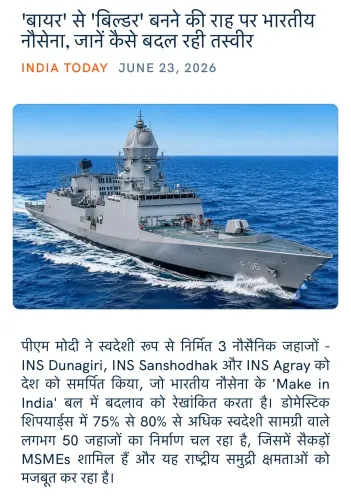
India has accelerated indigenous naval construction across platform categories — from aircraft carriers to destroyers and submarines — to reduce import dependence.
Key upcoming milestones include Project 75(I) submarines and next-generation destroyer programmes that will test the pace of indigenization.
India is positioning itself as an emerging maritime defence exporter, with strategic relevance in Indo-Pacific security dynamics.
Union Defence Minister Rajnath Singh on Saturday, July 11, 2026, underscored the strategic importance of indigenous warship construction, asserting that building modern naval vessels strengthens not only the Indian Navy but also the country's technological capacity, defence industrial ecosystem, and economic power.
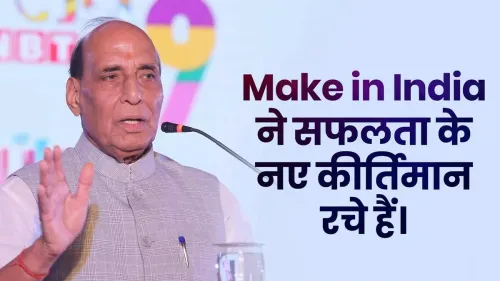
Posting in Hindi on X, Singh stated: 'आधुनिक युद्धपोतों का निर्माण हमारी नौसेना के साथ-साथ भारत की तकनीकी क्षमता, रक्षा औद्योगिक इकोसिस्टम और आर्थिक शक्ति को भी सशक्त करता है' ('The construction of modern warships strengthens not only our Navy but also India's technological capability, defence industrial ecosystem, and economic power'). He added that under the leadership of Prime Minister Narendra Modi, India is rapidly advancing toward becoming a leading global centre for shipbuilding and maritime defence, driven by the resolve of Atmanirbhar Bharat.
Context
The post comes as India has significantly ramped up its indigenous naval shipbuilding programme over recent years. The Indian Navy has been at the forefront of this push, commissioning domestically designed and built warships across categories — from aircraft carriers to frigates and destroyers. This shift reflects a broader national ambition to reduce dependence on foreign defence platforms and develop sovereign design and production capability.
Singh's remarks tie the naval build-up directly to economic and technological development, framing warship construction not merely as a security imperative but as an industrial and innovation driver for the country.
Policy Backdrop
The Atmanirbhar Bharat Abhiyan, launched by Prime Minister Modi in May 2020, placed defence indigenization at its core. The accompanying Defence Procurement Procedure 2020 introduced priority categories for indigenously designed, developed, and manufactured platforms — including warships and submarines — to systematically reduce import reliance.
Under the Make in India initiative, defence shipyards have been tasked with expanding capacity and absorbing technology to support next-generation programmes. India has also articulated targets for defence exports, with maritime platforms identified as a segment where domestic industry can compete internationally.
Stakeholders and Impact
The primary beneficiaries of this push are the Indian Navy, public-sector defence shipyards, and a growing ecosystem of private-sector suppliers and component manufacturers. Indigenous construction reduces the foreign exchange outflow associated with importing complex naval platforms and creates high-skill employment in engineering, manufacturing, and logistics.
For the broader defence industrial base, successful warship programmes serve as anchor projects that develop capabilities transferable to adjacent sectors. India's positioning as an emerging maritime defence exporter also carries strategic weight in the Indo-Pacific, where partner nations are seeking reliable alternatives for naval procurement.
What's Next
Milestones in programmes such as Project 75(I) — India's next-generation submarine acquisition under indigenous construction — and advanced destroyer projects will serve as near-term indicators of how rapidly the ambition translates into operational capability. Progress on defence export agreements in the maritime segment will also be closely watched as a measure of India's credibility as a global shipbuilding hub.
With Singh framing indigenous warship construction as a pillar of both national security and economic strength, the political and policy momentum behind naval indigenization is unlikely to slow ahead of key fleet modernization deadlines.
Point of View
The Defence Ministry is broadening the constituency for defence indigenization beyond security circles to industry and the public. The emphasis on India becoming a 'leading global centre' for maritime defence signals an intent to project credibility as an exporter, not merely a domestic producer. This fits a consistent pattern of the BJP government using defence achievements as proof-of-concept for its broader economic and strategic vision.
NationPress
11 Jul 2026
Frequently Asked Questions
What did Rajnath Singh say about India's shipbuilding ambitions?
Rajnath Singh said that building modern warships strengthens India's Navy, technological capability, defence industrial ecosystem, and economic power, and that India is rapidly advancing toward becoming a leading global centre for shipbuilding and maritime defence under the Atmanirbhar Bharat initiative.
What is Atmanirbhar Bharat and how does it relate to defence?
Atmanirbhar Bharat is a national self-reliance campaign launched by Prime Minister Narendra Modi in May 2020. It includes specific targets for indigenous defence production to reduce India's dependence on imported military platforms, including warships and submarines.
Which Indian naval programmes are driving indigenization?
Key programmes include Project 75(I) for next-generation submarines and advanced destroyer projects, alongside the commissioning of domestically designed aircraft carriers, frigates, and other warships under the Make in India and Atmanirbhar Bharat frameworks.
Is India planning to export warships?
India has stated defence export targets and identified maritime platforms as a segment where domestic industry can compete internationally, positioning the country as an emerging exporter in the Indo-Pacific region.
What is the Defence Procurement Procedure 2020?
The Defence Procurement Procedure 2020 is a policy framework introduced to prioritise indigenously designed, developed, and manufactured defence platforms — including warships — in government procurement, reducing reliance on foreign suppliers.