Giriraj Singh Backs Navy's Shift from Buyer to Builder
Synopsis
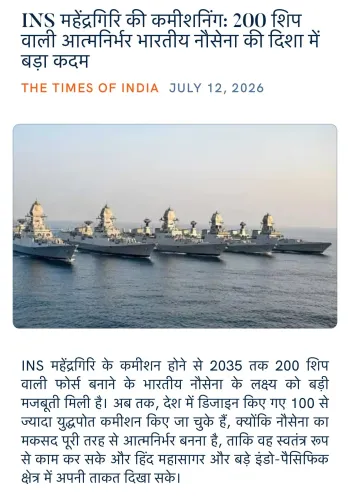
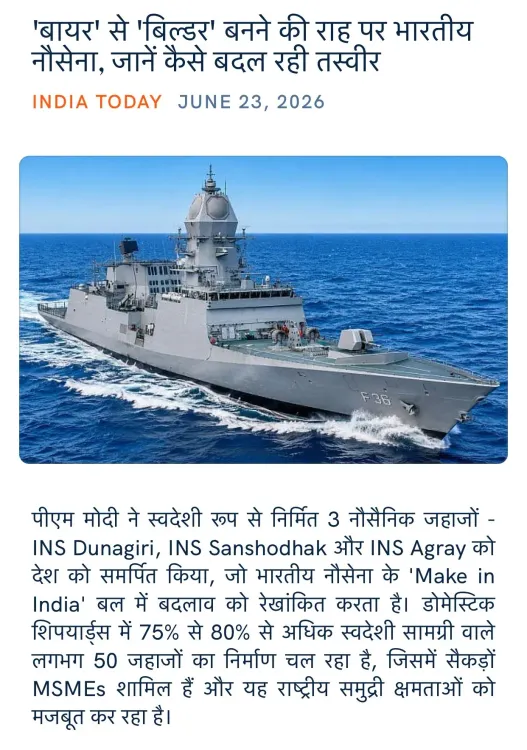
Union Textiles Minister Giriraj Singh amplified a piece on the Indian Navy's transition from a buyer to a builder of warships, spotlighting the Atmanirbhar Bharat and Make in India frameworks driving domestic naval construction across public and private shipyards.
Key Takeaways
Giriraj Singh , Union Textiles Minister and BJP MP from Begusarai , shared the post via the NaMo App on June 23, 2026 .
The post highlights the Indian Navy's structural shift from procuring foreign platforms to building warships and submarines domestically.
The shift is underpinned by the Make in India initiative (2014) and the Atmanirbhar Bharat campaign (2020), which set mandatory indigenisation targets.
Defence Procurement Procedure revisions, including the 2016 overhaul, created 'Buy Indian' categories mandating rising domestic content.
Public shipyards and emerging private players are primary beneficiaries, gaining long-term orders and technology absorption opportunities.
Commissioning timelines for upcoming indigenous platforms will be the key test of India's 'buyer to builder' ambition.
Union Textiles Minister Giriraj Singh on Tuesday, June 23, 2026, shared an article highlighting the Indian Navy's ongoing transformation from a force that primarily procures foreign platforms to one that builds its own warships and submarines domestically, amplifying the piece via the NaMo App on his official X account.
Context
The post, shared in Hindi, carries the headline 'Bayer se Builder banne ki raah par Bhartiya Nausena' ('Indian Navy on the path from buyer to builder'), pointing to a structural shift in how India equips its maritime forces. Singh's decision to amplify a defence story as a senior BJP leader and Lok Sabha MP from Begusarai, Bihar, underscores the ruling party's effort to keep the self-reliance narrative prominent across ministerial portfolios, not just defence.
The share comes at a moment when India's naval modernisation programme is drawing considerable attention, with multiple indigenous warship and submarine projects at various stages of design, construction, and commissioning at domestic shipyards.
Policy Backdrop
The Navy's pivot toward domestic construction is rooted in a policy architecture built over more than a decade. The Make in India initiative, launched in 2014, placed defence shipbuilding among its priority sectors, while successive revisions to the Defence Procurement Procedure—including the 2016 overhaul—created dedicated 'Buy Indian' and 'Buy and Make Indian' categories that mandate rising indigenous content thresholds.
The Atmanirbhar Bharat campaign, announced in 2020, deepened this framework by setting explicit localisation targets and publishing positive indigenisation lists that bar import of specified equipment. Public shipyards such as Mazagon Dock Shipbuilders and Garden Reach Shipbuilders and Engineers, along with emerging private players, have absorbed technology through design partnerships to meet these mandates.
The broader pattern mirrors parallel indigenisation drives in the Indian Army and Indian Air Force, signalling a whole-of-forces approach to reducing import dependence and building strategic autonomy in defence manufacturing.
Stakeholders and Impact
The primary beneficiaries of this shift are domestic shipbuilders—both public-sector yards and private players—who gain long-term order books, technology absorption opportunities, and the ability to develop export credentials. For the Indian Navy, building rather than buying means greater control over maintenance cycles, spare-part supply chains, and platform upgrades.
The defence workforce and ancillary manufacturing ecosystems in port cities and industrial clusters also stand to gain as naval construction orders multiply. Strategically, reducing dependence on foreign original equipment manufacturers strengthens India's negotiating position and insulates critical capabilities from geopolitical supply-chain disruptions.
What's Next
Attention will now turn to the commissioning timelines of upcoming indigenous platforms and any revisions to the Defence Procurement Manual that may be tabled in forthcoming parliamentary sessions. The government's ability to meet stated indigenisation milestones on submarines and next-generation destroyers will be the clearest test of whether the 'buyer to builder' narrative translates into operational reality.
Singh's amplification of this story, though outside his direct ministerial brief, reflects the BJP's broader political investment in the self-reliance brand — suggesting the theme will remain a fixture of the party's communication ahead of future electoral cycles.
Point of View
Not merely a defence-ministry talking point. The 'buyer to builder' framing is politically potent because it conflates manufacturing nationalism with strategic security, giving the ruling party a narrative that resonates across voter segments. Giriraj Singh's use of the NaMo App as the sharing vehicle reinforces the party's digital ecosystem as a parallel amplification channel. Watched over time, such cross-ministerial messaging suggests the Atmanirbhar Bharat theme will be central to the BJP's political identity well into the next electoral cycle.
NationPress
22 Sept 2026
Frequently Asked Questions
What does 'buyer to builder' mean for the Indian Navy?
It means the Indian Navy is shifting from primarily purchasing warships and submarines from foreign suppliers to designing and constructing them domestically at Indian shipyards, reducing import dependence and building strategic self-reliance.
Why did Giriraj Singh share a post about the Indian Navy when he is the Textiles Minister?
As a senior BJP leader, Giriraj Singh regularly amplifies the party's broader policy narratives, including the Atmanirbhar Bharat self-reliance campaign, which spans defence, manufacturing, and textiles alike.
What is the Atmanirbhar Bharat initiative and how does it relate to naval shipbuilding?
Atmanirbhar Bharat, launched in 2020, is a national self-reliance campaign that set explicit localisation targets and positive indigenisation lists across sectors, including defence, pushing the Navy to source platforms from domestic shipbuilders.
Which Indian shipyards are building naval vessels under the Make in India programme?
Public-sector yards such as Mazagon Dock Shipbuilders and Garden Reach Shipbuilders and Engineers are key players, alongside emerging private shipbuilders, all of whom have absorbed technology through design partnerships to meet indigenisation mandates.
What is the NaMo App and why do BJP leaders use it to share content?
The NaMo App is a BJP-affiliated digital platform used by party leaders and supporters to share and amplify government and party messaging, functioning as a parallel communication channel alongside mainstream social media.