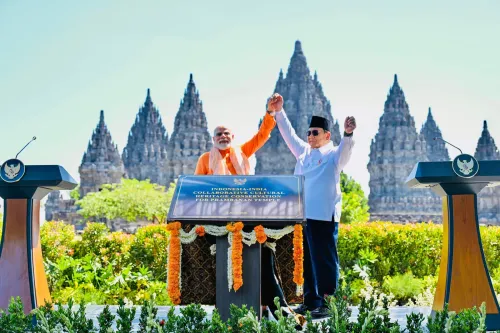
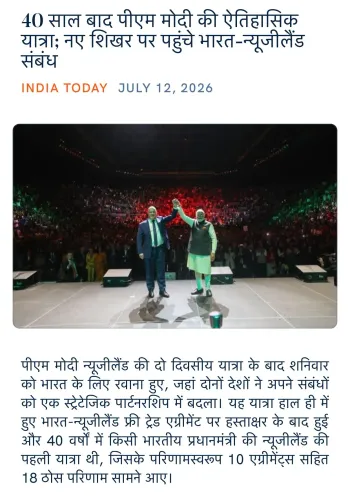
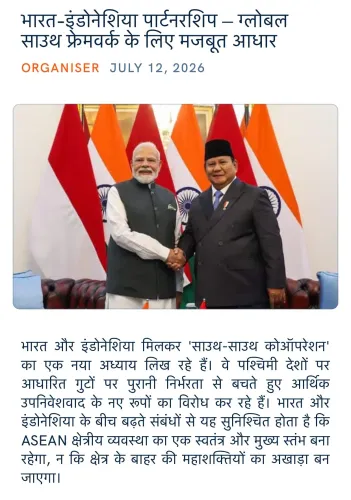
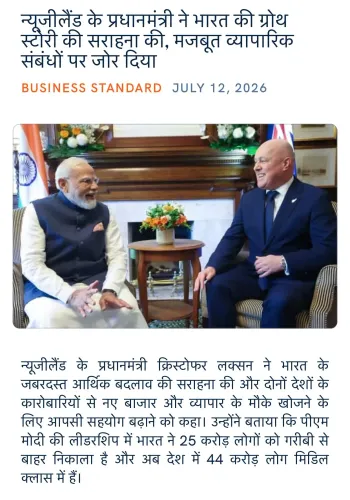
Giriraj Singh Backs Modi's Indo-Pacific Vision Spanning Indonesia to New Zealand
Synopsis
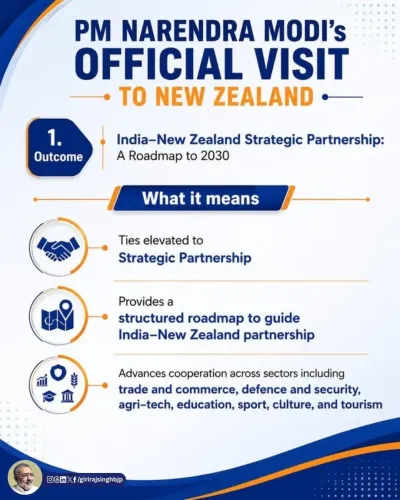
Union Textiles Minister Giriraj Singh amplified PM Modi's Indo-Pacific vision on 7 July 2026, sharing India's strategic arc from Indonesia to Australia to New Zealand via the NaMo App, reflecting party-wide endorsement of India's expanding maritime diplomacy.
Key Takeaways
Union Textiles Minister Giriraj Singh shared PM Modi's Indo-Pacific vision on 7 July 2026 via the NaMo App , signalling party-level backing.
India's Indo-Pacific arc spans Indonesia , Australia and New Zealand , reflecting a continuous strategic corridor from Southeast Asia to the South Pacific.
The policy lineage dates to 2018 when PM Modi articulated India's free, open and inclusive Indo-Pacific vision at the Shangri-La Dialogue .
India's Act East Policy , launched in 2014 , underpins deepening ties with ASEAN nations and Pacific partners.
The Quad — India, Australia, the United States and Japan — remains a key institutional pillar of India's Indo-Pacific architecture.
Upcoming ASEAN-India Summit outcomes and new Pacific island bilateral agreements are the next diplomatic markers to watch.
Union Textiles Minister Giriraj Singh on Tuesday, 7 July 2026, shared a post on X amplifying Prime Minister Narendra Modi's Indo-Pacific outreach, highlighting India's strategic arc stretching from Indonesia to Australia to New Zealand. The senior BJP leader and Lok Sabha MP from Begusarai, Bihar, shared the link via the NaMo App, signalling party-level endorsement of the government's foreign-policy posture in the Indo-Pacific region.
Context
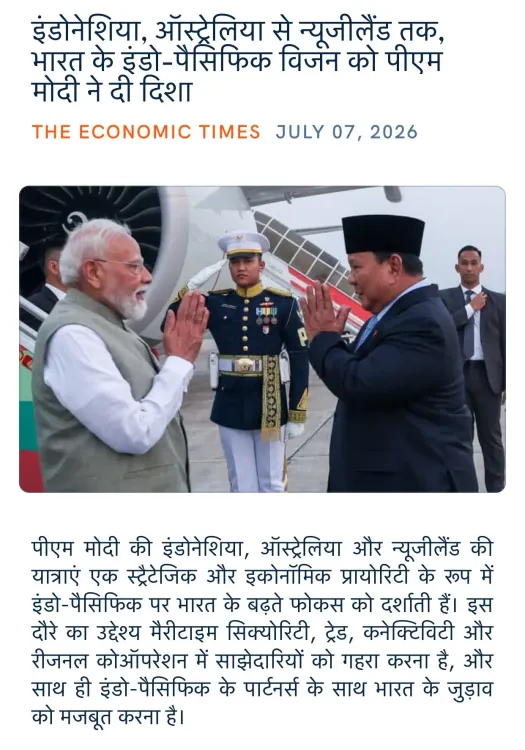
Singh's post — titled 'Indonesia se Australia se New Zealand tak, Bharat ke Indo-Pacific vision ko PM Modi ne di disha' ('From Indonesia to Australia to New Zealand, PM Modi gives direction to India's Indo-Pacific vision') — underscores the ruling party's effort to build domestic visibility around India's expanding maritime diplomacy. The NaMo App share indicates the content is being pushed through official BJP digital channels, amplifying reach beyond the minister's personal follower base.
The framing of a continuous 'arc' from Southeast Asia through the Pacific reflects a deliberate strategic narrative: India is no longer a passive observer in the Indo-Pacific but an active shaper of its rules and partnerships.
Policy Backdrop
India's Indo-Pacific doctrine traces its formal articulation to 2018, when Prime Minister Modi addressed the Shangri-La Dialogue in Singapore and laid out a vision for a free, open and inclusive Indo-Pacific with ASEAN centrality. That speech built on the Act East Policy announced in 2014, which upgraded the earlier Look East Policy to deepen strategic and economic engagement with Southeast Asia and the broader Pacific.
India's approach stresses maritime cooperation, connectivity, and a rules-based order across the Indian Ocean and Pacific Ocean, while deliberately avoiding exclusive military alliances. Key institutional pillars include the Quad — comprising India, Australia, the United States and Japan — and deepening bilateral defence and trade frameworks with ASEAN members including Indonesia.
Indonesia, as the largest ASEAN economy and a major maritime nation, occupies a pivotal position in India's Act East calculus. Australia, a fellow Quad partner, has emerged as a critical defence and critical-minerals ally. New Zealand, while geographically distant, represents India's growing people-to-people and trade footprint in the South Pacific.
Stakeholders and Impact
The Indo-Pacific arc framing has direct implications for Indian exporters, particularly in sectors like textiles, pharmaceuticals and IT services, where market access agreements with ASEAN and Pacific nations remain active negotiating fronts. For Singh's own portfolio — textiles — expanded trade ties with Australia and Indonesia could open new export corridors for Indian fabric and garment manufacturers.
Strategically, the messaging reinforces India's positioning as a net security provider in the Indian Ocean Region, a role that resonates with smaller Pacific island nations seeking alternatives to dependence on any single great power. ASEAN nations, Quad partners, and Pacific island states all stand as stakeholders in the stability this framework is designed to underwrite.
What's Next
Observers will watch the outcomes of upcoming ASEAN-India Summit engagements and any new bilateral agreements with Pacific island nations during high-level visits. The consistency with which senior cabinet ministers like Singh amplify the Indo-Pacific narrative suggests the government is preparing the domestic political ground for a series of diplomatic announcements. India's ability to translate its Indo-Pacific vision into concrete trade, defence and connectivity deliverables — from the Andaman Sea to the South Pacific — will be the measure of the arc's strategic durability.
Point of View
Ensuring it reaches a curated, politically engaged audience rather than the broader news cycle. This pattern of senior BJP figures reinforcing foreign-policy wins has intensified since the 2018 Shangri-La articulation, suggesting the party views Indo-Pacific leadership as an electoral asset, not merely a diplomatic posture. The framing of a seamless arc from Indonesia to New Zealand also quietly signals India's ambition to be seen as the connective tissue of the Indo-Pacific, a role that carries both strategic opportunity and the burden of expectation from smaller Pacific nations.
NationPress
6 Oct 2026
Frequently Asked Questions
What is India's Indo-Pacific vision under PM Modi?
India's Indo-Pacific vision, formally articulated by PM Modi at the 2018 Shangri-La Dialogue, calls for a free, open and inclusive Indo-Pacific with ASEAN centrality, emphasising maritime cooperation, connectivity and a rules-based order across the Indian and Pacific Oceans.
Why did Giriraj Singh post about India's Indo-Pacific policy?
As a senior BJP leader and Union Minister, Giriraj Singh shared the post via the NaMo App to amplify the ruling party's foreign-policy narrative, reflecting party-wide endorsement of PM Modi's Indo-Pacific outreach from Indonesia to Australia to New Zealand.
What is India's Act East Policy and how does it relate to the Indo-Pacific?
India's Act East Policy, announced in 2014, upgraded the earlier Look East Policy to deepen strategic and economic ties with Southeast Asia and the Pacific, and forms the foundation of India's broader Indo-Pacific engagement.
What role does Australia play in India's Indo-Pacific strategy?
Australia is a fellow Quad member and a key defence and critical-minerals partner for India, occupying a central position in the eastern Indian Ocean and Pacific dimensions of India's Indo-Pacific arc.
What is the Quad and why does it matter for India?
The Quad is a strategic grouping of India, Australia, the United States and Japan focused on maritime security, technology cooperation and a rules-based Indo-Pacific order; it is one of the primary institutional pillars of India's regional strategy.