Giriraj Singh backs PM Modi's chips-to-ships manufacturing vision
Synopsis
Union Textiles Minister Giriraj Singh on 10 July 2026 shared PM Modi's statement that India is building a new manufacturing ecosystem 'from chips to ships', spotlighting the government's interlocking PLI, semiconductor, and Sagarmala programmes as pillars of the Atmanirbhar Bharat push.
Key Takeaways
Giriraj Singh amplified PM Modi's 'chips to ships' manufacturing vision on 10 July 2026 via the NaMo App .
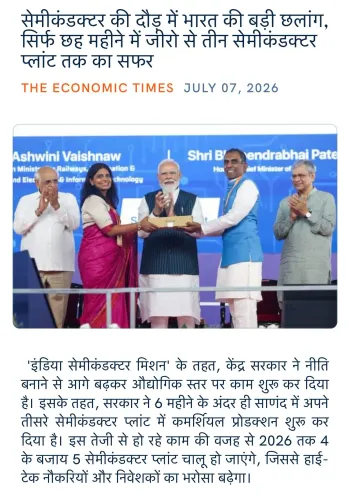
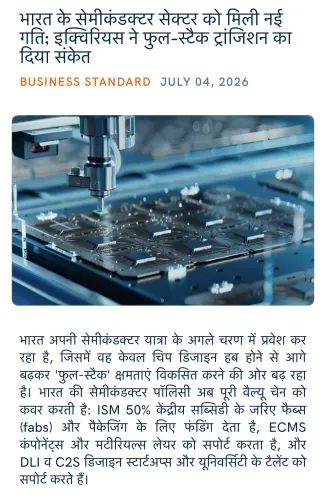
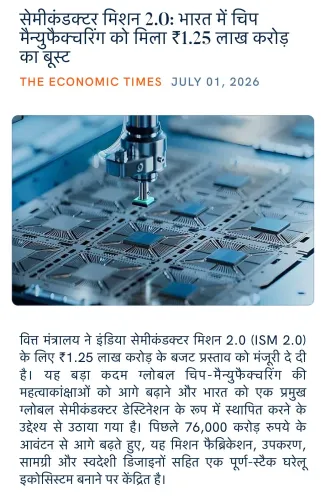
The phrase spans two policy pillars: the India Semiconductor Mission (approved December 2021 , outlay Rs 76,000 crore ) and the Sagarmala Project (launched 2015 ) for port-led shipbuilding.
The Production Linked Incentive (PLI) scheme, active across 14 sectors since 2020 , provides the financial backbone linking both ends of the manufacturing spectrum.
The overarching framework is Atmanirbhar Bharat , announced in 2020 , targeting reduced import dependence across strategic industries.
Key stakeholders include electronics manufacturers, shipbuilding firms, and MSME exporters feeding into both supply chains.
Progress on semiconductor fabrication units and fresh shipbuilding incentives in the next Union Budget will be the practical test of this ambition.
Union Textiles Minister Giriraj Singh on Friday, 10 July 2026 shared a statement attributed to Prime Minister Narendra Modi highlighting India's ambition to build a new manufacturing ecosystem spanning semiconductors to shipbuilding, amplifying the message across his social media platforms.
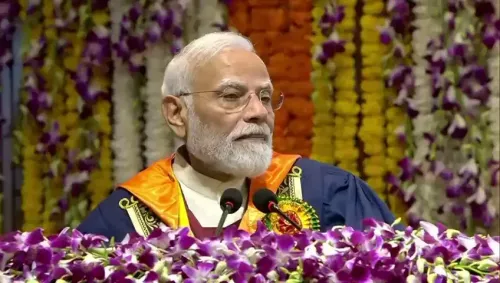
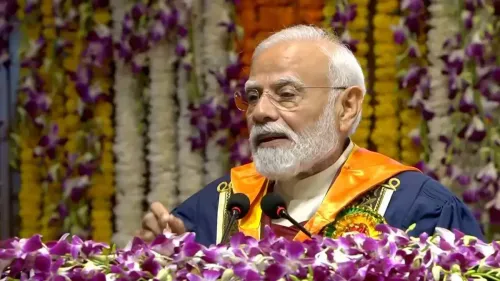
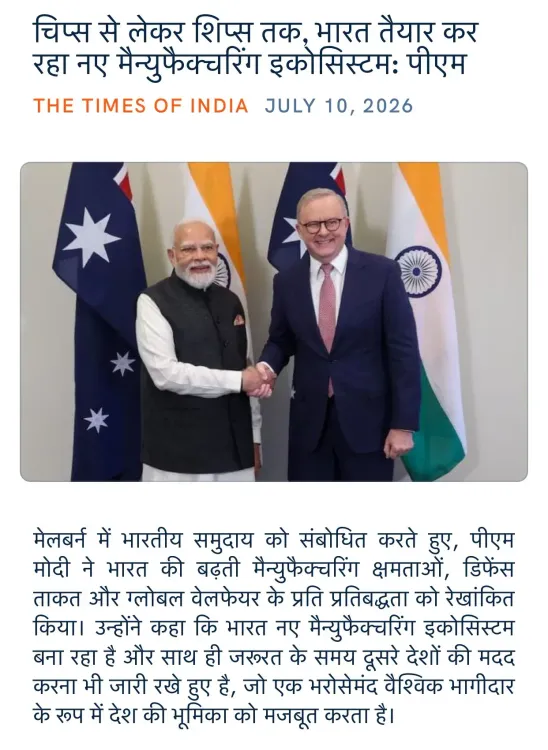
Sharing the post via the NaMo App, Singh quoted the Prime Minister as saying: 'chips se lekar ships tak, Bharat tayaar kar raha naye manufacturing ecosystem' — 'from chips to ships, India is creating new manufacturing ecosystems.' The post carried an image and was shared in the context of the government's sustained push for domestic industrial self-reliance.
Context
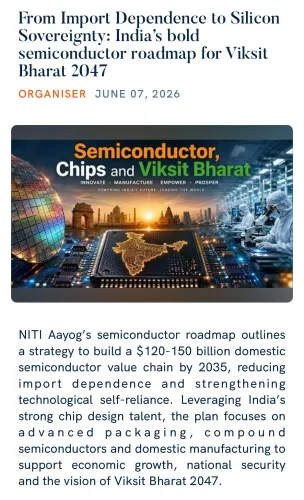
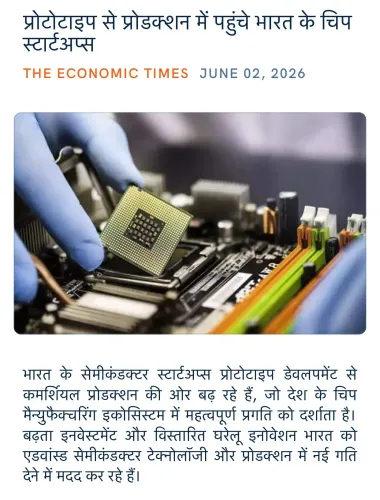
The 'chips to ships' formulation encapsulates two ends of the manufacturing spectrum that the Modi government has sought to develop simultaneously. On one end are semiconductors — high-technology, precision components that India has historically imported in large volumes. On the other are ships — capital-intensive, labour-absorbing vessels that require deep industrial capacity and port infrastructure.
The phrase signals a deliberate policy intent to position India as a full-spectrum manufacturing destination, not merely an assembler of imported components. Giriraj Singh, a senior BJP leader and Lok Sabha MP from Begusarai, Bihar, has consistently used his platform to amplify the Prime Minister's industrial policy messaging.
Policy Backdrop
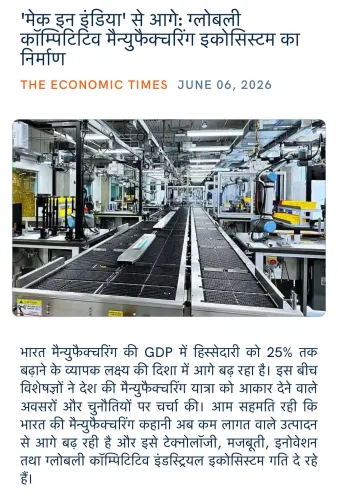
The government's manufacturing drive rests on several interlocking programmes. The Make in India initiative, launched in September 2014, set the strategic direction by targeting a higher share of manufacturing in GDP and attracting global investment. It was followed by the Production Linked Incentive (PLI) scheme, rolled out from 2020 across 14 sectors including electronics, white goods, and pharmaceuticals, offering direct financial incentives tied to incremental output.
For semiconductors specifically, the government approved the India Semiconductor Mission in December 2021 with an outlay of Rs 76,000 crore, aimed at establishing domestic fabrication and assembly ecosystems and reducing import dependence in chips and displays. On the maritime side, the Sagarmala Project, initiated in 2015, has sought to modernise ports and build domestic shipbuilding capacity — the 'ships' half of the equation.
Together these schemes form the backbone of the Atmanirbhar Bharat ('self-reliant India') framework announced in 2020, which seeks reduced reliance on imports across strategic sectors ranging from defence electronics to industrial machinery.
Stakeholders and Impact
The beneficiaries of this dual push span a wide industrial base. Electronics manufacturers and global semiconductor companies evaluating India as a fabrication destination stand to gain from the India Semiconductor Mission's incentive structure. Shipbuilding firms and ancillary industries — steel, engineering, logistics — are the intended beneficiaries of port-led development and any fresh maritime incentives.
MSME exporters across both sectors also feature prominently in the government's calculations, as smaller suppliers feed into the supply chains of both chip assembly units and shipyards. The framing of 'chips to ships' is partly aimed at signalling to global investors that India's manufacturing ambition is broad-based and not confined to a single sector.
What's Next
Analysts and industry watchers will track the commissioning progress of semiconductor fabrication units approved under the India Semiconductor Mission, as well as any fresh shipbuilding incentives that may be outlined in the next Union Budget or a dedicated maritime policy review. The government's ability to translate the 'chips to ships' vision into operational plants and launched vessels will be the real measure of this manufacturing ambition — and a key electoral and economic narrative heading into the next budget cycle.
Point of View
PLI) with blue-collar manufacturing optics (shipyards, ports), broadening the coalition of interests invested in the government's economic narrative. For the BJP, this dual framing serves both the investor-relations goal of signalling policy seriousness to global capital and the domestic political goal of associating the party with job-creating heavy industry. The real stress test will come when semiconductor fabs move from approval to production and shipbuilding order books are assessed — timelines the government has so far kept deliberately flexible.
NationPress
10 Oct 2026
Frequently Asked Questions
What did PM Modi mean by 'chips to ships' in India's manufacturing context?
PM Modi used 'chips to ships' to describe India's ambition to build manufacturing capacity across the full industrial spectrum — from semiconductors (chips) requiring high-technology precision to large vessels (ships) requiring heavy industrial infrastructure — under schemes like the India Semiconductor Mission and the Sagarmala Project.
What is the India Semiconductor Mission and how much has been allocated to it?
The India Semiconductor Mission is a government programme approved in December 2021 with an outlay of Rs 76,000 crore to establish domestic semiconductor fabrication and assembly ecosystems and reduce India's dependence on imported chips and displays.
What is the PLI scheme and which sectors does it cover?
The Production Linked Incentive (PLI) scheme, rolled out from 2020, offers financial incentives linked to incremental production output and covers 14 sectors including electronics, white goods, pharmaceuticals, and textiles, forming a key pillar of the Make in India and Atmanirbhar Bharat frameworks.
Why did Giriraj Singh share this post about manufacturing?
As Union Textiles Minister and a senior BJP leader, Giriraj Singh regularly amplifies Prime Minister Modi's statements on industrial and economic policy; sharing the 'chips to ships' message extends its reach and signals cabinet-level alignment behind the government's manufacturing agenda.
What is the Sagarmala Project and how does it relate to shipbuilding?
The Sagarmala Project, initiated in 2015, is a central government programme to modernise India's ports and promote domestic shipbuilding capacity, representing the 'ships' dimension of the broader chips-to-ships manufacturing vision.