CM Manik Saha: Tripura Draws ₹1.21 Lakh Crore at Business Conclave
Synopsis
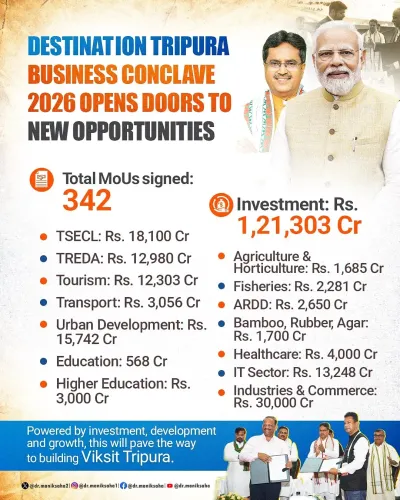
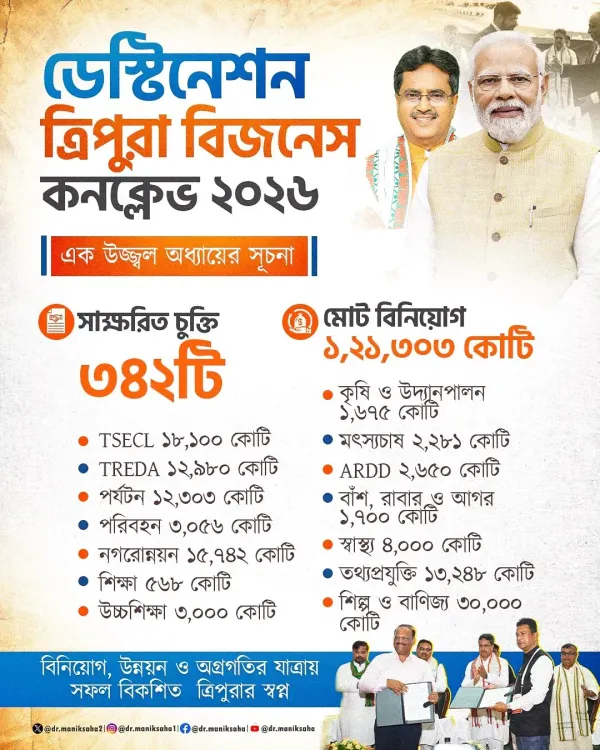
Tripura Chief Minister Dr. Manik Saha announced that the Destination Tripura Business Conclave 2026 secured 342 MoUs totalling ₹1,21,303 crore in investment commitments, framing the outcome as a cornerstone of the state's Viksit Tripura vision aligned with PM Modi's Viksit Bharat roadmap.
Key Takeaways
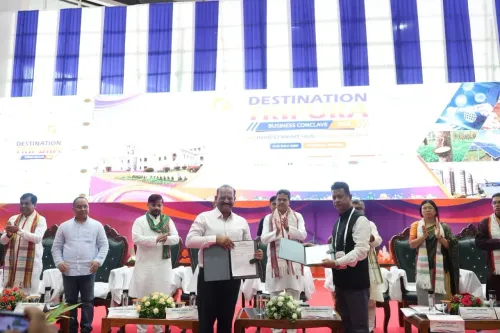
342 MoUs were signed at the Destination Tripura Business Conclave 2026 , held in July 2026 .
Total investment commitments stand at ₹1,21,303 crore , one of the largest single-event capital pledges for the northeastern state.
Manik Saha linked the conclave's outcome directly to PM Narendra Modi 's Viksit Bharat vision for a developed India by 2047 .
The conclave builds on central policy pillars including the North East Industrial Development Scheme (NEIDS) and the Act East Policy .
Tripura 's strategic location bordering Bangladesh is a key selling point for investors targeting ASEAN -linked trade corridors.
MoU implementation rates and follow-up investor meets in 2027 will determine the real economic impact of the summit.
Tripura Chief Minister Dr. Manik Saha announced on Friday, 10 July 2026 that the Destination Tripura Business Conclave 2026 has secured investment commitments worth ₹1,21,303 crore through 342 Memoranda of Understanding (MoUs), marking what he described as a new chapter in the state's development trajectory.
Posting in Bengali on X, Dr. Saha wrote: 'ডেস্টিনেশন ত্রিপুরা বিজনেস কনক্লেভ ২০২৬ এর মাধ্যমে সূচিত হলো উন্নয়নের এক নতুন অধ্যায়' — ['Through the Destination Tripura Business Conclave 2026, a new chapter of development has begun']. He added that the investments would build the foundation of a 'Viksit Tripura' in line with Prime Minister Narendra Modi's vision of a Viksit Bharat.
Context
The Destination Tripura Business Conclave 2026 is a state-hosted investment summit designed to attract large-scale private capital into one of India's smaller northeastern states. Tripura, which shares a long border with Bangladesh, has been positioned by the BJP-led state government as a gateway to Southeast Asia under the Centre's Act East Policy. The conclave follows a format pioneered by larger states such as Gujarat and increasingly adopted by northeastern states to signal investor readiness.
Policy Backdrop
The investment push sits within a broader national framework. The North East Industrial Development Scheme (NEIDS), launched in 2017, provides fiscal incentives for new industrial units across the eight northeastern states, including Tripura. The Act East Policy, formally revitalised in 2014, has prioritised roads, rail links, and cross-border trade corridors that improve Tripura's connectivity with Bangladesh and the wider ASEAN region. Successive central budgets have raised capital outlays for the North East Region (NER), creating an enabling environment for state-level MoU drives of this scale.
The Viksit Bharat vision — a roadmap for a developed India by 2047 — has become a recurring reference point for state governments aligning local industrial policy with national goals. Dr. Saha explicitly framed the ₹1,21,303 crore commitment as a building block for 'Viksit Tripura', directly echoing the national narrative of Atmanirbhar Bharat.
Stakeholders and Impact
The 342 MoUs span multiple sectors, with industrial investors and Tripura's domestic entrepreneurial community identified as primary stakeholders. If even a significant share of the committed investment is translated into ground-level projects, it would represent a transformative injection of capital into a state whose economy has historically depended on central transfers and agriculture. Employment generation, infrastructure development, and enhanced border trade with Bangladesh are among the anticipated downstream benefits.
Local entrepreneurs and small businesses stand to benefit from ancillary demand generated by larger industrial projects, while the state government would gain from expanded tax revenues and improved fiscal headroom for social spending.
What's Next
The credibility of the conclave will ultimately be measured by MoU-to-implementation conversion rates — a metric that has historically varied widely across Indian investment summits. Progress reports embedded in Tripura's annual state budgets and any follow-up investor meets planned for 2027 will be closely watched by industry observers and opposition parties alike. Dr. Saha's government has staked considerable political capital on delivering tangible outcomes from this conclave, making implementation tracking a key benchmark for the state's economic governance record ahead of the next assembly election cycle.
Point of View
CM Saha is simultaneously seeking political credit at the state level while reinforcing alignment with the national party's development messaging. The sheer scale of the commitment — ₹1,21,303 crore — will face intense scrutiny over implementation, given that MoU-to-project conversion has been an Achilles heel for investment summits across India. The conclave nonetheless signals that the northeastern states are increasingly confident participants in India's competitive federalism for capital attraction.
NationPress
10 Jul 2026
Frequently Asked Questions
What is the Destination Tripura Business Conclave 2026?
The Destination Tripura Business Conclave 2026 is a state-hosted investment summit organised by the Tripura government to attract private capital into the state. The 2026 edition resulted in 342 MoUs with investment commitments totalling ₹1,21,303 crore.
How much investment was pledged at the Tripura Business Conclave 2026?
Investment commitments worth ₹1,21,303 crore were pledged through 342 MoUs at the Destination Tripura Business Conclave 2026, as announced by Chief Minister Dr. Manik Saha on 10 July 2026.
What is Viksit Tripura and how does it relate to Viksit Bharat?
'Viksit Tripura' is the state-level development vision articulated by CM Dr. Manik Saha, aligned with Prime Minister Narendra Modi's national 'Viksit Bharat' roadmap that targets a fully developed India by 2047. State investment drives like the business conclave are presented as building blocks of this larger goal.
What central schemes support industrial investment in Tripura?
The North East Industrial Development Scheme (NEIDS), launched in 2017, provides fiscal incentives for new industrial units in Tripura and other northeastern states. The Act East Policy further supports the region by improving cross-border connectivity with Bangladesh and ASEAN nations.
Who is Tripura Chief Minister Dr. Manik Saha?
Dr. Manik Saha is a BJP leader who has served as Chief Minister of Tripura since May 2022. He has focused his tenure on state industrial promotion, connectivity improvements, and aligning Tripura's development agenda with central government schemes.