Joshi Urges Assam to Fast-Track 1.8 Lakh Solar Installations
Synopsis
Union Minister Pralhad Joshi met Assam CM Himanta Biswa Sarma on 10 July 2026, pressing for faster rollout of 1.8 lakh rooftop solar units under PM Surya Ghar, where Assam leads the North East. The two also discussed scheme convergence to boost food storage and PMGKAY delivery.
Key Takeaways
Pralhad Joshi met Assam CM Himanta Biswa Sarma on 10 July 2026 to review PM Surya Ghar implementation.
Joshi urged the state to expedite 1.8 lakh rooftop solar installations already awarded under the ULA-led model.
The central government offers a subsidy of up to ₹85,000 per household for Assam and other North Eastern states under PM Surya Ghar.
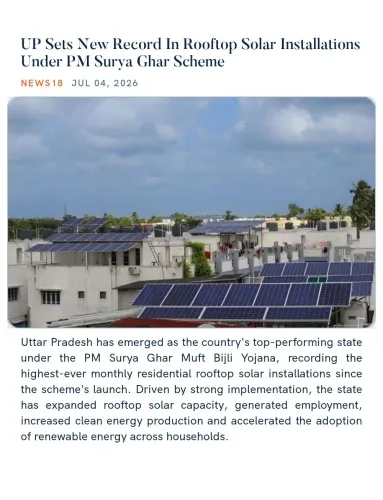
Assam is the best-performing North Eastern state in household rooftop solar and ranks among national leaders under the scheme.
The two leaders discussed convergence of Ministry of Cooperation and Ministry of Consumer Affairs schemes to strengthen food storage and support PMGKAY delivery.
The discussions align with India's target of 500 GW non-fossil energy capacity by 2030 .
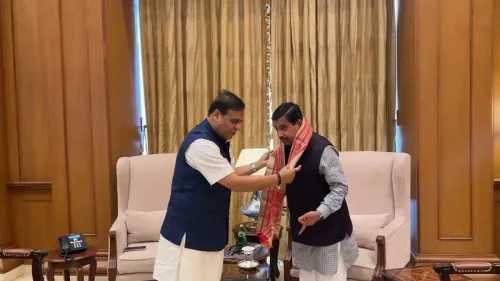
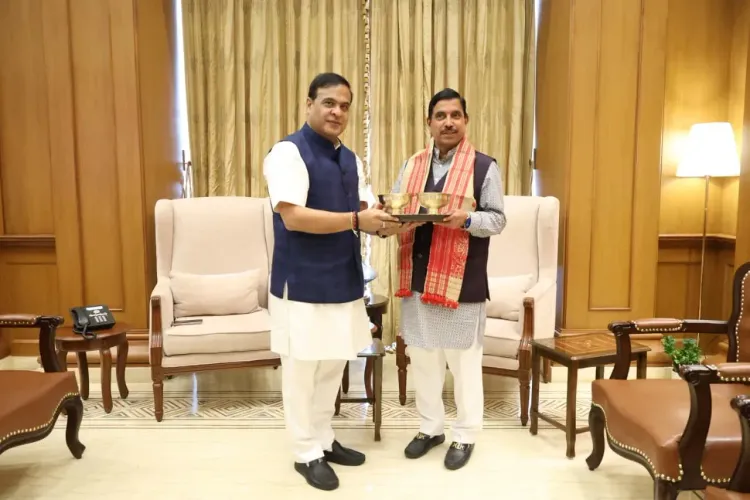
Union Consumer Affairs and New and Renewable Energy Minister Pralhad Joshi met with Assam Chief Minister Himanta Biswa Sarma on Friday, 10 July 2026, to review the state's progress under the PM Surya Ghar Muft Bijli Yojana and urged faster execution of pending rooftop solar targets.
Context
Joshi described the meeting as productive and highlighted that Assam has emerged as the best-performing state in the North East for household rooftop solar installations under PM Surya Ghar, and now ranks among the leading performers nationally. He credited the progress to what he called the 'visionary leadership' of Prime Minister Narendra Modi and the administrative focus of CM Sarma.
The minister urged the state government to expedite implementation of the 1.8 lakh rooftop solar installations already awarded under the Urban Local Authority (ULA)-led model, signalling that sanctions are in place but on-ground execution needs to accelerate.
Policy Backdrop
PM Surya Ghar Muft Bijli Yojana was launched in February 2024 with a national target of one crore rooftop solar installations, offering central financial assistance covering up to 60 per cent of system cost. For Assam and other North Eastern states, the central government has structured a higher subsidy of up to ₹85,000 per household, reflecting the special category treatment these states receive under renewable energy financing norms.
This enhanced support is part of India's broader push to achieve 500 GW of non-fossil energy capacity by 2030, with distributed rooftop solar seen as critical to reaching underserved and geographically challenging regions.
Stakeholders and Impact
The meeting also covered food security, with Joshi and Sarma discussing plans to strengthen storage capacity in Assam through convergence of schemes run by the Ministry of Cooperation and the Ministry of Consumer Affairs, Food and Public Distribution. The objective is to support effective delivery of the Pradhan Mantri Garib Kalyan Anna Yojana (PMGKAY), which provides free food grains to eligible households and has been extended through 2028.
Improved storage infrastructure would reduce grain wastage and leakages in welfare delivery, directly benefiting Assam's food-insecure population. The convergence model, if formalised, could serve as a template for other North Eastern states facing similar logistical constraints.
What's Next
Attention will now turn to state-level progress reports on the 1.8 lakh sanctioned solar installations and any formal agreements or project approvals for integrated storage facilities under the two ministries. Assam's ability to translate its North East leadership position into faster ground-level execution will be a key indicator of how effectively enhanced central subsidies translate into energy access for ordinary households.
For the broader PM Surya Ghar programme, Assam's trajectory in the coming months will be closely watched as a test case for whether higher subsidies alone are sufficient to drive adoption in states where installation infrastructure and consumer awareness remain works in progress.
Frequently Asked Questions
What is PM Surya Ghar Muft Bijli Yojana?
PM Surya Ghar Muft Bijli Yojana is a central government rooftop solar scheme launched in February 2024 that offers subsidies covering up to 60 per cent of installation cost, targeting one crore household installations nationally, with higher subsidies for North Eastern states.
How much subsidy does Assam get under PM Surya Ghar?
The central government provides a subsidy of up to ₹85,000 per household for Assam and other North Eastern states under PM Surya Ghar, higher than the standard rate applicable to other states.
Why did Pralhad Joshi meet Assam CM Himanta Biswa Sarma?
Union Minister Pralhad Joshi met Assam CM Himanta Biswa Sarma on 10 July 2026 to review progress under PM Surya Ghar, urge faster execution of 1.8 lakh sanctioned rooftop solar installations, and discuss scheme convergence for food storage under PMGKAY.
What is PMGKAY and how does it relate to Assam's food storage plans?
PMGKAY (Pradhan Mantri Garib Kalyan Anna Yojana) provides free food grains to eligible households and has been extended through 2028. Joshi and Sarma discussed strengthening Assam's storage capacity through convergence of Ministry of Cooperation and Ministry of Consumer Affairs schemes to improve PMGKAY delivery.
Is Assam the best state in North East for rooftop solar?
According to Union Minister Pralhad Joshi's statement on 10 July 2026, Assam has emerged as the best-performing state in the North East for household rooftop solar installations under PM Surya Ghar and is now among the leading performers nationally.