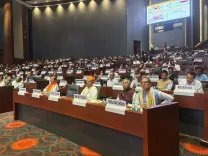
Giriraj Singh Backs India Semiconductor Mission 2.0 Push
Synopsis
Union Textiles Minister Giriraj Singh has amplified a report citing a ₹1.25 lakh crore boost for India's chip manufacturing under Semiconductor Mission 2.0, signalling wide government backing for the country's semiconductor self-reliance push beyond the electronics ministry.
Key Takeaways
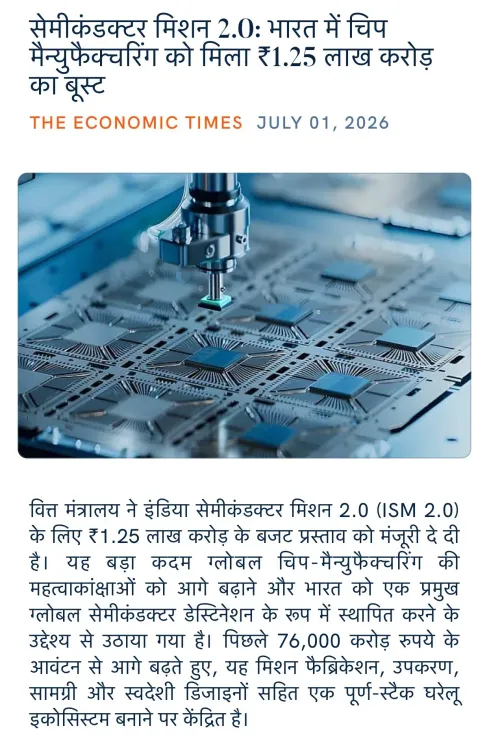
Union Textiles Minister Giriraj Singh shared a report on 1 July 2026 highlighting a proposed ₹1.25 lakh crore boost to India's chip manufacturing under Semiconductor Mission 2.0 .
India's original Semiconductor Mission , approved in 2021 , carried an outlay of ₹76,000 crore under the Ministry of Electronics and IT .
The semiconductor drive is anchored in the Atmanirbhar Bharat framework, aiming to reduce India's dependence on chip imports from East Asia .
The PLI scheme for electronics , notified in 2020 , was an earlier policy step targeting mobile phone and component manufacturing.
A formal Cabinet approval codifying the expanded outlay and the structure of Mission 2.0 is the key milestone to watch.
India's strategy mirrors similar programmes in the US , EU , and Japan to diversify global semiconductor supply chains.
Union Textiles Minister Giriraj Singh on Wednesday, 1 July 2026 shared a report highlighting a proposed ₹1.25 lakh crore boost to India's chip manufacturing ambitions under what is being described as Semiconductor Mission 2.0, signalling broad cross-ministerial support within the BJP-led government for the country's semiconductor self-reliance drive.
Context
Singh shared the development via the NaMo App, amplifying coverage of what the report terms 'Semiconductor Mission 2.0' (Semiconductor Mission 2.0: Bharat mein chip manufacturing ko mila ₹1.25 lakh crore ka boost — 'Semiconductor Mission 2.0: India's chip manufacturing gets a ₹1.25 lakh crore boost'). The post underscores the ruling party's intent to keep semiconductor policy in the national conversation well beyond the ministries directly responsible for it.
India's original Semiconductor Mission was approved in 2021 with an outlay of ₹76,000 crore under the Ministry of Electronics and Information Technology, aiming to build domestic design and fabrication capacity and reduce dependence on chip imports from East Asia.
Policy Backdrop
The semiconductor push sits within the broader Atmanirbhar Bharat framework, which has sought to attract global foundry, packaging, and assembly investments to India. The Production Linked Incentive (PLI) scheme for electronics, notified in 2020, laid earlier groundwork by targeting mobile phone and component manufacturing.
India's approach mirrors industrial strategies pursued by the United States, the European Union, and Japan, all of which have introduced large-scale incentive programmes to diversify semiconductor supply chains away from concentrated production nodes. A reported scale-up to ₹1.25 lakh crore — if confirmed through a formal Cabinet decision — would represent a significant expansion of the original mission's financial architecture.
Stakeholders and Impact
The primary beneficiaries of an expanded semiconductor mission would be electronics manufacturers, domestic and foreign semiconductor firms considering India as a fabrication or assembly destination, and the broader component supply chain. Downstream industries — from consumer electronics to automotive and defence — stand to gain from a more resilient domestic chip supply.
For Bihar and other states competing to host semiconductor facilities, a larger national outlay could translate into more greenfield projects and associated employment. Singh's constituency of Begusarai falls within a state that has actively sought manufacturing investment under successive central schemes.
What's Next
Analysts and industry bodies will watch for a formal Cabinet approval that codifies the reported ₹1.25 lakh crore commitment and defines the structure of Semiconductor Mission 2.0. Progress on the first operational fabrication units already in the pipeline under the original mission is also a near-term milestone that will test the government's execution capacity.
Should the expanded outlay be officially notified, it would cement India's position as one of the most aggressively incentivised semiconductor destinations globally, with implications for foreign direct investment flows and the country's long-term technology trade balance.
Point of View
It would mark a sharp escalation from the original ₹76,000 crore mission and place India's chip ambitions on par with the largest sovereign semiconductor programmes globally. The political signal is clear: semiconductor self-reliance is being positioned as a whole-of-government priority, not merely a technocratic one.
NationPress
30 Sept 2026
Frequently Asked Questions
What is Semiconductor Mission 2.0 in India?
Semiconductor Mission 2.0 refers to a reported expansion of India's original India Semiconductor Mission, which was launched in 2021 with a ₹76,000 crore outlay. The newer phase is reported to involve a ₹1.25 lakh crore push to further scale up domestic chip design and manufacturing capacity.
Why is Textiles Minister Giriraj Singh talking about semiconductors?
Senior cabinet ministers across portfolios routinely amplify major government policy announcements on social media as part of a coordinated communication strategy. Singh shared the semiconductor report via the NaMo App to signal broad ruling-party support for India's chip self-reliance goals.
How much has India committed to semiconductor manufacturing?
India's original Semiconductor Mission approved in 2021 carried an outlay of ₹76,000 crore. Reports now point to a further ₹1.25 lakh crore boost under what is being called Semiconductor Mission 2.0, though a formal Cabinet notification is awaited.
Which ministry oversees India's semiconductor mission?
The India Semiconductor Mission is administered by the Ministry of Electronics and Information Technology (MeitY), not the Textiles Ministry. Giriraj Singh's post reflects cross-ministerial promotion of the initiative.
How does India's semiconductor push compare globally?
India's approach mirrors large-scale chip incentive programmes launched by the United States, the European Union, and Japan, all aimed at diversifying semiconductor supply chains away from concentrated East Asian production hubs.