Giriraj Singh backs India's semiconductor push for Viksit Bharat 2047
Synopsis
Union Textiles Minister Giriraj Singh amplified India's semiconductor sovereignty agenda on June 7, 2026, sharing a detailed roadmap piece via the NaMo App. Anchored in the Viksit Bharat 2047 vision and backed by a Rs 76,000 crore India Semiconductor Mission, the post underscores the BJP government's cross-ministerial commitment to reducing chip import dependence.
Key Takeaways
Union Textiles Minister Giriraj Singh shared India's semiconductor roadmap on June 7, 2026 via the NaMo App, linking it to the Viksit Bharat 2047 vision.
The India Semiconductor Mission , approved in December 2021 , carries an outlay of Rs 76,000 crore to build domestic chip manufacturing and design capacity.
The Production Linked Incentive (PLI) scheme extends fiscal incentives to electronics, IT hardware, and semiconductor firms to attract global investment.
India's semiconductor strategy includes technology partnerships with the United States, Taiwan, Japan , and the European Union to diversify global chip supply chains.
Progress on approved semiconductor fabrication units and potential new cabinet approvals in the next Union Budget cycle are the key near-term milestones to watch.
Union Textiles Minister Giriraj Singh on Sunday, June 7, 2026, shared a detailed commentary on India's semiconductor roadmap, amplifying the national conversation around technology sovereignty and the country's ambition to move from import dependence to domestic chip manufacturing under the Viksit Bharat 2047 vision.
Context
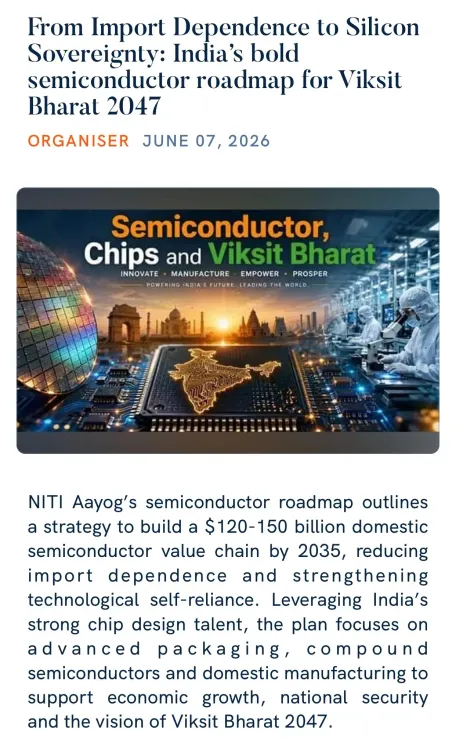
Singh shared the piece via the NaMo App, framing the semiconductor agenda as a cornerstone of India's long-term development strategy. The post, titled 'From Import Dependence to Silicon Sovereignty: India's bold semiconductor roadmap for Viksit Bharat 2047', signals the ruling BJP's intent to keep strategic technology manufacturing at the centre of its political and policy messaging. While Singh's primary portfolio is textiles, his amplification of the semiconductor narrative reflects the broader cross-ministerial ownership the BJP government has cultivated around the Atmanirbhar Bharat and Viksit Bharat 2047 frameworks.
Policy Backdrop
India's semiconductor push has its roots in the Atmanirbhar Bharat Abhiyan, launched in May 2020, which explicitly identified electronics and semiconductor self-reliance as priority sectors. The India Semiconductor Mission was approved by the Union Cabinet in December 2021 with an outlay of Rs 76,000 crore, making it one of the largest technology-sector interventions in the country's history. First in-principle approvals for semiconductor manufacturing proposals followed in 2022, laying the groundwork for domestic fabrication capacity.
Complementing this, the Production Linked Incentive (PLI) scheme extended fiscal incentives to electronics, IT hardware, and semiconductor firms to attract global investment into Indian manufacturing. These initiatives collectively form a multi-layered strategy to reduce India's dependence on imported chips — a vulnerability exposed sharply by the global semiconductor shortage of 2020-2022 that disrupted automobile, consumer electronics, and defence supply chains worldwide.
Stakeholders and Impact
The semiconductor mission directly affects a wide range of actors: large electronics manufacturers seeking stable domestic chip supply, semiconductor design firms looking to scale in India, and MSME component suppliers that feed into the broader electronics value chain. India's technology sovereignty ambitions have also attracted strategic partnerships with the United States, Taiwan, Japan, and the European Union, each of which has its own interest in diversifying chip supply chains away from concentrated geographies.
For ordinary consumers and industry alike, a successful domestic semiconductor ecosystem would mean greater supply-chain resilience, potential cost reductions in electronics, and the creation of high-skill manufacturing jobs — a key deliverable under the Viksit Bharat 2047 framework that envisions India as a fully developed economy by the centenary of its independence.
What's Next
The immediate focus for policymakers and industry observers will be progress reports on semiconductor units that have already received approval under the India Semiconductor Mission, as well as any fresh cabinet decisions on additional fabrication facilities that could be announced in the next Union Budget cycle. Singh's post reinforces that semiconductor self-sufficiency will remain a live political and policy priority well into the coming years. The convergence of the PLI scheme, the India Semiconductor Mission, and the overarching Viksit Bharat 2047 narrative suggests India's chip ambitions are now embedded in the country's long-term national identity — not merely a short-term industrial policy.
Point of View
Not leaving it to the IT or electronics ministries alone. The post reinforces a pattern seen since 2020: senior party figures across portfolios routinely boost Atmanirbhar Bharat messaging to keep it salient in public discourse. With global chip geopolitics intensifying and India's approved fabrication units yet to reach full production, the political stakes of the semiconductor mission are rising — making ministerial amplification both a messaging strategy and an accountability signal. Whether India can translate policy ambition into operational fabs by 2047 will be the defining test of this narrative.
NationPress
22 Oct 2026
Frequently Asked Questions
What is India's semiconductor mission and how much has the government invested?
The India Semiconductor Mission is a central government programme approved in December 2021 with an outlay of Rs 76,000 crore to build domestic chip manufacturing and design capabilities and reduce India's dependence on imported semiconductors.
What is Viksit Bharat 2047?
Viksit Bharat 2047 is the Indian government's official vision framework to transform India into a fully developed economy by 2047, the centenary of independence, with semiconductor self-reliance identified as a key pillar.
Why is Giriraj Singh, a Textiles Minister, talking about semiconductors?
Senior BJP ministers routinely amplify cross-sector Atmanirbhar Bharat and Viksit Bharat 2047 messaging beyond their own portfolios, reflecting the party's strategy of projecting whole-of-government ownership over national development priorities.
How does India plan to reduce semiconductor import dependence?
India is pursuing semiconductor self-reliance through the India Semiconductor Mission, PLI incentives for electronics and chip firms, and strategic technology partnerships with the United States, Taiwan, Japan, and the European Union.
What is the PLI scheme for semiconductors in India?
The Production Linked Incentive scheme extends fiscal incentives to electronics, IT hardware, and semiconductor manufacturers to attract global investment into Indian production facilities and build domestic supply-chain depth.