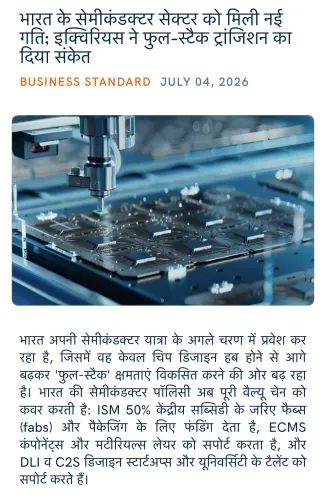
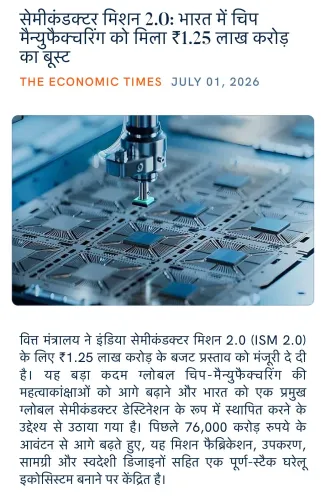
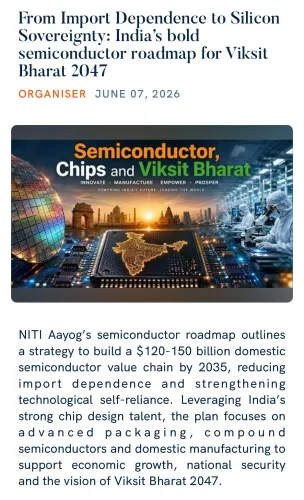
Giriraj Singh flags India chip startups crossing into production
Synopsis
Union Textiles Minister Giriraj Singh on June 2, 2026 amplified a report showing Indian semiconductor startups have moved from prototype to commercial production, underscoring progress under the Rs 76,000 crore India Semiconductor Mission and the broader Atmanirbhar Bharat drive for chip self-reliance.
Key Takeaways
Giriraj Singh shared a report on June 2, 2026 highlighting Indian chip startups entering commercial production.
The India Semiconductor Mission , approved in December 2021 with an outlay of Rs 76,000 crore , underpins the ecosystem.
The PLI scheme for semiconductors, launched in 2020 , provides additional financial incentives for domestic and foreign manufacturers.
Micron Technology announced an assembly and testing plant in Sanand, Gujarat in 2023 as a marquee ISM investment.
India's chip push is driven by a strategic need to reduce dependence on Taiwan and South Korea following pandemic-era supply shocks.
Commercial-scale domestic chip production could strengthen India's semiconductor diplomacy with the US and EU .
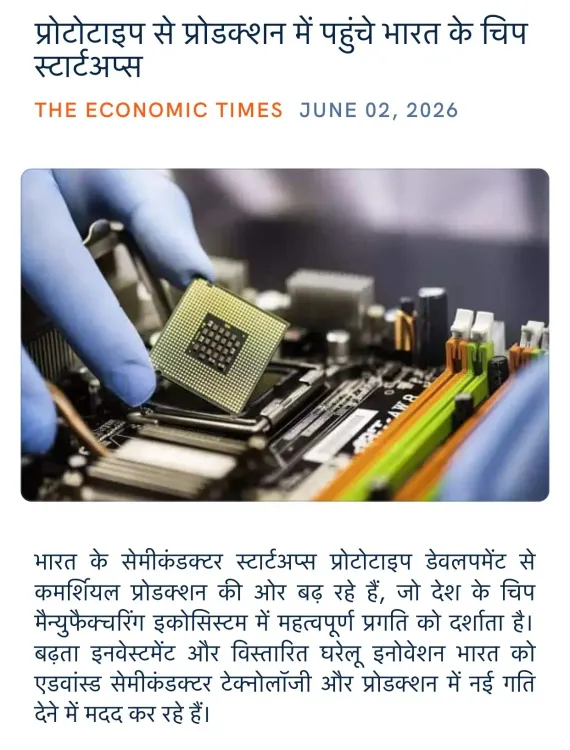
Union Textiles Minister Giriraj Singh on Tuesday, June 2, 2026 shared a report highlighting that Indian semiconductor startups have moved beyond the prototype stage and are now entering commercial production, signalling a tangible shift in the country's chip manufacturing ambitions.
Context
The post, shared via the NaMo App, carried the headline 'प्रोटोटाइप से प्रोडक्शन में पहुंचे भारत के चिप स्टार्टअप्स' — 'India's chip startups have moved from prototype to production' — pointing to a report on domestic semiconductor ventures graduating to full-scale manufacturing. While the minister's primary portfolio is textiles, senior BJP leaders routinely amplify technology and self-reliance milestones as part of the broader Atmanirbhar Bharat narrative.
The development, if confirmed at scale, would mark a meaningful inflection point for India's semiconductor ecosystem, which has historically been limited to chip design rather than fabrication or mass production.
Policy Backdrop
India's semiconductor push is anchored in the India Semiconductor Mission (ISM), approved by the Union Cabinet in December 2021 with an outlay of Rs 76,000 crore. The mission provides incentives for chip fabrication, assembly, testing, marking, and packaging units, aiming to build an end-to-end domestic supply chain.
The Production Linked Incentive (PLI) scheme, launched in 2020 for electronics and later extended to semiconductors, further sweetened the investment case for both domestic startups and global players. Micron Technology, the US-based semiconductor firm, announced an assembly and testing facility in Sanand, Gujarat in 2023 under the ISM framework, providing a high-profile anchor for the ecosystem.
These policy instruments were designed in direct response to the global chip shortage exposed during the COVID-19 pandemic, which laid bare India's dependence on concentrated suppliers in Taiwan and South Korea.
Stakeholders and Impact
The transition from prototype to production is the most capital-intensive and technically demanding leap for any semiconductor startup, requiring cleanroom infrastructure, yield management, and reliable supply chains for raw materials. Indian chip startups clearing this threshold would signal that the ISM's financial incentives are producing operational results, not merely investment announcements.
For the broader electronics manufacturing sector, domestic chip production reduces input-cost volatility tied to global supply disruptions and currency fluctuations. Smaller downstream manufacturers — particularly in consumer electronics, automotive components, and industrial automation — stand to benefit from locally sourced chips with shorter lead times.
The development also carries strategic weight: a domestic production capability, even at modest scale, strengthens India's position in ongoing semiconductor diplomacy with the United States and the European Union, both of which are actively seeking to diversify supply chains away from East Asia.
What's Next
Attention will now turn to the scale and commercial viability of these production runs, and whether ISM-approved projects can sustain yields competitive with established Asian manufacturers. Analysts and industry observers will watch for any additional incentives or partnership announcements in the next Union Budget or electronics policy review. A credible pipeline of startups reaching full commercial output could accelerate further foreign direct investment into India's chip ecosystem and cement the country's place in the global semiconductor value chain.
Point of View
If sustained, would validate the ISM's incentive architecture and give the government a concrete deliverable to cite ahead of the next electoral cycle. However, the credibility of the milestone will depend on verified production volumes and yield data, which remain unconfirmed. The broader pattern suggests India is moving from policy announcements to early operational proof points in deep-tech manufacturing, a shift that could reshape investor sentiment toward the sector.
NationPress
16 Oct 2026
Frequently Asked Questions
What is the India Semiconductor Mission?
The India Semiconductor Mission is a government scheme approved in December 2021 with an outlay of Rs 76,000 crore to build a domestic semiconductor ecosystem covering chip fabrication, assembly, testing, and packaging.
Why did Giriraj Singh share a chip startup report if he is the Textiles Minister?
Senior BJP ministers routinely share technology and self-reliance milestones as part of the Atmanirbhar Bharat communication strategy, regardless of their specific portfolio.
Which foreign company has invested in India's semiconductor sector under ISM?
Micron Technology, the US-based semiconductor firm, announced an assembly and testing facility in Sanand, Gujarat in 2023 under the India Semiconductor Mission framework.
What does prototype to production mean for chip startups?
It means a startup has moved beyond building and testing a single working chip design and is now manufacturing chips at commercial scale, which requires significantly more infrastructure, capital, and process control.
How does India's chip push reduce import dependence?
By building domestic fabrication and assembly capacity, India aims to reduce reliance on concentrated chip suppliers in Taiwan and South Korea, which were disrupted during the COVID-19 pandemic.