CM Bhupendra Patel Backs India's Rs 1.25 Lakh Crore Chip Push
Synopsis
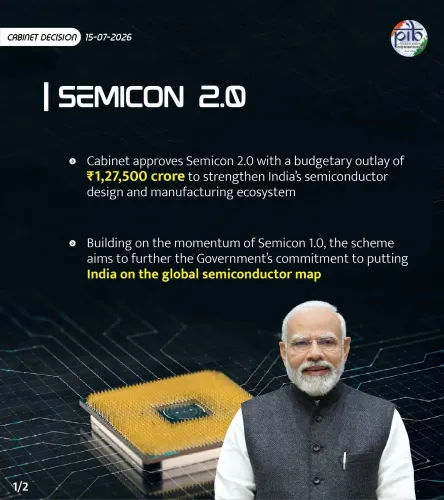
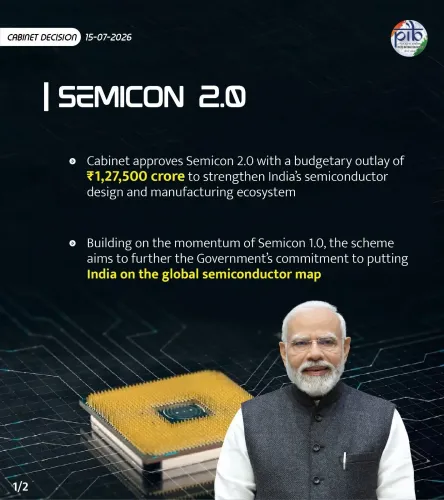
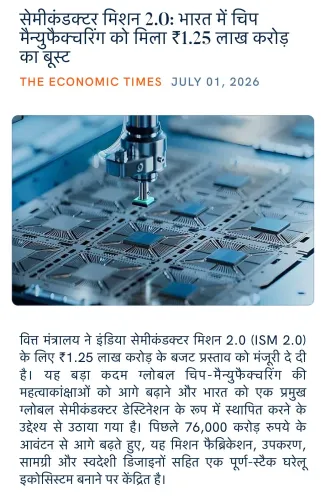
Gujarat Chief Minister Bhupendra Patel has amplified news of Semiconductor Mission 2.0, a reported Rs 1.25 lakh crore initiative to deepen India's domestic chip manufacturing capabilities, building on the original Rs 76,000 crore Semicon India programme launched in 2021.
Key Takeaways
Gujarat CM Bhupendra Patel shared news of Semiconductor Mission 2.0 on 2 July 2026 via the NaMo App .
The initiative is reported to carry an outlay of Rs 1.25 lakh crore , substantially larger than the original Rs 76,000 crore Semicon India programme approved in December 2021 .
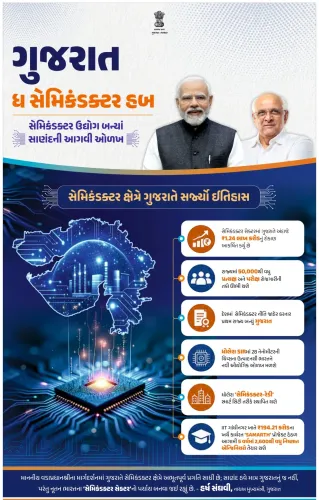
Gujarat has been a leading state in attracting semiconductor and electronics investments under national schemes.
The mission aligns with India's Atmanirbhar Bharat strategy to reduce dependence on East Asian chip suppliers.
India's approach mirrors similar large-scale semiconductor policies adopted by the United States , European Union , and Japan .
Cabinet approval and scheme notification remain key milestones before the expanded outlay is operationalised.
Gujarat Chief Minister Bhupendra Patel on Thursday, 2 July 2026 shared news of Semiconductor Mission 2.0, a proposed Rs 1.25 lakh crore initiative aimed at accelerating India's domestic chip manufacturing ambitions, amplifying the announcement through the NaMo App.
Context
The post, shared from CM Patel's official X account, highlights what is being described as a major scaling-up of India's semiconductor self-reliance agenda. The Rs 1.25 lakh crore figure represents a significant expansion over the original Semicon India programme, which was approved by the Union Cabinet in December 2021 with an outlay of Rs 76,000 crore. That earlier scheme was designed to incentivise semiconductor fabrication, display manufacturing, and chip design across the country.
Gujarat, which CM Patel has governed since September 2021, has been one of the most active states in attracting semiconductor and electronics investments under the national framework, positioning itself alongside Assam as an emerging node in India's chip supply chain.
Policy Backdrop
India's semiconductor push sits within the broader Atmanirbhar Bharat framework, which seeks to reduce the country's heavy dependence on a handful of East Asian suppliers for critical electronic components. The original Semicon India programme combined fiscal incentives — including capital subsidies of up to 50 per cent — with state-level facilitation on land, power, and approvals.
The Production Linked Incentive (PLI) scheme for large-scale electronics, notified in April 2020, was subsequently expanded to include semiconductor components, creating a layered policy architecture. Semiconductor Mission 2.0 is reported to build on these foundations with a substantially larger financial commitment, reflecting both the capital intensity of chip fabrication and India's intent to move beyond assembly into deeper manufacturing.
India's strategy mirrors industrial policies adopted by the United States, the European Union, and Japan, all of which have launched large-scale domestic semiconductor programmes to diversify global production away from concentrated manufacturing locations.
Stakeholders and Impact
The semiconductor supply chain spans a wide set of stakeholders: global and domestic chip designers, wafer fabrication equipment suppliers, chemical and materials companies, and downstream electronics manufacturers. States like Gujarat stand to benefit directly through industrial investment, employment generation, and integration into global electronics supply chains.
CM Patel's amplification of the announcement underscores Gujarat's positioning as a preferred destination for high-technology manufacturing. The state has already hosted announcements related to semiconductor assembly and testing facilities, and a larger national outlay could accelerate further project commitments within its borders.
For electronics manufacturers operating in India, a well-funded Semiconductor Mission 2.0 could reduce input costs over time by enabling domestic sourcing of chips currently imported at significant foreign-exchange cost.
What's Next
Formal Union Cabinet approval and a detailed scheme notification will be key milestones to watch, as will the pace of approvals for fabrication units already announced under the earlier Semicon India programme. Progress on greenfield fab projects in Gujarat and other states will serve as an early indicator of whether the expanded financial commitment translates into on-ground momentum.
If the Rs 1.25 lakh crore outlay is operationalised at scale, it could mark a structural shift in India's electronics manufacturing value chain — moving the country closer to the kind of end-to-end chip ecosystem that currently exists only in a handful of nations worldwide.
Point of View
If formalised, would represent the single largest sectoral industrial commitment in post-liberalisation India, reflecting how central chip sovereignty has become to the ruling dispensation's economic narrative. For the BJP, semiconductor policy serves a dual purpose: it projects technological nationalism domestically while signalling supply-chain reliability to global investors. The real test, however, will be execution speed — India's earlier semiconductor announcements have faced delays between cabinet approval and ground-breaking, a gap that Mission 2.0 will need to close to be credible.
NationPress
1 Oct 2026
Frequently Asked Questions
What is Semiconductor Mission 2.0 in India?
Semiconductor Mission 2.0 is a reported expansion of India's chip manufacturing policy, with a proposed outlay of Rs 1.25 lakh crore aimed at building domestic fabrication, assembly, and design capabilities — scaling up the original Rs 76,000 crore Semicon India programme launched in 2021.
Why did Gujarat CM Bhupendra Patel share the semiconductor mission news?
CM Bhupendra Patel shared the news to highlight India's growing semiconductor ambitions and Gujarat's role as a key investment destination, amplifying the announcement through the NaMo App on 2 July 2026.
How much is India investing in semiconductor manufacturing under Mission 2.0?
Semiconductor Mission 2.0 is reported to involve an outlay of Rs 1.25 lakh crore, compared to the Rs 76,000 crore committed under the original Semicon India programme approved in December 2021.
What is the original Semicon India programme?
The Semicon India programme was approved by the Union Cabinet in December 2021 with an outlay of Rs 76,000 crore to incentivise semiconductor fabrication, display manufacturing, and chip design through capital subsidies and state-level facilitation.
Which states benefit from India's semiconductor policy?
Gujarat and Assam have emerged as leading states under India's semiconductor policy, attracting announcements for assembly, testing, and fabrication facilities supported by national incentives and state-level land and power facilitation.