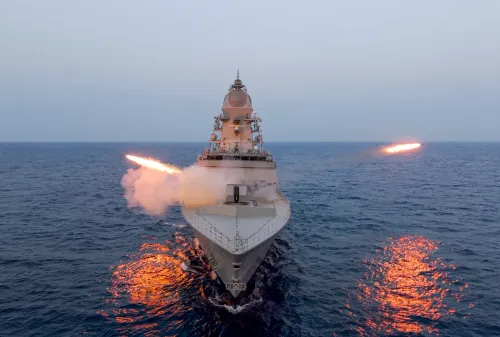
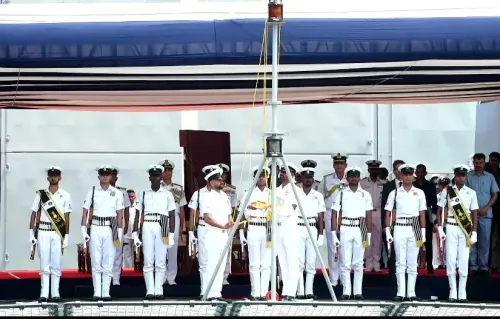
Giriraj Singh hails INS Mahendragiri commissioning as step toward 200-ship Navy
Synopsis
Union Textiles Minister Giriraj Singh on 12 July 2026 celebrated the commissioning of INS Mahendragiri, a Project 17A Nilgiri-class stealth frigate, calling it a landmark advance in India's drive to build a self-reliant 200-ship Navy under the Atmanirbhar Bharat initiative.
Key Takeaways
Union Textiles Minister Giriraj Singh posted on 12 July 2026 hailing the commissioning of INS Mahendragiri as a milestone toward a 200-ship Atmanirbhar Navy.
INS Mahendragiri is a Nilgiri-class stealth frigate built under Project 17A , a 2019 -approved programme for seven indigenously built frigates.
India's stated target is a 200-ship Navy by the mid-2030s , anchored in domestically constructed warships.
The Atmanirbhar Bharat Abhiyan , launched in May 2020 , set the policy framework for high indigenous content in defence platforms including naval vessels.
Cross-ministry amplification of the commissioning reflects the BJP government's coordinated Atmanirbhar communications strategy.
Commissioning timelines of remaining Project 17A frigates will be a key indicator of progress toward India's naval force-level goals.
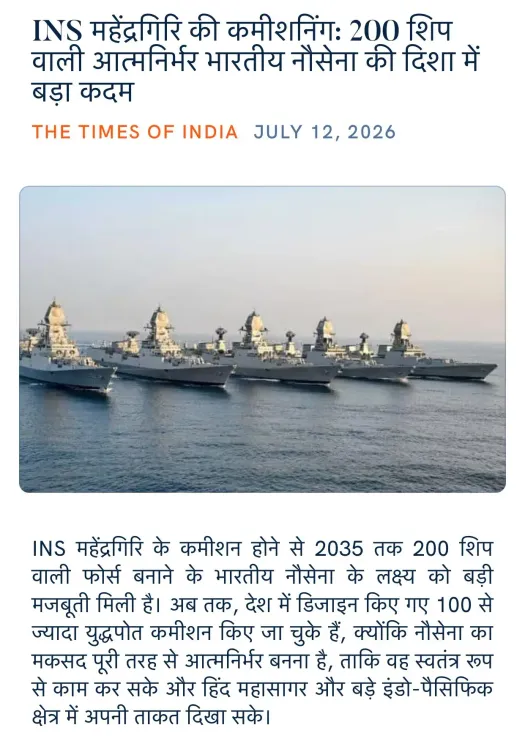
Union Textiles Minister Giriraj Singh on Sunday, 12 July 2026 shared a post on X celebrating the commissioning of INS Mahendragiri, calling it a major step toward building a self-reliant, 200-ship Indian Navy. The minister framed the milestone as a tangible advance in India's Atmanirbhar Bharat vision for indigenous defence manufacturing.
Context
In his post, Giriraj Singh described the commissioning as '200 shiv wali atmanirbhar Bharatiya Nausena ki disha mein bada kadam' — 'a big step toward a self-reliant Indian Navy of 200 ships.' Though Singh holds the Textiles portfolio, his amplification of the event underscores the whole-of-government effort to broadcast Atmanirbhar Bharat milestones across ministries and social media platforms.
INS Mahendragiri is a Nilgiri-class stealth frigate built under Project 17A, a programme approved in 2019 for the construction of seven advanced stealth frigates entirely within Indian shipyards. The vessel's name is drawn from the Mahendragiri hills in southern India, continuing the Navy's tradition of naming warships after Indian geographical features.
Policy Backdrop
Project 17A is a cornerstone of India's push to reduce dependence on foreign warship imports. The programme was sanctioned with a mandate for high indigenous content, aligning with the broader Atmanirbhar Bharat Abhiyan announced in May 2020. Successive defence budgets have progressively raised the minimum indigenous content threshold for naval platforms, making programmes like Project 17A both a strategic and industrial priority.
India's stated goal of operating a 200-ship Navy by the mid-2030s requires a sustained pipeline of domestically built vessels. Frigates, destroyers, and submarines being built at yards such as Mazagon Dock Shipbuilders Limited (MDL) in Mumbai and Garden Reach Shipbuilders and Engineers (GRSE) in Kolkata are central to that ambition. Each commissioning under Project 17A is therefore tracked as a benchmark for the broader force-level target.
Stakeholders and Impact
The Indian Navy gains enhanced blue-water capability with each Nilgiri-class frigate that enters service, strengthening sea-lane protection and power projection in the Indian Ocean Region. The commissioning also signals continued work for domestic defence-industrial units, supporting thousands of skilled jobs in shipbuilding and ancillary manufacturing sectors.
For the ruling BJP, milestones under Atmanirbhar Bharat serve as political proof-points of economic self-reliance. Cross-ministry amplification — a Textiles Minister posting about a Navy commissioning — reflects a coordinated communications strategy to keep the self-reliance narrative prominent in public discourse ahead of ongoing parliamentary sessions.
What's Next
Attention will now shift to the commissioning timelines of the remaining Project 17A frigates still under construction. Parliamentary committees on defence are expected to seek updates on force-level goals and the indigenous content ratios achieved in each vessel. The Navy's trajectory toward its 200-ship target will depend on whether shipyard production schedules hold and whether budgetary allocations in successive Union Budgets continue to prioritise naval capital expenditure.
As India's maritime ambitions grow in an increasingly contested Indo-Pacific environment, each indigenous warship commissioned reinforces both strategic depth and the credibility of the Atmanirbhar defence manufacturing ecosystem.
Point of View
Ensuring the self-reliance message saturates multiple political audiences simultaneously. INS Mahendragiri's induction under Project 17A is a genuine industrial milestone, but its political packaging as proof of the 200-ship vision also serves to pre-empt opposition critiques about delayed defence procurement timelines. The post's framing — 'a big step' rather than 'the achievement' — is calibrated, acknowledging distance still to travel while claiming momentum. Watching whether parliamentary scrutiny of remaining Project 17A delivery dates matches the celebratory tone will reveal whether the milestone is as schedule-compliant as the messaging implies.
NationPress
11 Oct 2026
Frequently Asked Questions
What is INS Mahendragiri?
INS Mahendragiri is a Nilgiri-class stealth frigate built under Project 17A, a programme approved in 2019 for seven indigenously constructed advanced frigates for the Indian Navy.
What is Project 17A?
Project 17A is an Indian Navy programme sanctioned in 2019 for the construction of seven stealth frigates entirely in Indian shipyards, with a high indigenous content mandate under the Atmanirbhar Bharat framework.
What is India's 200-ship Navy goal?
India aims to operate a fleet of 200 warships by the mid-2030s through a combination of indigenously built vessels and select imports, with programmes like Project 17A central to achieving that target.
Why is Giriraj Singh, a Textiles Minister, posting about a Navy commissioning?
Giriraj Singh's post reflects the BJP government's cross-ministry amplification of Atmanirbhar Bharat milestones, using ministers across portfolios to broaden the reach of the self-reliance narrative on social media.
What is Atmanirbhar Bharat Abhiyan in defence?
Atmanirbhar Bharat Abhiyan, announced in May 2020, is India's national self-reliance initiative that in defence mandates higher indigenous content for military platforms, prioritising domestic shipyards, manufacturers, and technology developers.