Sitharaman Highlights India's STEM and AVGC Push at Aix Forum
Synopsis
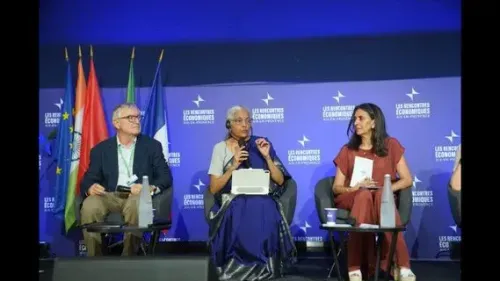
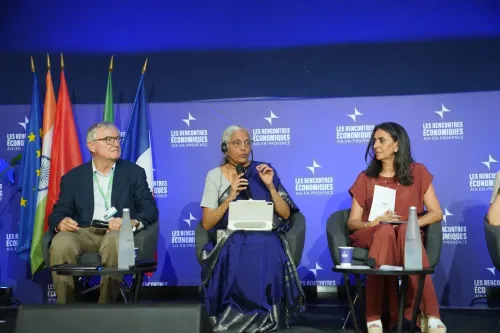
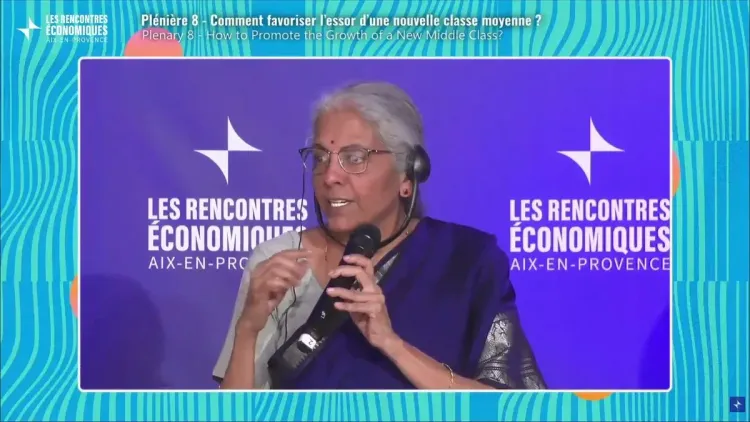
Union Finance Minister Nirmala Sitharaman, speaking at the Rencontres Économiques d'Aix-en-Provence in France, said India has consistently used successive Union Budgets to strengthen STEM education and future-ready sectors like AVGC, framing these investments as central to developing the country's youth workforce.
Key Takeaways
Finance Minister Nirmala Sitharaman addressed the Rencontres Économiques d'Aix-en-Provence on 3 July 2026 , highlighting India's education and skilling priorities.
She said successive Union Budgets have progressively increased support for STEM education and future-ready sectors.
The AVGC sector — Animation, Visual Effects, Gaming and Comics — was specifically cited as a focus area for youth employment and global competitiveness.
India's skilling push is rooted in the National Education Policy 2020 and the Skill India mission launched in 2014 .
The international forum provided a platform to signal policy continuity and attract global partnerships in education and creative industries.
Union Finance Minister Nirmala Sitharaman on Friday, 3 July 2026, told an international audience at the Rencontres Économiques d'Aix-en-Provence in France that successive Union Budgets have progressively strengthened education and skilling for India's youth, with particular emphasis on STEM education and future-ready sectors such as Animation, Visual Effects, Gaming and Comics (AVGC).
Context
Speaking at one of Europe's most prominent annual economics forums, Sitharaman underscored a multi-budget commitment to aligning India's workforce with the demands of a knowledge economy. 'Budget after budget, India has strengthened education and skilling of the youth through greater support for STEM education and future-ready sectors like AVGC,' she said, according to a post on her official X account.
The Rencontres Économiques d'Aix-en-Provence brings together heads of state, finance ministers, central bank governors and business leaders from across the world each year, making it a high-visibility platform for India to project its economic policy direction to a global audience.
Policy Backdrop
India's focus on STEM and creative industries is rooted in the National Education Policy 2020, which prioritised multidisciplinary learning, vocational training and the integration of emerging technologies into mainstream curricula. Successive Union Budgets since 2014 have raised allocations for school and higher education as well as skill-development programmes under the Skill India mission.
The AVGC sector — covering animation, visual effects, gaming and comics — has been explicitly called out in recent budgets as a high-growth, employment-generating industry with strong export potential. A dedicated AVGC Task Force was constituted to draw up a national action plan, positioning India as a global hub for creative-technology services.
These investments are framed within a broader demographic argument: with the largest youth population in the world, India's long-term growth trajectory depends on converting that demographic into a skilled, productive workforce capable of competing in global technology and creative markets.
Stakeholders and Impact
The direct beneficiaries of these policies span millions of students enrolled in STEM programmes at central universities, IITs, IIITs and polytechnics, as well as trainees under skill-development schemes. The AVGC industry — comprising domestic studios, gaming start-ups and post-production firms — stands to gain from sustained budgetary support and the policy attention that international advocacy generates.
Global investors and partner governments present at Aix-en-Provence are a secondary audience: the Finance Minister's remarks signal policy continuity and invite collaboration in education technology, creative industries and workforce partnerships with Indian institutions.
What's Next
Attention will now turn to whether the Aix-en-Provence engagements yield concrete bilateral or multilateral agreements on education and skilling cooperation. Domestically, the trajectory of STEM and AVGC allocations in the next Union Budget will be the clearest indicator of how firmly these sectors remain at the centre of India's human-capital strategy. Any follow-up announcements from the Finance Ministry on AVGC task-force recommendations will be closely watched by the creative-technology industry.
Point of View
Using high-profile global forums to reinforce the message of a reform-oriented, investment-friendly economy. The explicit mention of AVGC alongside STEM signals that the government views the creative-technology sector not as a niche but as a mainstream pillar of its human-capital agenda. This framing also serves a domestic political purpose: positioning the BJP-led government as the architect of a forward-looking education and skilling ecosystem ahead of future electoral cycles. The consistency of the messaging across multiple budgets suggests this is a durable policy commitment rather than a one-off announcement.
NationPress
2 Oct 2026
Frequently Asked Questions
What did Nirmala Sitharaman say at Aix-en-Provence about education?
Sitharaman said that budget after budget, India has strengthened education and skilling for its youth through greater support for STEM education and future-ready sectors like AVGC — Animation, Visual Effects, Gaming and Comics.
What is the AVGC sector in India?
AVGC stands for Animation, Visual Effects, Gaming and Comics. The Indian government has promoted it as a high-growth, employment-generating creative-technology industry with strong export potential, and a dedicated task force was set up to develop a national action plan for the sector.
What is the Rencontres Économiques d'Aix-en-Provence?
It is an annual international economics forum held in Aix-en-Provence, France, that brings together global policymakers, central bankers and business leaders to discuss major economic issues.
How has India's budget supported STEM education over the years?
Successive Union Budgets since 2014 have raised allocations for school and higher education and skill-development programmes. The National Education Policy 2020 also prioritised multidisciplinary STEM learning and vocational training.
Why is India focusing on AVGC in its budget policy?
India sees the AVGC sector as a way to harness its large youth population, generate skilled employment and build export-competitive creative industries, aligning workforce capabilities with growing global demand for animation, gaming and visual-effects services.