Sitharaman marks 9 years of GST, highlights Next-Gen upgrades
Synopsis
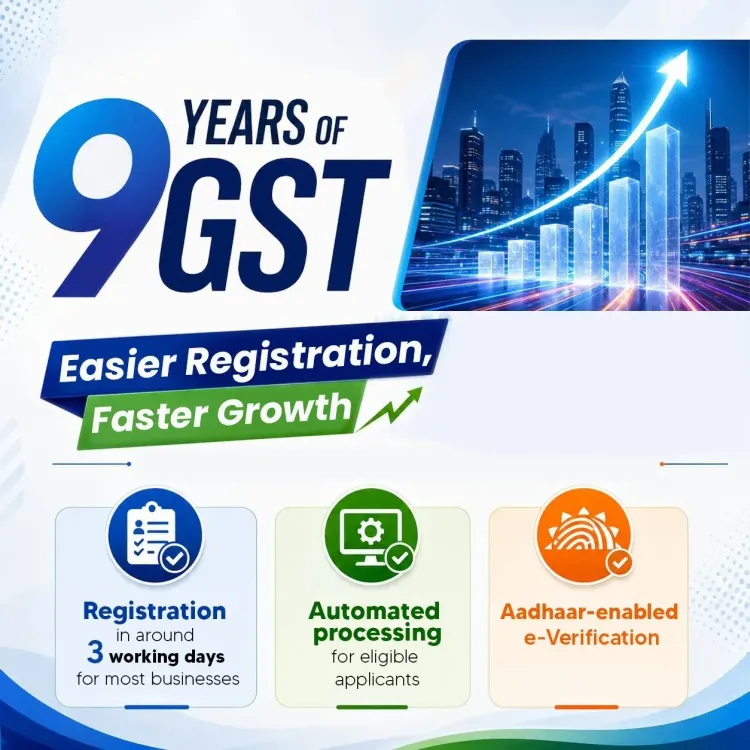
Union Finance Minister Nirmala Sitharaman marked nine years of GST on 1 July 2026, crediting Next-Gen GST with cutting registration time to as little as three days and introducing Aadhaar-based e-verification to simplify compliance for businesses across India.
Key Takeaways
GST completed nine years on 1 July 2026 , having been launched nationwide on 1 July 2017 .
Finance Minister Nirmala Sitharaman highlighted the 'Next-Gen GST' initiative as a key driver of ease of doing business.
New registrations can be completed in as little as three days for most businesses under the upgraded system.
Aadhaar-enabled e-verification has been introduced to automate and secure the GST registration process.
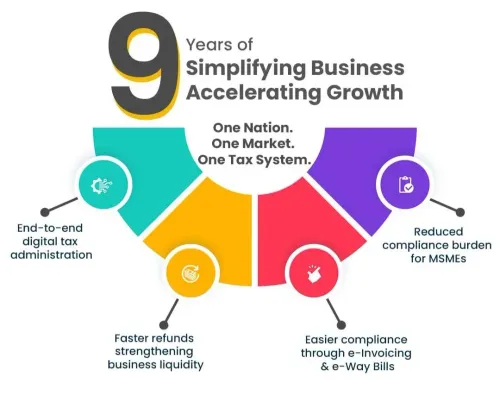
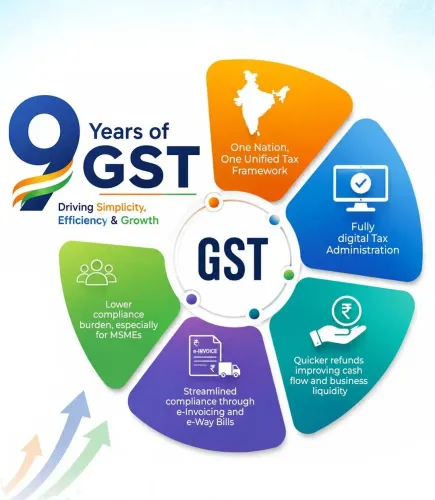
The reforms build on a decade-long digitisation push that includes e-invoicing, simplified returns, and faceless processing.
MSMEs and first-time registrants are among the primary beneficiaries of reduced compliance burdens.
Union Finance Minister Nirmala Sitharaman on Wednesday, 1 July 2026 marked the ninth anniversary of the Goods and Services Tax (GST), highlighting how the 'Next-Gen GST' initiative has transformed India's indirect tax architecture through faster registration and automated processing.
Context
GST was rolled out across India on 1 July 2017, replacing a fragmented web of central and state levies — including central excise duty, service tax, and value-added tax — with a single destination-based unified levy. The reform is widely regarded as one of the most significant restructurings of India's indirect tax system since independence. Each subsequent anniversary has served as an occasion for the government to catalogue incremental improvements to the framework.
In her post on X, Sitharaman stated that Next-Gen GST has brought 'easier registration and automated processing,' with businesses able to complete registration 'in as little as three days.' She also flagged Aadhaar-enabled e-verification as a key feature driving the system's modernisation. The hashtag #9YearsOfGST accompanied the post.
Policy Backdrop
The GST Network (GSTN), set up as the IT backbone as early as 2013 and subsequently converted into a government company, underpins registration, return filing, and payment processing for all taxpayers on the platform. Over the years, the government has layered on successive reforms: mandatory e-invoicing for larger businesses, simplified return formats, and Aadhaar-based authentication to reduce physical touchpoints and curb fraudulent registrations.
The shift toward faceless, automated processing mirrors a broader digitisation push in Indian tax administration, which also includes faceless assessment under the direct-tax regime and electronic compliance tools under the Insolvency and Bankruptcy Code (IBC). Together, these reforms form the operational core of India's ease-of-doing-business agenda over the past decade.
Stakeholders and Impact
The most direct beneficiaries of faster registration and Aadhaar-linked e-verification are MSMEs (Micro, Small and Medium Enterprises) and first-time business registrants, who previously faced lengthy paper-intensive processes. Reducing the compliance burden for smaller enterprises has been a stated priority of successive GST Council meetings, where both the Centre and states are represented.
Larger businesses benefit from automated processing through reduced manual intervention, lower error rates in returns, and faster input tax credit reconciliation. The cumulative effect, the government argues, is a more transparent and predictable indirect tax environment that supports investment and formalisation of the economy.
What's Next
Attention now turns to the next GST Council meeting, where decisions on rate rationalisation and further portal upgrades are expected to feature on the agenda. Any announcements on GST reform are also likely to find mention in the forthcoming Union Budget speech, as the government looks to sustain momentum on tax simplification. The trajectory of Next-Gen GST upgrades — particularly around real-time analytics and AI-driven compliance nudges — will be closely watched by industry bodies and state finance departments alike.
Point of View
Framing incremental administrative upgrades as evidence of a maturing reform. By foregrounding speed — 'as little as three days' — and biometric authentication, the government signals a shift from the rocky early years of GST, marked by portal outages and compliance confusion, toward a more confident, tech-led narrative. The 'Next-Gen GST' label is itself a political choice: it resets the conversation from legacy grievances to future-readiness. With rate rationalisation still pending and the next Union Budget on the horizon, this anniversary marks as much a political staging post as a policy milestone.
NationPress
1 Jul 2026
Frequently Asked Questions
What is Next-Gen GST in India?
Next-Gen GST refers to the upgraded Goods and Services Tax system in India that features automated processing, faster registration timelines of as little as three days for most businesses, and Aadhaar-enabled e-verification to simplify compliance.
How many years has GST completed in India?
GST completed nine years on 1 July 2026 , having been launched across India on 1 July 2017 as a unified indirect tax replacing multiple central and state levies.
How fast is GST registration under the new system?
Under the Next-Gen GST system, most businesses can complete their GST registration in as little as three days , a significant reduction from earlier timelines.
What is Aadhaar e-verification for GST?
Aadhaar e-verification for GST allows applicants to authenticate their identity digitally using India's biometric identity platform, replacing physical document submission and reducing the scope for fraudulent registrations.
What did Nirmala Sitharaman say about GST on its 9th anniversary?
Finance Minister Nirmala Sitharaman posted on X that Next-Gen GST has 'transformed India's indirect tax system with easier registration and automated processing,' highlighting three-day registration and Aadhaar-enabled e-verification as key milestones.