Smriti Irani Launches Two Public Health Reports at IIM Bangalore
Synopsis
BJP leader Smriti Irani launched two research reports at the EPHP Conference 2026 at IIM Bangalore on June 8, covering technology-driven Universal Health Coverage and the promise of Ayushman Aarogya Mandirs, alongside ICMR's Additional Director General Dr. Sanghamitra Pati.
Key Takeaways
Two reports launched at the EPHP Conference 2026 at IIM Bangalore on June 8, 2026 under the Women's Collective Forum's Advancing Public Health Outcomes initiative.
Report one, by the National Disease Modelling Consortium and IIT Bombay , addresses technology's role in achieving Universal Health Coverage .
Report two, by IIM Bangalore , IIM Udaipur , IIM Shillong , and IIM Ranchi , examines the potential of Ayushman Aarogya Mandirs for last-mile care.
Smriti Irani participated in her capacity as Advisor to the Women's Collective Forum , alongside Dr.
Sanghamitra Pati of ICMR .
The reports build on the Ayushman Bharat programme (2018) , the National Health Policy (2017) , and the National Digital Health Mission (2020) .
State health departments and NHM planners are the key audience for translating research findings into budgets and programme plans.
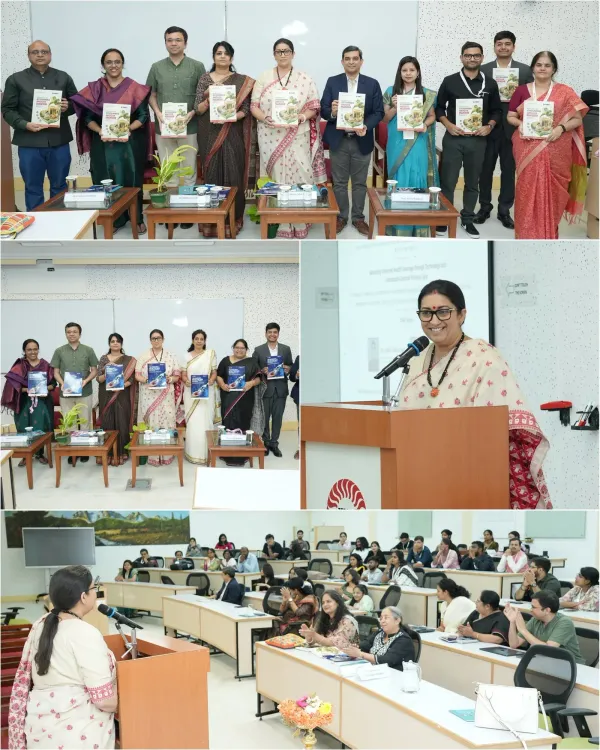
BJP leader Smriti Irani, serving as Advisor to the Women's Collective Forum, addressed public health leaders at the EPHP Conference 2026 hosted by IIM Bangalore on Monday, June 8, 2026, and launched two research reports under the Forum's Advancing Public Health Outcomes initiative alongside Dr. Sanghamitra Pati, Additional Director General, ICMR.
What Was Launched
The first report, 'Technology for Healthcare: India's Mantra for Universal Health Coverage', was prepared by the National Disease Modelling Consortium in collaboration with IIT Bombay. It examines how technology and data-driven disease modelling can be leveraged to advance Universal Health Coverage across India.
The second report, 'Healthcare at Your Doorstep: The Promise of Ayushman Aarogya Mandirs', was prepared by IIM Bangalore in collaboration with IIM Udaipur, IIM Shillong, and IIM Ranchi. It focuses on the role of Ayushman Aarogya Mandirs — the primary healthcare centres established under the Ayushman Bharat programme — in delivering last-mile health services.
Context
The Ayushman Bharat programme was launched in 2018 with a dual mandate: expand financial health protection and convert sub-centres and primary health centres into Health and Wellness Centres, later rebranded as Ayushman Aarogya Mandirs. These facilities are designed to deliver comprehensive primary care, including maternal health, non-communicable disease screening, and telemedicine services.
The National Health Policy of 2017 had earlier set the framework for universal health coverage, while the National Digital Health Mission, launched in 2020, pushed for technology integration and unified health data infrastructure. The two reports launched at IIM Bangalore sit squarely within this evolving policy continuum.
Policy Backdrop
Irani, speaking at the conference, stated: 'The true value of research lies in its ability to drive meaningful change.' She noted that the reports provide insights into how 'technology, disease modelling and data-driven decision-making can complement strong primary healthcare institutions such as Ayushman Aarogya Mandirs in advancing Universal Health Coverage in India.'
Her remarks underscored a recurring theme in India's health governance: bridging the gap between evidence and implementation, particularly at the last mile. India's institutional capacity — spanning premier research bodies like ICMR and technical institutions like IIT Bombay — has increasingly been channelled into producing actionable health policy research.
Stakeholders and Impact
The reports are directed at state health departments, district health planners, and policymakers responsible for operationalising National Health Mission programme implementation plans. Primary care patients — particularly in rural and peri-urban areas — stand to benefit if the modelling outputs and doorstep-care frameworks are adopted at scale.
The involvement of four IIMs and IIT Bombay in producing the reports signals an effort to ground health policy recommendations in rigorous academic and quantitative analysis, rather than administrative prescription alone.
What's Next
Attention will now turn to whether state governments and central health planners incorporate the findings into annual NHM Programme Implementation Plans and health budget allocations. Irani's call to 'move from evidence to action' places the onus on administrative machinery to translate the research into on-ground improvements in healthcare delivery — with equity and dignity as the stated benchmarks.
Point of View
Anchored in institutions like ICMR and four IIMs, lends technocratic credibility to the Women's Collective Forum's public health agenda. The emphasis on 'evidence to action' is a pointed signal to state governments, which remain the primary implementers of Ayushman Bharat and NHM frameworks. Whether these reports influence actual budget allocations or remain in the citation ecosystem of policy documents will be the true measure of their impact.
NationPress
22 Sept 2026
Frequently Asked Questions
What is the EPHP Conference 2026?
The EPHP Conference 2026 is a public health leadership forum hosted at IIM Bangalore, where policymakers, researchers, and health administrators gather to discuss evidence-based approaches to healthcare delivery in India.
What are Ayushman Aarogya Mandirs?
Ayushman Aarogya Mandirs are Health and Wellness Centres established under the Ayushman Bharat programme launched in 2018, designed to deliver comprehensive primary healthcare services including maternal care, non-communicable disease screening, and telemedicine at the community level.
What did Smriti Irani launch at IIM Bangalore?
Smriti Irani launched two research reports: one on technology and Universal Health Coverage prepared by the National Disease Modelling Consortium and IIT Bombay, and another on Ayushman Aarogya Mandirs prepared by IIM Bangalore with IIM Udaipur, IIM Shillong, and IIM Ranchi.
What is the Women's Collective Forum?
The Women's Collective Forum is a civil society platform focused on advancing public health outcomes in India, for which Smriti Irani serves as Advisor.
How does India plan to achieve Universal Health Coverage?
India's approach combines the Ayushman Bharat programme's primary care infrastructure, the National Digital Health Mission's technology integration, and evidence-based planning through bodies like ICMR and the National Disease Modelling Consortium to reach universal health coverage goals set under the National Health Policy 2017.