Smriti Irani Marks 12 Years of India's Healthcare Overhaul
Synopsis
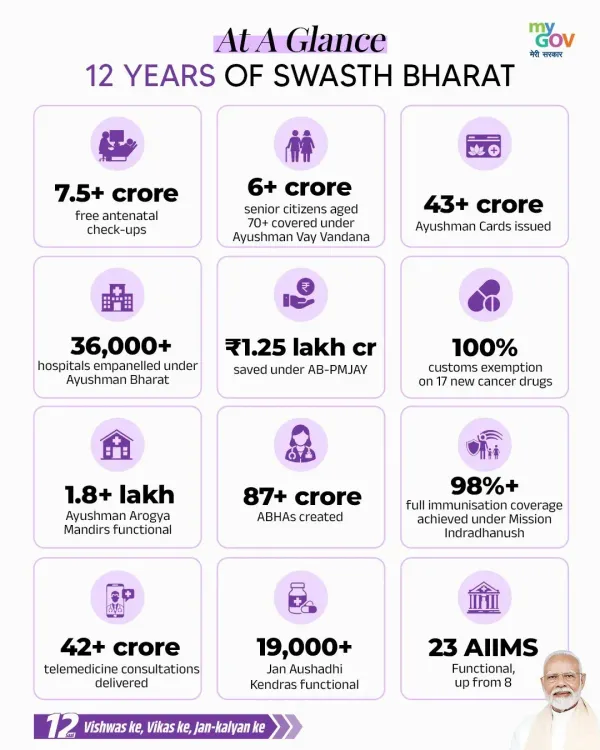
BJP leader Smriti Irani invoked the #12YearsOfSwasthBharat hashtag on June 14, 2026, highlighting India's healthcare transformation since 2014 — spanning Ayushman Bharat insurance, generic medicine networks, new AIIMS campuses, and a national digital health mission.
Key Takeaways
Smriti Irani posted on June 14, 2026 marking 12 years of India's healthcare journey under the #12YearsOfSwasthBharat campaign.
Ayushman Bharat PM-JAY , launched in 2018 , provides up to Rs 5 lakh annual hospitalisation coverage per family for low-income households.
The Pradhan Mantri Bharatiya Janaushadhi Pariyojana , expanded from 2015 , offers affordable generic medicines through a dedicated retail network.
New AIIMS campuses and medical colleges were approved and opened under the Pradhan Mantri Swasthya Suraksha Yojana to address tertiary-care and education gaps.
The Ayushman Bharat Digital Mission (announced 2020 ) aims to build digital health IDs, unified records, and telemedicine infrastructure nationwide.
Health Ministry scheme utilisation figures and new medical-college approvals are expected in the forthcoming Union Budget session .
BJP leader Smriti Irani on Sunday, June 14, 2026, highlighted what she described as a sweeping transformation of India's healthcare system over the past 12 years, citing expanded access, affordable medicines, digital health infrastructure, and world-class medical institutions as pillars of the country's health journey under the #12YearsOfSwasthBharat campaign.
Context
Irani's post frames the last 12 years — coinciding with the Narendra Modi-led government's tenure since 2014 — as a coherent 'Swasth Bharat' arc. Her statement, 'A healthier India is the foundation of a stronger India,' anchors the ruling party's narrative that health investment is central to national development. The hashtag #12YearsOfSwasthBharat signals a coordinated BJP communications push marking this milestone.
The framing brings together multiple policy strands — insurance, generic drugs, digital records, and tertiary infrastructure — under one umbrella, a pattern that has defined the party's health messaging since its return to power.
Policy Backdrop
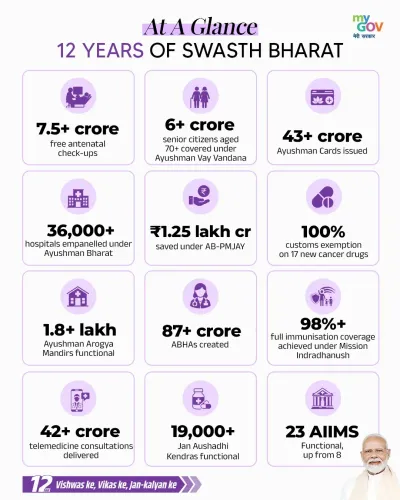
Ayushman Bharat Pradhan Mantri Jan Arogya Yojana, launched in 2018, is the flagship health insurance scheme offering up to Rs 5 lakh annual hospitalisation coverage per family, targeting low-income households. It remains one of the world's largest government-funded health assurance programmes by intended beneficiary count.
On the medicines front, the Pradhan Mantri Bharatiya Janaushadhi Pariyojana — strengthened from 2015 — expanded a network of outlets dispensing quality generic medicines at significantly lower prices than branded alternatives, aimed at reducing out-of-pocket expenditure for ordinary families. Simultaneously, the Pradhan Mantri Swasthya Suraksha Yojana drove the approval and opening of new All India Institutes of Medical Sciences (AIIMS) campuses and medical colleges across states, addressing both tertiary-care gaps and medical education capacity.
The Ayushman Bharat Digital Mission, announced in 2020, added a fourth dimension: building digital health IDs, unified patient records, and telemedicine infrastructure to connect citizens with healthcare providers remotely — a priority that gained urgency during the pandemic years.
Stakeholders and Impact
The primary beneficiaries of these stacked schemes are low-income families and rural patients who historically faced both financial and geographic barriers to quality care. Generic medicine outlets have reduced drug costs for millions, while new AIIMS campuses have expanded both patient access and seats for medical students in underserved regions.
The digital health mission's rollout has also created infrastructure for future integration — linking insurance eligibility, health records, and telemedicine consultations — though enrolment progress and utilisation depth remain subjects of ongoing policy scrutiny.
What's Next
Attention will turn to the forthcoming Union Budget session, where the Health Ministry is expected to release scheme utilisation figures and potentially announce new medical-college approvals. Progress on Ayushman Bharat Digital Mission enrolment targets will be a key indicator of how deeply the digital health layer has penetrated beyond urban centres.
The #12YearsOfSwasthBharat campaign is likely to serve as a platform for the BJP to consolidate its health-governance record ahead of future electoral cycles, making the data behind these schemes a contested political as much as a policy terrain.
Point of View
Branded 12-year arc just as the party prepares its next electoral pitch. By framing health as the 'foundation of a stronger India,' the messaging elevates welfare delivery into a civilisational argument, not merely a policy record. The choice of the #12YearsOfSwasthBharat hashtag suggests a coordinated party-wide communications exercise, likely timed to coincide with Budget-season announcements on scheme utilisation. The real test will be whether independent data on insurance claim settlements, medicine outlet reach, and digital health enrolments supports the sweep of the claim.
NationPress
23 Sept 2026
Frequently Asked Questions
What is #12YearsOfSwasthBharat?
#12YearsOfSwasthBharat is a BJP campaign hashtag marking 12 years of central government health initiatives since 2014, covering schemes such as Ayushman Bharat, the Janaushadhi generic medicine network, new AIIMS campuses, and the Ayushman Bharat Digital Mission.
What is Ayushman Bharat and who benefits from it?
Ayushman Bharat Pradhan Mantri Jan Arogya Yojana, launched in 2018, provides up to Rs 5 lakh annual health insurance coverage per family for secondary and tertiary hospitalisation, primarily targeting low-income and rural households.
What is the Pradhan Mantri Bharatiya Janaushadhi Pariyojana?
It is a central government scheme, strengthened from 2015, that runs a network of outlets selling quality generic medicines at prices significantly lower than branded drugs, aimed at reducing out-of-pocket health expenditure for ordinary citizens.
What is the Ayushman Bharat Digital Mission?
Announced in 2020, the Ayushman Bharat Digital Mission aims to create digital health IDs for citizens, unify patient health records, and build telemedicine infrastructure to connect patients with healthcare providers across India.
Why did Smriti Irani post about India's healthcare on June 14, 2026?
Irani's post aligns with the BJP's #12YearsOfSwasthBharat communications campaign, marking 12 years since the party came to power in 2014 and framing the cumulative health policy record as a coherent national achievement.