Smriti Irani Highlights 12 Years of Middle-Class Growth
Synopsis
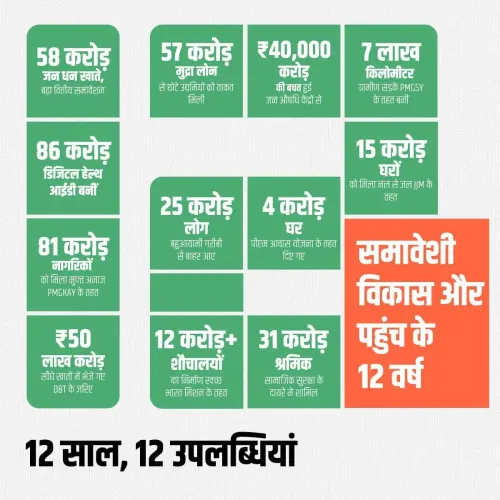
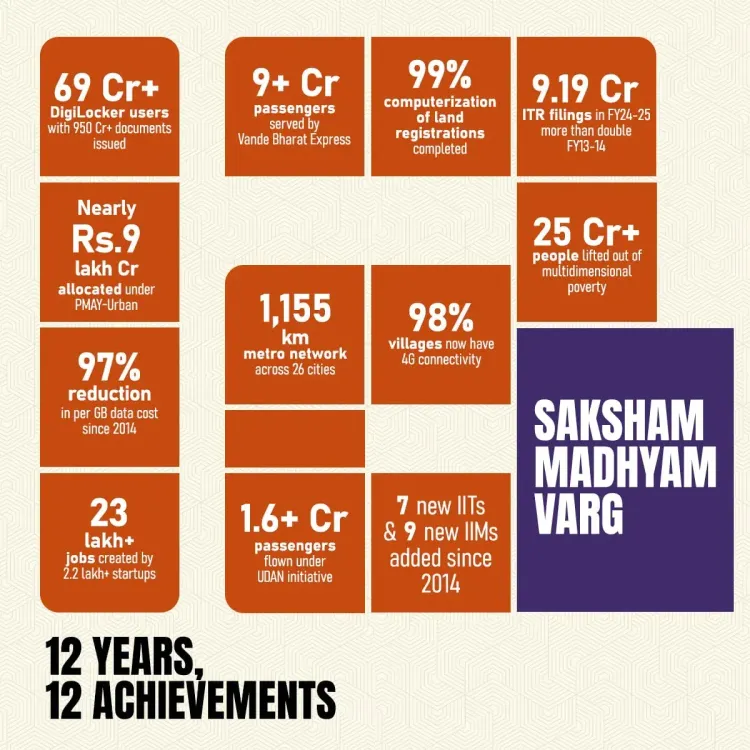
BJP leader Smriti Irani on June 15, 2026 credited twelve years of Modi government policies — spanning housing, highways, Startup India and Digital India — with strengthening the aspirations of India's middle class, using the hashtag #12YearsOfSakshamMiddleClass.
Key Takeaways
BJP leader Smriti Irani posted on June 15, 2026 highlighting twelve years of central government policies aimed at India's middle class.
Pradhan Mantri Awas Yojana , launched in June 2015 , provided housing support through interest subsidies and credit-linked schemes for middle- and lower-income groups.
Bharatmala Pariyojana , approved in October 2017 , targeted highway construction linking economic corridors to smaller towns.
Digital India (announced August 2015 ) and Startup India (launched January 2016 ) are cited as pillars of digital and entrepreneurial empowerment.
The hashtag #12YearsOfSakshamMiddleClass frames the BJP's governance record as aspiration-driven rather than subsidy-led.
Upcoming Union Budget debates on tax slabs and housing subsidies will be key tests of these policy claims.
BJP leader and former Union Minister Smriti Irani on Monday, June 15, 2026, invoked twelve years of central government policy to argue that India's middle class has grown stronger and more aspirational, citing gains across housing, infrastructure, startups, and digital empowerment.
In her post on X, Irani wrote: 'From homes and highways to startups and digital empowerment, the last 12 years have strengthened the aspirations of India's middle class,' tagging the message with the hashtag #12YearsOfSakshamMiddleClass — roughly translating to '12 Years of an Empowered Middle Class.'
Context
The post arrives as the BJP marks what it frames as a twelve-year record of governance under Prime Minister Narendra Modi, who first took office in May 2014. The phrase 'Saksham Middle Class' — meaning capable or empowered middle class — has been used by the party to encapsulate a policy shift away from subsidy-led welfare toward aspiration-driven growth. Irani, a senior party figure who has held cabinet portfolios including Women and Child Development, is among several leaders amplifying this messaging.
Policy Backdrop
The four pillars Irani references — homes, highways, startups, and digital empowerment — each correspond to flagship central government programmes. Pradhan Mantri Awas Yojana, launched in June 2015, extended interest subsidies and credit-linked support to lower- and middle-income households seeking to own homes. Bharatmala Pariyojana, approved by the Cabinet in October 2017, targeted the construction and upgrade of national highways linking economic corridors to smaller towns.
On the digital and enterprise side, the Digital India programme, announced in August 2015, aimed to deliver broadband connectivity, e-governance services, and digital literacy across urban and rural areas. Startup India, launched in January 2016, offered tax incentives, simplified compliance, and a fund-of-funds structure to back early-stage ventures. Together, these initiatives have been presented as tools to raise disposable incomes and expand the consuming middle class.
Stakeholders and Impact
The constituencies most directly addressed by this framing are urban professionals, middle-income households, and startup founders — groups that have grown in both size and political salience over the past decade. The government's approach has combined physical infrastructure investment with digital public goods and direct benefit transfers, replacing older subsidy architectures with online service portals and targeted credit schemes. Analysts have noted that this policy mix also serves electoral messaging by positioning the BJP as the party of aspiration rather than welfare dependency.
The broader pattern mirrors liberalisation-era efforts to enlarge India's consuming class, but adds new delivery mechanisms that make benefits more traceable and politically attributable to the ruling party.
What's Next
The messaging around #12YearsOfSakshamMiddleClass is likely to intensify ahead of parliamentary debates on the next Union Budget, where revisions to income-tax slabs and housing subsidy outlays will be closely watched. Progress reports on PMAY and Bharatmala completion targets will also serve as benchmarks against which these claims will be tested. Whether the government announces new extensions or expansions of these schemes will shape how the middle-class narrative evolves in the months ahead.
Point of View
Anchoring the BJP's twelve-year record to the aspirations of a middle class that has become a decisive electoral constituency. By threading together housing, highways, startups, and digital access in a single message, the party signals that its governance pitch is shifting from welfare delivery to upward mobility — a framing designed to resonate with urban professionals and first-generation homeowners. The hashtag 'SakshamMiddleClass' also sets up a contrast with opposition narratives around inequality and unemployment. As the next Union Budget approaches, this messaging will likely intensify, making middle-class policy a central axis of political competition.
NationPress
18 Sept 2026
Frequently Asked Questions
What is #12YearsOfSakshamMiddleClass?
'#12YearsOfSakshamMiddleClass' is a BJP hashtag marking twelve years of the Modi government's policies — including PMAY, Bharatmala, Startup India and Digital India — that the party says have strengthened India's middle class.
What schemes has the Modi government launched for the middle class?
Key schemes include Pradhan Mantri Awas Yojana for affordable housing (2015), Bharatmala Pariyojana for highway infrastructure (2017), Digital India for broadband and e-governance (2015), and Startup India for entrepreneurship support (2016).
Who is Smriti Irani and what is her role in BJP?
Smriti Irani is a senior BJP leader and former Union Minister who has held portfolios including Women and Child Development and Minority Affairs; she is a prominent party spokesperson on governance and social policy.
What is Pradhan Mantri Awas Yojana?
Pradhan Mantri Awas Yojana is a central government housing mission launched in June 2015 that offers interest subsidies and credit-linked support to help lower- and middle-income families purchase or build homes.
What is Startup India and how does it help the middle class?
Startup India, launched in January 2016, provides tax incentives, simplified regulatory compliance, and a fund-of-funds for early-stage ventures, helping middle-class entrepreneurs build businesses with lower financial and bureaucratic barriers.