CM Dhami Hails 12 Years of Modi Govt Empowering Middle Class
Synopsis
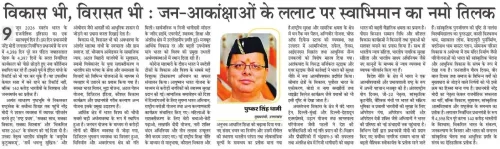
Uttarakhand CM Pushkar Singh Dhami on 15 June 2026 credited PM Modi's 12-year governance record with empowering India's middle class through Digital India, PMAY, Ayushman Bharat, Skill India and improved infrastructure, calling the segment the primary driver of a Developed India.
Key Takeaways
Uttarakhand CM Pushkar Singh Dhami posted on 15 June 2026 under the hashtag #12YearsOfSakshamMiddleClass praising PM Modi's governance record.
Dhami cited Digital India and UPI expansion as transformative for everyday financial transactions among middle-income households.
Pradhan Mantri Awas Yojana (approved June 2015 ) and Ayushman Bharat (rolled out September 2018 ) were highlighted as key social protection pillars for the middle class.
Skill India and Startup India were credited with boosting entrepreneurship and self-employment opportunities since 2015-16 .
Dhami framed India's middle class as 'the primary carrier of the resolve for a Viksit Bharat,' signalling the segment's centrality to BJP's long-term political narrative.
State-level utilisation data for PMAY and skill schemes, and provisions in the next Union Budget , will be key indicators of delivery against this narrative.
Uttarakhand Chief Minister Pushkar Singh Dhami on Monday, 15 June 2026, credited Prime Minister Narendra Modi's government with delivering a series of 'historic and far-sighted decisions' over the past 12 years to strengthen India's middle class, citing advances in digital payments, infrastructure, affordable housing, healthcare, education and entrepreneurship.
Posting under the hashtag #12YearsOfSakshamMiddleClass ('12 years of an empowered middle class'), Dhami wrote that these policies have made the lives of middle-class Indians 'more convenient and prosperous,' and that the segment has emerged not merely as a participant in development but as 'the primary carrier of the resolve for a Viksit Bharat (Developed India).'
Context
The post arrives as the BJP-led central government marks over a decade in power at the Centre. State-level leaders across BJP-governed states have amplified a coordinated narrative around the #12YearsOfSakshamMiddleClass campaign, highlighting convergence between central scheme delivery and local implementation. Dhami, who has led Uttarakhand since 2021, is among the most active state voices in echoing central government messaging.
Policy Backdrop
The schemes Dhami references have deep policy roots. The Digital India programme, launched in July 2015, accelerated financial inclusion through UPI and Aadhaar-linked services, fundamentally reshaping everyday transactions for urban and semi-urban households. Pradhan Mantri Awas Yojana (Urban), approved in June 2015, extended central assistance for affordable housing to middle-income families, while the Startup India initiative, announced in January 2016, eased compliance burdens and introduced tax incentives for new enterprises.
On the health front, Ayushman Bharat, rolled out in September 2018, extended insurance coverage to economically vulnerable and lower-middle-income households. Skill India, launched in 2015, scaled vocational training and entrepreneurship support for youth — a segment that forms the aspirational core of India's middle-income demographic. Together, these programmes represent a sustained effort across successive Union Budgets to raise consumption and productivity among middle-income Indians.
Stakeholders and Impact
India's middle class — broadly comprising urban professionals, small business owners and salaried households — has been the stated target of this policy cluster. Improved road, rail and air connectivity has reduced logistics costs and travel times, benefiting both consumers and small entrepreneurs. Digital payment infrastructure has lowered transaction friction and expanded access to credit and government transfers for millions who previously depended on cash-based systems.
Affordable housing subsidies under PMAY have enabled first-time homeownership for a segment that historically fell between eligibility criteria for welfare schemes and the affordability threshold for market-rate housing. Health coverage under Ayushman Bharat has partially addressed the out-of-pocket expenditure burden that has long been a financial vulnerability for middle-income families.
What's Next
Analysts will watch state-level utilisation reports for PMAY and Skill India in the next quarterly review cycle for evidence of on-ground delivery matching the political narrative. Any new middle-class-focused provisions in the forthcoming Union Budget will be closely tracked as a signal of whether the government plans to deepen or expand this policy agenda. As India's aspirational middle class continues to grow, its political and economic expectations will remain a central variable in both electoral and policymaking calculus.
Point of View
Where chief ministers amplify central government milestones to reinforce party identity ahead of electoral cycles. The framing of the middle class as a 'carrier of Viksit Bharat' is deliberate: it repositions a traditionally swing-voting demographic as ideologically invested in the BJP project, not merely a beneficiary of welfare. The 12-year timestamp is also significant — it pre-empts opposition narratives about unfulfilled promises by anchoring the conversation in accumulated policy lineage rather than any single term. Whether this messaging translates into durable middle-class loyalty will depend on whether upcoming budget allocations and scheme delivery data match the political rhetoric.
NationPress
16 Sept 2026
Frequently Asked Questions
What is the #12YearsOfSakshamMiddleClass campaign about?
The #12YearsOfSakshamMiddleClass hashtag marks 12 years of the BJP-led central government under PM Narendra Modi and highlights policies such as Digital India , PMAY , Ayushman Bharat and Skill India that the party credits with improving quality of life for India's middle-income households.
What did CM Pushkar Singh Dhami say about PM Modi's governance?
Uttarakhand CM Pushkar Singh Dhami said that over the past 12 years , 'historic and far-sighted decisions' under PM Modi 's leadership have made the middle class's life 'more convenient and prosperous,' and that the segment has become 'the primary carrier of the resolve for a Viksit Bharat.'
How has Digital India helped the middle class?
The Digital India programme, launched in July 2015 , expanded UPI and Aadhaar-linked services, lowering transaction costs, widening access to credit and enabling direct government transfers — benefits that have been especially significant for urban and semi-urban middle-income households.
What is Pradhan Mantri Awas Yojana and who does it target?
Pradhan Mantri Awas Yojana (Urban) , approved in June 2015 , provides central government subsidies for affordable housing and specifically targets middle-income and lower-middle-income families who previously fell between welfare eligibility and market-rate affordability thresholds.
What is Viksit Bharat and why does the BJP link it to the middle class?
'Viksit Bharat' translates to 'Developed India' and is the BJP government's long-term vision for India's economic and social transformation. The party frames the middle class as central to this goal because its consumption, productivity and aspirations are seen as key drivers of sustained economic growth.