CM Bhajan Lal hails 12 years of Modi govt's middle-class gains
Synopsis
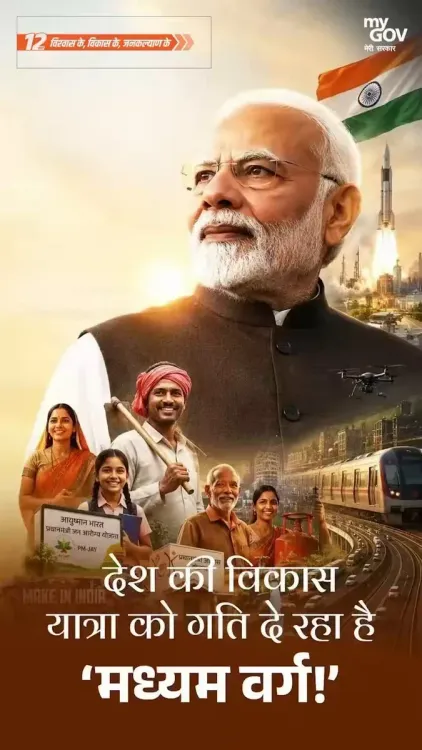
Rajasthan Chief Minister Bhajan Lal Sharma on 15 June 2026 lauded Prime Minister Modi's 12-year governance record, highlighting tax relief, affordable housing, Ayushman Bharat and Digital India as transformative gains for India's middle class under the Viksit Bharat vision.
Key Takeaways
CM Bhajan Lal Sharma posted on 15 June 2026 crediting 12 years of PM Modi's government with uplifting India's middle class.
Key initiatives cited include GST (2017), Pradhan Mantri Awas Yojana Urban (2015), Ayushman Bharat (2018) and the Digital India programme (2015).
The post frames an empowered, self-reliant middle class as the 'strong foundation' of the Viksit Bharat — developed India by 2047 — vision.
The hashtag #12YearsOfSakshamMiddleClass indicates a coordinated BJP communication campaign marking the government's 12-year milestone.
The next Union Budget and state-level PMAY and Ayushman Bharat progress in Rajasthan will be key markers of continued middle-class policy delivery.
Rajasthan Chief Minister Bhajan Lal Sharma on Monday, 15 June 2026, credited Prime Minister Narendra Modi's government with delivering 'unprecedented work' over 12 years to make the lives of India's middle class 'simpler, safer and more prosperous,' citing tax relief, affordable housing, modern infrastructure, quality healthcare and digital services as key pillars of this transformation.
Context
Posting under the hashtag #12YearsOfSakshamMiddleClass ('capable middle class'), CM Sharma wrote that welfare-oriented policies over these years had 'given new flight to the dreams of the middle class and brought remarkable improvement in their quality of life.' He described the empowered, self-reliant middle class as the 'strong foundation of the resolve for a Viksit Bharat' — a developed India. The post marks a coordinated BJP communication effort timed to 12 years of the Modi government, which began in May 2014.
Policy Backdrop
The claims in the post draw on a sequence of Union government initiatives spanning more than a decade. The Goods and Services Tax (GST), introduced in July 2017, unified indirect taxation and was positioned as reducing the compliance burden on households and businesses. The Pradhan Mantri Awas Yojana (Urban), launched in June 2015, aimed at affordable housing for lower- and middle-income families, while the Ayushman Bharat Pradhan Mantri Jan Arogya Yojana, rolled out in September 2018, expanded health insurance coverage to economically vulnerable sections.
The Digital India programme, initiated in July 2015, built digital infrastructure, promoted e-governance and expanded financial inclusion through platforms such as UPI and Aadhaar. Successive Union budgets have also combined direct-tax rationalisation with large-scale infrastructure spending to address middle-class aspirations, positioning this cohort as both a beneficiary and an engine of economic growth.
Stakeholders and Impact
Urban taxpayers and middle-class households are the stated beneficiaries of the policy arc described by CM Sharma. The Viksit Bharat framework — the central government's long-term vision targeting developed-economy status by 2047 — explicitly identifies an empowered middle class as a structural pillar. In Rajasthan, state-level implementation of schemes such as PMAY and Ayushman Bharat has been a recurring theme in the Sharma administration's communications since he assumed office in December 2023.
The post's framing — linking individual welfare gains to a national developmental vision — reflects a broader pattern in BJP messaging that seeks to connect scheme delivery at the ground level with the party's ideological narrative of economic self-reliance.
What's Next
Attention will now turn to the next Union Budget for any fresh adjustments to income-tax slabs or standard deduction limits that could further ease the burden on salaried middle-class households. At the state level, progress reports on PMAY and Ayushman Bharat implementation in Rajasthan will be closely watched as indicators of on-the-ground delivery. CM Sharma's post signals that the middle class will remain a central theme in BJP's political and policy messaging in the months ahead.
Point of View
Timed precisely to the BJP's 12-year governing milestone and amplifying a central-party narrative about middle-class empowerment. The use of the Viksit Bharat frame is deliberate — it ties routine scheme delivery to a grand civilisational arc, making the middle class both audience and protagonist. For the BJP, this cohort is electorally decisive in urban and semi-urban Rajasthan, and Sharma's consistent alignment with Delhi's messaging reinforces his position as a reliable party voice. The forward-looking implication is clear: as the next budget cycle approaches, the party will continue to use middle-class welfare as a primary political currency.
NationPress
26 Sept 2026
Frequently Asked Questions
What is the #12YearsOfSakshamMiddleClass campaign about?
It is a BJP communication campaign marking 12 years of the Modi government, highlighting policies said to have benefited India's middle class through tax relief, affordable housing, healthcare and digital services.
What did Rajasthan CM Bhajan Lal Sharma say about PM Modi's government?
CM Sharma credited PM Modi's 12-year tenure with 'unprecedented work' to make middle-class life simpler, safer and more prosperous, citing GST, PMAY, Ayushman Bharat and Digital India as key initiatives.
What is Viksit Bharat and how does the middle class fit into it?
Viksit Bharat is the central government's vision to achieve developed-economy status by 2047. The BJP frames an empowered, self-reliant middle class as a foundational pillar of this goal.
Which central government schemes have benefited India's middle class since 2014?
Key schemes include the Goods and Services Tax (2017) for tax simplification, Pradhan Mantri Awas Yojana Urban (2015) for affordable housing, Ayushman Bharat (2018) for health coverage, and Digital India (2015) for digital access and financial inclusion.
When did Bhajan Lal Sharma become Chief Minister of Rajasthan?
Bhajan Lal Sharma became Chief Minister of Rajasthan in December 2023, representing the BJP after the party's victory in the state assembly elections.