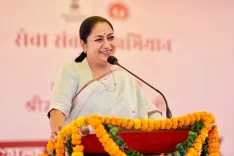
CM Bhajan Lal Marks 12 Years of Modi Govt's Welfare Drive
Synopsis
Rajasthan CM Bhajan Lal Sharma marked twelve years of PM Narendra Modi's government on 8 June 2026, highlighting welfare milestones including 12 crore toilets, 10.5 crore Ujjwala LPG links and 16 crore Jal Jeevan tap connections as proof of Antyodaya-driven governance.
Key Takeaways
Rajasthan CM Bhajan Lal Sharma posted on 8 June 2026 marking 12 years of the Modi government under the hashtag #12YearsOfGaribKalyan .
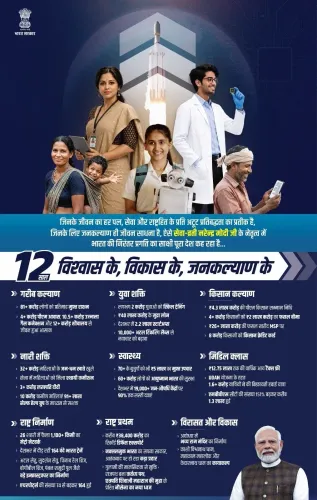
The post cites construction of more than 12 crore toilets under the Swachh Bharat Mission as a key sanitation achievement.
More than 10.5 crore LPG connections have been distributed under the Pradhan Mantri Ujjwala Yojana to BPL households.
Over 16 crore tap-water connections have been provided under the Jal Jeevan Mission to rural families.
Schemes including Jan Dhan Yojana , Pradhan Mantri Awas Yojana , and Ayushman Bharat are highlighted as pillars of poor empowerment.
The post frames these achievements within the Viksit Bharat vision targeting 140 crore Indians by 2047 .
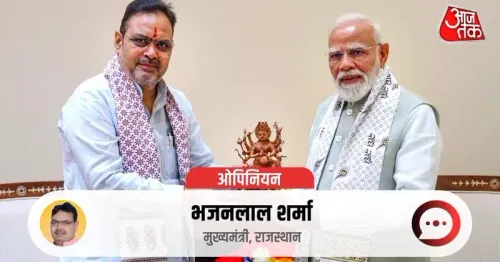
Rajasthan Chief Minister Bhajan Lal Sharma on Monday, 8 June 2026, lauded Prime Minister Narendra Modi's twelve years in office as a 'historic chapter' in India's development journey, citing large-scale welfare delivery under the Antyodaya (upliftment of the last person) principle as the defining achievement of the period.
Context
Posting under the hashtag #12YearsOfGaribKalyan, CM Sharma described the twelve-year span as dedicated to 'service, dedication and good governance' (seva, samarpan aur sushasan). He said the government had worked to bring 'comprehensive transformation' to the lives of the poor, marginalised and needy, ensuring that the benefits of development reach 'the person standing in the last row.'
The post enumerates three flagship infrastructure milestones: construction of more than 12 crore toilets under the Swachh Bharat Mission; distribution of more than 10.5 crore LPG connections under the Pradhan Mantri Ujjwala Yojana; and provision of more than 16 crore tap-water connections under the Jal Jeevan Mission.
Policy Backdrop
The schemes cited by CM Sharma span the full tenure of the Modi government. The Swachh Bharat Mission was launched on 2 October 2014 with the goal of making India open-defecation-free. The Pradhan Mantri Ujjwala Yojana, announced in May 2016, initially targeted five crore LPG connections for below-poverty-line families and has since been expanded in successive phases.
The Jal Jeevan Mission was unveiled in August 2019 with the ambition of piped water to every rural household. Alongside these, CM Sharma highlighted the Pradhan Mantri Jan Dhan Yojana, Direct Benefit Transfer, the Pradhan Mantri Awas Yojana housing scheme, and Ayushman Bharat — the government-funded health assurance scheme rolled out in September 2018 offering up to Rs 5 lakh in annual coverage per family — as the 'strong cornerstones of poor empowerment.'
The ideological anchor for this cluster of programmes is the Deendayal Upadhyaya concept of Antyodaya, which frames state action around improving the condition of society's most vulnerable members. The Modi government has consistently invoked this principle to position welfare delivery as both a governance priority and a moral commitment.
Stakeholders and Impact
Rajasthan, governed by CM Bhajan Lal Sharma's BJP administration since December 2023, has reported high saturation levels for several of these centrally sponsored schemes. Rural women, below-poverty-line households and residents of water-stressed districts in the state stand among the primary beneficiaries of the Ujjwala and Jal Jeevan programmes.
The post frames the aggregate impact as touching 140 crore Indians, describing the ongoing journey as giving 'new energy' to the resolve of building a Viksit Bharat (Developed India) — the overarching national vision the Modi government has set for 2047, the centenary of independence.
What's Next
Attention will now turn to state-level progress reports on Jal Jeevan Mission saturation and any announcements on an Ujjwala Phase III target ahead of the next Union Budget. For Rajasthan, the convergence of these central programmes with the state's own welfare initiatives will be a key metric as the Sharma government approaches its mid-term mark. The Viksit Bharat roadmap implies continued scaling of direct-benefit infrastructure through 2047, making the twelve-year review a baseline for future accountability.
Point of View
Gas connections, tap water — rather than broad rhetoric, Sharma aligns Rajasthan's political identity with the Modi government's delivery record, reinforcing the state unit's loyalty at a time when the party is building towards the 2029 electoral cycle. The invocation of Antyodaya and Viksit Bharat in a single post also signals the party's intent to stitch its historical ideological roots to its contemporary development agenda. For Rajasthan, a state with significant rural poverty and water scarcity, the emphasis on Jal Jeevan and Ujjwala is politically pointed as much as it is substantive.
NationPress
24 Sept 2026
Frequently Asked Questions
What is #12YearsOfGaribKalyan about?
#12YearsOfGaribKalyan is a BJP-promoted hashtag marking twelve years of the Narendra Modi government's welfare and governance record since May 2014, highlighting schemes targeting poor and marginalised households.
How many toilets were built under Swachh Bharat Mission?
According to CM Bhajan Lal Sharma's post, more than 12 crore toilets have been constructed under the Swachh Bharat Mission since the programme's launch in October 2014.
What is the Pradhan Mantri Ujjwala Yojana and how many connections have been given?
Pradhan Mantri Ujjwala Yojana is a central government scheme launched in May 2016 to provide free LPG connections to below-poverty-line families. CM Sharma's post states that more than 10.5 crore connections have been distributed.
What is Jal Jeevan Mission and its progress?
Jal Jeevan Mission is a programme announced in August 2019 to provide piped tap water to every rural household in India. CM Sharma cited more than 16 crore household tap connections provided under the mission.
What is the Viksit Bharat vision mentioned by CM Bhajan Lal Sharma?
Viksit Bharat, meaning 'Developed India,' is the Modi government's long-term national development goal targeting 2047, the centenary of India's independence, envisioning a fully developed economy and society for all 140 crore citizens.