CM Hemant Soren orders strict action against Ramgarh police personnel

Synopsis
Jharkhand Chief Minister Hemant Soren on 4 June 2026 publicly ordered Ramgarh district police and the Jharkhand Police headquarters to take immediate cognisance and ensure the harshest action against guilty personnel, calling the situation 'absolutely intolerable' and warning that it must not be repeated.
Key Takeaways
Jharkhand CM Hemant Soren issued a public directive on X on 4 June 2026 to Ramgarh and state police.
He called the situation 'absolutely intolerable' and demanded the strictest action against guilty personnel.
Both Ramgarh Police and Jharkhand Police headquarters were tagged, placing local and state-level accountability.
The post was accompanied by a video but did not specify the incident in text.
Ramgarh is a coal-mining industrial district with a history of localised policing challenges.
Next steps are likely to include departmental inquiry and a formal statement from the state police leadership.
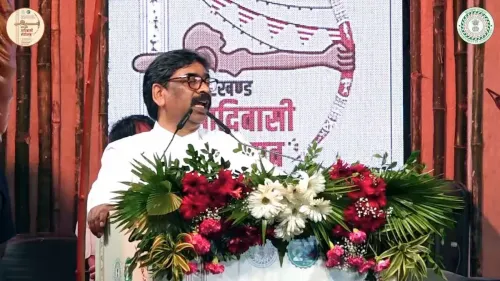
Jharkhand Chief Minister Hemant Soren on Thursday, 4 June 2026, publicly directed the Ramgarh district police and the Jharkhand Police headquarters to take immediate cognisance of an apparent incident involving police personnel and ensure the strictest possible disciplinary action against those found guilty. In a post on X tagging both forces, the Chief Minister called the situation 'absolutely intolerable' and warned that such occurrences must not be repeated.
Addressing the Ramgarh Police, Soren wrote that they must 'tatkaal sangyaan len' (take immediate cognisance) and ensure the harshest action against guilty personnel. Turning to the state police leadership, he added that the situation was 'not fit to be tolerated at all' and instructed the force to ensure 'such a situation does not arise again'. The post was accompanied by a video, though the Chief Minister did not describe the specific incident in his message.
Context
The directive arrived in the form of a short, sharply worded social-media intervention rather than a formal government order, a format the Chief Minister has used before to flag administrative concerns in real time. By tagging both the district unit and the state headquarters, Soren placed responsibility on the local command in Ramgarh while also signalling that the matter would be tracked from the top.
The Chief Minister, who also serves as executive president of the Jharkhand Mukti Morcha (JMM), has held the state's top office across multiple terms since 2013, with law and order in the mineral-rich state forming a recurring administrative focus.
Policy backdrop
Ramgarh is an industrial district carved out of the erstwhile Hazaribagh region, with significant coal mining activity and a long history of local policing challenges linked to extraction economies and labour movement. The district police have periodically come under public scrutiny for incidents involving conduct of personnel on the ground.
State chief ministers in India routinely issue public directives to police following reported misconduct or operational failure, both to signal administrative control and to reassure citizens. In Jharkhand, successive governments have addressed policing gaps tied to resource extraction, left-wing extremism and frequent friction between communities and uniformed personnel.
Stakeholders and impact
The most immediate stakeholders are the Ramgarh district police, whose senior officers will be expected to identify the personnel involved and initiate departmental proceedings, and the Jharkhand Police headquarters, which oversees uniform standards of conduct and discipline across the force.
For residents of Ramgarh, the public nature of the Chief Minister's intervention raises expectations of visible action, including suspension or transfer of those identified, registration of a formal complaint where warranted, and a clear statement from the police hierarchy on what occurred.
For the wider Jharkhand administration, the post functions as a marker of executive oversight. By making the directive public on X, the Chief Minister has set a measurable benchmark against which the response of the force will be judged in the coming days.
What's next
Attention will now turn to the Ramgarh superintendent of police and the state police headquarters for a formal response, including any suspension orders, departmental inquiry or first information report linked to the matter. A statement from the Director General of Police's office on disciplinary proceedings is the most likely next step.
Whether the Chief Minister follows up with a state-level police review meeting will indicate how seriously the leadership intends to escalate the matter beyond a single district. For now, the post leaves the force with little room to delay a public accounting.
Point of View
Bypassing slower official channels to flag accountability publicly. For Hemant Soren, who has framed his tenure around responsive governance in a mineral-rich and policing-sensitive state, the intervention reinforces an image of direct executive control over the uniformed services. The sharper test, however, lies in the follow-through — whether named personnel face visible disciplinary consequences within a short window. In Jharkhand's broader law-and-order arc, such public directives tend to set expectations that, if unmet, can rebound on the political leadership itself.
NationPress
14 Sept 2026
Frequently Asked Questions
What did Hemant Soren say about Ramgarh Police?
Jharkhand Chief Minister Hemant Soren directed Ramgarh Police to take immediate cognisance and ensure the strictest possible action against guilty personnel, calling the situation 'absolutely intolerable' in a post on X on 4 June 2026.
Why did the Jharkhand CM tag Jharkhand Police in his post?
By tagging the state police headquarters alongside the Ramgarh district unit, the Chief Minister placed accountability on both local commanders and the senior state leadership, and asked the force to ensure such a situation does not recur.
What incident prompted Hemant Soren's directive?
The Chief Minister's post did not describe the specific incident in text, though it was accompanied by a video. No official details of the triggering event were provided in the message itself.
What action can Ramgarh Police take against guilty personnel?
Standard options include suspension, departmental inquiry, transfer and, where warranted, registration of a first information report against the personnel concerned, followed by formal disciplinary proceedings under service rules.
Where is Ramgarh district located?
Ramgarh is an industrial district in Jharkhand, carved out of the erstwhile Hazaribagh region, known for significant coal mining activity and a population dependent on the extraction economy.