CM Hemant Soren: Schemes Must Show Results in Villages
Synopsis
Jharkhand Chief Minister Hemant Soren has declared that the impact of government schemes must be visible in villages, not confined to files — a sharp governance accountability statement from the JMM-led administration targeting last-mile welfare delivery in one of India's most tribal-heavy states.
Key Takeaways
The Chief Minister's Office of Jharkhand shared a governance directive from CM Hemant Soren on 28 May 2026 .
Soren stated: 'The impact of schemes should not remain only in files; it must be seen in villages.' Jharkhand has a large tribal population and a history of rural welfare delivery gaps.
The JMM government has emphasised field-level monitoring of welfare schemes since 2019 .
The statement signals an accountability benchmark shift — from documentation compliance to village-level outcomes.
Analysts will watch for follow-up administrative action such as scheme audits or revised district-level performance metrics.
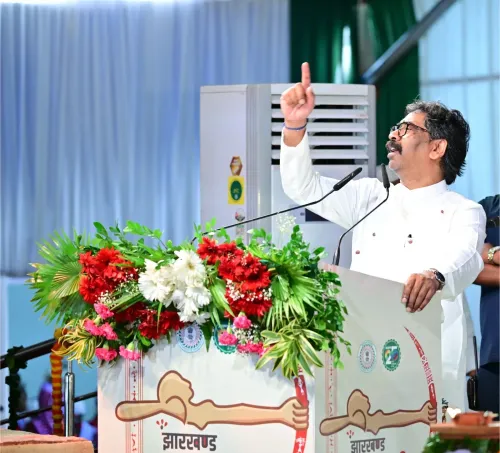
The Chief Minister's Office of Jharkhand, on Thursday, 28 May 2026, shared a pointed governance directive attributed to Chief Minister Hemant Soren, emphasising that the true measure of any government scheme lies not in paperwork but in visible, ground-level change in villages across the state.
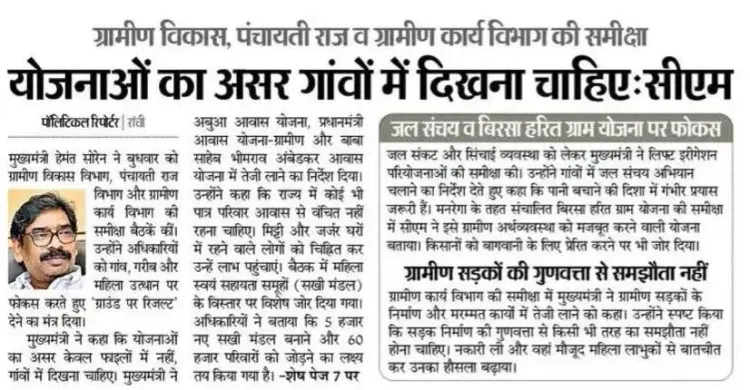
The post quoted Hemant Soren in Hindi: 'Yojanaon ka asar keval failon mein nahin, gaanvon mein dikhna chahiye' — 'The impact of schemes should not remain only in files; it must be seen in villages.' The statement captures a recurring concern in Indian governance: the gap between policy design and actual delivery at the last mile.
Context
Jharkhand is an eastern Indian state with one of the country's largest tribal populations, where rural welfare delivery has historically faced structural challenges including difficult terrain, administrative capacity gaps, and uneven infrastructure. Chief Minister Soren, who leads the Jharkhand Mukti Morcha (JMM), has since his first term in 2019 consistently positioned his government around the idea of reaching the most marginalised communities. The remark reflects a direct acknowledgement that scheme documentation alone does not constitute development.
Policy Backdrop
Since taking office, the Soren-led government has launched multiple rural welfare programmes targeting tribal belts, covering areas such as food security, housing, livelihood support, and infrastructure. A recurring theme in the administration's communication has been field-level monitoring — ensuring that benefits sanctioned on paper actually reach intended beneficiaries in remote villages. This emphasis on implementation accountability mirrors a broader challenge faced by state governments across India, where scheme utilisation rates often diverge sharply from allocation figures.
The statement also signals an internal governance posture: officials and departments are expected to treat village-level outcomes, not file compliance, as the primary benchmark. Such messaging is often a precursor to administrative reviews, district-level audits, or revised monitoring frameworks.
Stakeholders and Impact
The communities most directly addressed by this directive are Jharkhand's rural and tribal populations — the intended beneficiaries of welfare schemes who bear the cost when delivery falls short. For frontline government functionaries — block-level officers, panchayat representatives, and district administrators — the statement sets a clear accountability expectation. Civil society organisations working on tribal rights and rural development in the state are also likely to read the remark as an opening for greater transparency in scheme monitoring.
For the JMM government politically, the messaging reinforces its identity as a party rooted in tribal welfare, drawing a contrast with administrative formalism and signalling voter-facing intent ahead of ongoing governance cycles.
What's Next
Observers will watch whether the statement translates into concrete administrative action — such as state-level scheme utilisation reviews, third-party field audits, or revised performance metrics for district officials. Jharkhand's rural welfare programmes will come under closer scrutiny if the government follows through with structured monitoring mechanisms. The broader implication is clear: in Jharkhand, the Soren administration is publicly staking its governance credibility on outcomes that are visible in villages, not merely verifiable in files — a standard that, if institutionalised, could meaningfully reshape how welfare delivery is measured in one of India's most underserved states.
Point of View
Where tribal and rural communities have historically been underserved despite significant scheme allocations, this framing carries political weight. It aligns with a broader pattern visible across several state governments of positioning welfare delivery as a credibility test, not merely a procedural exercise. Whether the statement catalyses structural reforms in monitoring or remains rhetorical will define its actual significance.
NationPress
19 Sept 2026
Frequently Asked Questions
What did Hemant Soren say about government schemes?
Hemant Soren stated that the impact of government schemes must be visible in villages, not just recorded in official files — emphasising last-mile delivery over documentation.
Why is scheme delivery a challenge in Jharkhand?
Jharkhand has a large tribal population spread across difficult terrain, which has historically made welfare delivery challenging. Administrative capacity and infrastructure gaps have often led to a disconnect between scheme allocation and actual beneficiary reach.
What is the JMM government's approach to rural welfare?
The Jharkhand Mukti Morcha government under Hemant Soren has since 2019 focused on launching rural and tribal welfare schemes alongside field-level monitoring to ensure benefits reach intended communities.
What does 'last-mile delivery' mean in Indian governance?
Last-mile delivery refers to the final step of getting government scheme benefits — such as food, housing, or cash transfers — directly to intended beneficiaries in remote villages, which is often the most difficult and poorly tracked part of implementation.
What will be the next steps after Soren's governance statement?
Observers expect possible follow-up in the form of state-level scheme utilisation reviews, third-party field audits, or new performance benchmarks for district and block-level officials in Jharkhand.