Stalin Demands Release of Detained Student Activists, Targets BJP
Synopsis
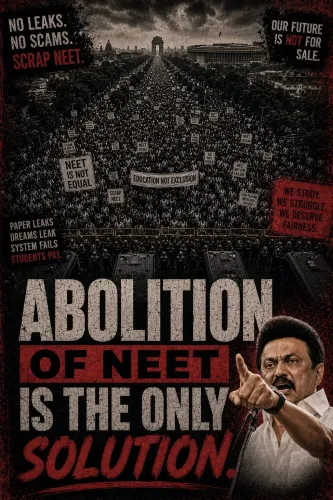
DMK president M. K. Stalin on 16 October 2026 publicly demanded the release of two student activists allegedly detained by the Union Government without disclosing their whereabouts, tagging AISA and SFI and calling the move illegal and inhumane under the hashtag #GyaneshKumarMustGo.
Key Takeaways
Stalin on 16 October 2026 called for the immediate release of two individuals tagged as @abhijeet_dipke and @neha_aisa .
Stalin described detaining activists without disclosing their whereabouts as 'blatantly illegal and deeply inhumane.' The post carries the hashtag #GyaneshKumarMustGo , indicating a specific institutional target of the student movement.
Left student bodies SFI and AISA were directly tagged, linking the statement to organised campus protest networks.
Legal experts are watching for possible habeas corpus petitions in Delhi courts ; the Ministry of Home Affairs has not publicly responded.
The move follows a DMK pattern of opposing BJP central government actions on student detentions, dating to the 2019–2020 CAA-NRC period.
Two student activists are missing — and DMK president M. K. Stalin wants to know exactly where they are. On Friday, 16 October 2026, Stalin took to X to demand the immediate release of individuals tagged as @abhijeet_dipke and @neha_aisa, accusing the Union BJP Government of holding them without disclosing their whereabouts — a practice he called 'blatantly illegal and deeply inhumane.'
The detention allegation and what Stalin is charging
Stalin's post is direct and unsparing: 'Detaining them without disclosing their whereabouts is blatantly illegal and deeply inhumane. The Union Government must release them immediately and stop suppressing peaceful protests.' The two individuals tagged appear to be associated with left-leaning student organisations — AISA (All India Students Association) and affiliated activist networks — though the specific circumstances of their alleged detention could not be independently verified at the time of publication.
The post also carries the hashtag #GyaneshKumarMustGo, directly targeting a named official and signalling that the student protest movement has a concrete institutional demand at its core. Stalin did not elaborate on the specific protests in question, but his mention of 'peaceful protests' and the tagging of SFI (Students' Federation of India) and AISA_Official_ places this firmly in the orbit of organised left student politics in Delhi.
Stalin, student movements, and a long-running opposition playbook
DMK has a documented history of aligning with left student organisations to challenge BJP-led central government actions on civil liberties. During the 2019–2020 CAA-NRC protests, opposition parties including DMK raised similar concerns about student detentions in Delhi — the pattern here is not new, but the sharpness of the language is notable. Stalin's framing — 'The Union BJP Government has no other option' — reads less as a plea and more as a political ultimatum.
The post tags prominent figures including @Aishe_Ghosh (associated with SFI) and @Dhruv_Rathee, broadening the intended audience well beyond party cadres. That cross-platform, cross-movement tagging strategy suggests a deliberate effort to amplify the issue into a wider public conversation about protest rights and state overreach.
What follows: courts, the Home Ministry, and the movement's next move
Legal observers are watching for possible habeas corpus petitions in Delhi courts — the standard judicial remedy when detention locations are withheld. The Ministry of Home Affairs has not publicly responded to the named detainees as of publication. Stalin's closing line — 'Every attempt to crush the movement will only make it stronger' — is as much a message to street-level protesters as it is a challenge to New Delhi.
The demand is simple. The politics around it are anything but.
Point of View
Prominent commentators, and civil liberties handles simultaneously, he transforms what could be a niche detention complaint into a federated political signal. The #GyaneshKumarMustGo hashtag reveals that the underlying student movement already has a named institutional target, giving this more policy traction than a generic protest-solidarity post. If habeas corpus petitions materialise in Delhi courts, Stalin's post will have served as early political scaffolding for the legal battle.
NationPress
16 Oct 2026
Frequently Asked Questions
Why is M. K. Stalin demanding the release of student activists?
Stalin alleges that two student activists — tagged as @abhijeet_dipke and @neha_aisa — have been detained by the Union Government without their whereabouts being disclosed, which he describes as illegal and inhumane. He is calling for their immediate release and an end to what he characterises as suppression of peaceful protests.
What is the #GyaneshKumarMustGo hashtag about?
The hashtag #GyaneshKumarMustGo is being used in connection with an ongoing student protest movement that appears to have a named official as its central target. The specific context of this demand could not be independently verified at the time of publication.
Which student organisations are involved in the protests Stalin is supporting?
Stalin's post tags AISA (All India Students Association) and SFI (Students' Federation of India), both left-leaning student bodies with a history of organising demonstrations in Delhi and on university campuses across India.
What legal remedy is available when someone is detained without disclosing their location?
A habeas corpus petition filed in a high court or the Supreme Court is the standard legal remedy in India when an individual is detained and their whereabouts are not disclosed. Such petitions compel the detaining authority to produce the person before the court.
Has the BJP government responded to Stalin's demand?
As of the time of publication, neither the Ministry of Home Affairs nor any official BJP spokesperson had publicly responded to Stalin's post or the allegations regarding the detained activists.