Stalin donates 5,000 books to Palayamkottai prison, Tambaram library

Synopsis
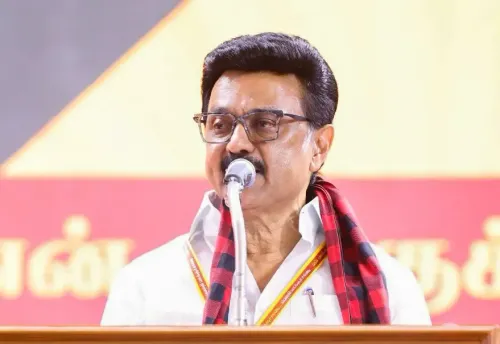
DMK president M. K. Stalin donated 5,000 books to Palayamkottai Central Prison and the newly opened Tambaram public library on 31 July 2026, extending an eight-year personal initiative that has redistributed 6 lakh gifted books to libraries across Tamil Nadu and abroad.
Key Takeaways
Stalin donated 5,000 books on 31 July 2026 to Palayamkottai Central Prison and the new Tambaram public library .
Since 2018 , Stalin has asked visitors to gift books instead of flowers or shawls — a request that has generated 6 lakh (600,000) books redistributed to libraries in Tamil Nadu and abroad.
The initiative is rooted in the Dravidian movement's historical emphasis on literacy as social empowerment and cultural preservation.
Educational institutions, libraries, and reading clubs across India can write to Stalin's office to receive book donations.
Stalin framed reading growth as essential to Tamil Nadu preserving its distinct cultural identity.
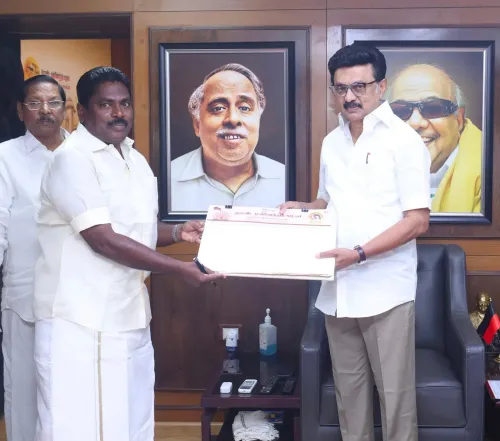
Since 2018, DMK president M. K. Stalin has turned every courtesy visit into a quiet act of cultural purpose — asking well-wishers to bring books instead of bouquets or shawls. On Friday, 31 July 2026, that eight-year-old request yielded its latest dividend: 5,000 books handed over to inmates at Palayamkottai Central Prison in Tirunelveli and to the newly opened public library in Tambaram, Chennai.
Six lakh books and counting — how a personal pledge became a movement
Stalin's post, written in Tamil, opens with a classical Thirukkural-echoing phrase — 'kattranaith thooRum aRivu' ('knowledge that soaks through all that is learnt') — before laying out the scale of what began as a personal request. Since assuming the DMK presidency, he says, visitors who heeded his call have collectively gifted a cumulative 6 lakh (600,000) books, all of which have been dispatched to libraries across Tamil Nadu and to Tamil diaspora institutions abroad.
The numbers are striking. What started as a gentle nudge to swap garlands for paperbacks has, over eight years, built a quiet, decentralised book-donation pipeline — no government budget line, no formal scheme, just a norm shift inside one political leader's public life.
Why Palayamkottai Prison — and what it signals
The choice of Palayamkottai as a recipient is deliberate and pointed. Prison libraries are among the most under-resourced reading spaces in India, and directing books there extends the Dravidian movement's foundational argument: literacy is not a privilege for the educated — it is the instrument of emancipation for those society has pushed furthest to the margins. The move echoes earlier DMK-era investments in Tamil-medium public education and the expansion of district library networks across the state.
The Tambaram library, described in the post as newly inaugurated, adds a second dimension — meeting fresh demand in a fast-growing Chennai suburb whose population has outpaced its civic infrastructure.
An open call: schools, libraries, and reading clubs can write in
Stalin's post closes with a direct public offer: educational institutions, libraries, and reading circles that need books are invited to write in and receive donations. The invitation is open-ended and national in scope, signalling that the distribution mechanism is intended to scale beyond ceremonial handovers.
His closing line lands with the weight of a political thesis: 'Vaasippu perugindaal thaan Tamilnadu than adaiyaalatthai izhakamal paadhukaakappadum' — 'Only if reading grows will Tamil Nadu be protected from losing its identity.' In a political climate where questions of language, culture, and regional assertion are never far from the surface, that is not a casual sentiment. It is a programme.
Point of View
He deliberately extends the movement's egalitarian logic to its most marginalised constituency. The open invitation to institutions to write in is politically astute: it decentralises the initiative and embeds it in civil society without requiring legislative action. Cumulatively, the 6-lakh figure — if it holds — makes this one of the more consequential grassroots reading campaigns run from a political office in recent Indian history.
NationPress
31 Jul 2026
Frequently Asked Questions
How many books has M. K. Stalin distributed since 2018?
According to Stalin's post on 31 July 2026, a cumulative total of 6 lakh (600,000) books gifted by visitors have been distributed to libraries in Tamil Nadu and abroad since he assumed the DMK presidency in 2018.
Why did Stalin give books to Palayamkottai Prison?
Stalin donated books to Palayamkottai Central Prison in Tirunelveli as part of his ongoing book-distribution initiative, extending reading access to prison inmates — a constituency that typically has very limited access to library resources.
How can schools or libraries get books from Stalin's initiative?
Stalin stated in his post that educational institutions, libraries, and reading clubs that need books can write to him directly and books will be provided to them.
Where is the new Tambaram library that received books?
The Tambaram library is located in Tambaram, a suburb of Chennai in Tamil Nadu. Stalin described it as newly opened at the time of the 31 July 2026 donation.
What is the DMK's historical connection to library promotion in Tamil Nadu?
The Dravida Munnetra Kazhagam has historically championed public education and library expansion as part of the Dravidian movement's emphasis on literacy, Tamil-medium education, and social empowerment for marginalised communities.