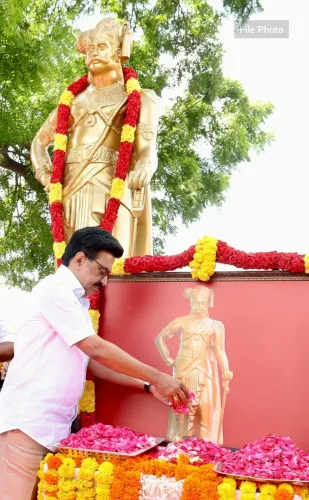
Stalin marks Raja Raja Chola's 1041st birthday, flags cancelled museum
Synopsis
DMK president M. K. Stalin marked Raja Raja Chola's 1041st Sathaya Vizha on 22 October 2026, reaffirming the DMK-instituted state festival and calling for revival of a ₹56-crore Chola Museum at Tamil University, Thanjavur, allegedly scrapped by the AIADMK.
Key Takeaways
22 October 2026 : Tamil Nadu marks the 1041st Sathaya Vizha (birth anniversary) of Chola emperor Raja Raja Chola I as an official state festival.
The state-festival status was created by the DMK government in 2022 under M.
Stalin's Dravidian Model governance initiative.
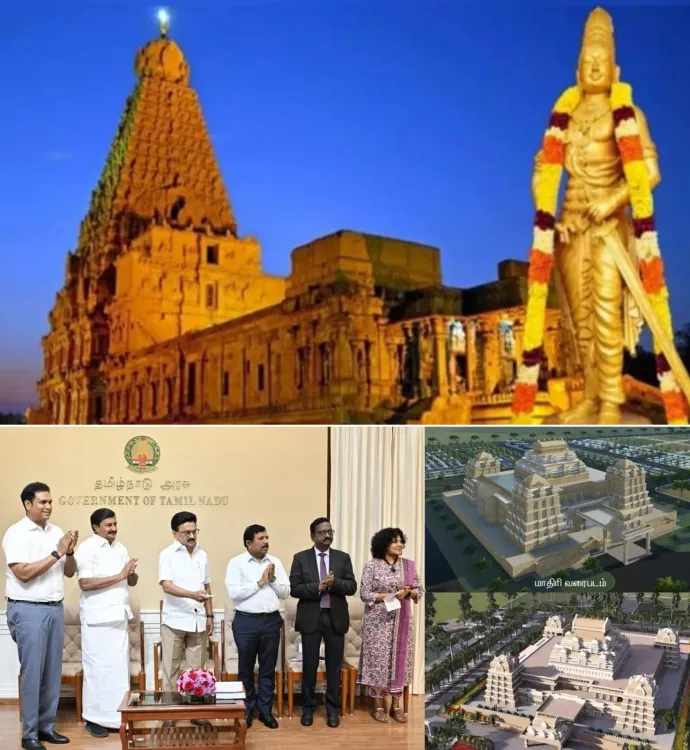
The DMK had announced a Chola Museum at Tamil University, Thanjavur , at an estimated cost of ₹56 crore to showcase Chola-era achievements across disciplines.
Stalin alleged the AIADMK government cancelled the museum project, describing it as 'suppression of Tamil history.' Raja Raja Chola I (r.
985–1014 CE ) is celebrated for military expansion, irrigation systems, land surveys, and construction of the Brihadeeswarar Temple , a UNESCO World Heritage Site in Thanjavur.
Whether the museum is revived in the current budget cycle remains the key political and cultural watchpoint from this announcement.
A king who surveyed land, managed rivers, commanded armies, and raised a temple that still stands — DMK president M. K. Stalin invoked that legacy on Thursday, 22 October 2026, as Thanjavur celebrated the 1041st Sathaya Vizha (birth anniversary) of the Chola emperor Raja Raja Chola I.
Writing in Tamil, Stalin hailed the emperor as one who brought the Tamil pெருமை ('Tamil glory') to global recognition — across water management, land administration, governance, architecture, and military prowess. The tribute was not merely ceremonial. It carried a pointed political edge.
The 2022 order that made it official
The celebration itself is a DMK creation. In 2022, Stalin's government issued a formal order declaring Raja Raja Chola's birthday an annual state festival — institutionalising what had previously been community-led commemorations. Today's 1041st edition marks the fourth year that the Sathaya Vizha has carried official state recognition.
The decision was framed as part of the Dravidian Model of governance, a branding that the DMK uses to position its administration as heir to ancient Tamil civilisational values — distinct from, and in competition with, the legacy of predecessor governments.
A ₹56-crore museum seed — and who uprooted it
The sharpest passage in Stalin's post concerned a planned Chola Museum at the Tamil University campus in Thanjavur, announced during the DMK's tenure at an estimated outlay of approximately ₹56 crore. The museum was designed to bring Chola-era achievements — department by department — in front of present generations.
Stalin alleged that the project was cancelled by the subsequent AIADMK government, calling it an act of இருட்டடிப்பு ('suppression of history'). 'The seed we planted must become a tree,' he wrote — and expressed hope that the current administration (he referred to it as த.வெ.க. அரசு, a Tamil abbreviation for DMK government, used in context to imply the then-AIADMK rule) would not, out of narrow political vision, erase Tamil history. The phrasing carries deliberate ambiguity, functioning both as an appeal and a challenge to the present political landscape.
Thanjavur as contested heritage ground
The choice of Thanjavur as the symbolic centre is loaded. The city is home to the Brihadeeswarar Temple, Raja Raja Chola's most enduring monument and a UNESCO World Heritage Site. It is also the seat of Tamil University, the institution where the museum was to have been built.
For the DMK, anchoring Tamil cultural memory in Thanjavur serves a dual purpose: it honours a pre-Islamic, pre-colonial Tamil golden age, and it places the party at the custodial centre of that heritage — a powerful positioning in a state where cultural identity drives electoral sentiment as reliably as economic performance.
Raja Raja Chola I — who reigned from roughly 985 to 1014 CE — is remembered for expanding the Chola empire across peninsular India and into Sri Lanka, commissioning land surveys that became models of administrative precision, and building irrigation infrastructure whose influence outlasted the dynasty by centuries.
Whether the Chola Museum finds a budget line in the next financial cycle — or remains a symbolic grievance — will say as much about Tamil Nadu's cultural politics as it does about government spending priorities.
Point of View
The DMK positions its opponents not merely as political rivals but as adversaries of Tamil civilisation itself. The ₹56-crore museum becomes less a line item and more a test of cultural stewardship — one the DMK intends to keep on the public ledger. With Tamil cultural pride a consistent electoral accelerant in the state, this kind of anniversary messaging reaches well beyond commemoration.
NationPress
22 Oct 2026
Frequently Asked Questions
Who was Raja Raja Chola and why is he celebrated in Tamil Nadu?
Raja Raja Chola I was a Chola emperor who ruled from approximately 985 to 1014 CE . He is celebrated for expanding the Chola empire across peninsular India and Sri Lanka, building sophisticated irrigation systems, conducting detailed land surveys, and constructing the Brihadeeswarar Temple in Thanjavur — now a UNESCO World Heritage Site. His birthday is observed as the Sathaya Vizha , declared an annual state festival by the DMK government in 2022.
What is the Sathaya Vizha and when did it become a state festival?
Sathaya Vizha is the birth anniversary celebration of Raja Raja Chola I. The DMK government under M. K. Stalin declared it an official state festival in 2022 , as part of the Dravidian Model governance initiative aimed at institutionalising Tamil heritage commemoration.
What is the proposed Chola Museum in Thanjavur?
The Chola Museum was a project announced by the DMK government, planned for the Tamil University campus in Thanjavur at an estimated cost of ₹56 crore . It was designed to present Chola-era achievements in water management, land administration, military science, and architecture to contemporary audiences. M. K. Stalin alleged the subsequent AIADMK government cancelled the project.
Why does M. K. Stalin accuse the AIADMK of cancelling the Chola Museum?
Stalin stated in his post that the AIADMK government , with a 'narrow vision,' scrapped the museum project — describing the move as இருட்டடிப்பு ('suppression of Tamil history'). He expressed hope the project would be revived, framing the cancellation as politically motivated cultural erasure rather than a legitimate policy decision.
Where is the Brihadeeswarar Temple and what is its significance?
The Brihadeeswarar Temple is located in Thanjavur, Tamil Nadu . Built by Raja Raja Chola I around 1010 CE, it is one of the largest Hindu temples in India and a UNESCO World Heritage Site . It stands as the most iconic symbol of Chola architectural and civilisational achievement.