Stalin Slams TVK Govt Over Arrest of 'Dravidian Model' Author
Synopsis
DMK president M. K. Stalin has condemned the TVK government's arrest of Dr. A. Kalaiyarasan — MIDS professor and Cambridge-published co-author of 'The Dravidian Model' — calling it illegal, fascist, and an assault on academic freedom, and demanding a public apology from Tamil Nadu's Chief Minister.
Key Takeaways
Kalaiyarasan , assistant professor at MIDS Chennai and Cambridge University Press co-author, was arrested by plainclothes officers in the early hours of October 28, 2026 .
Stalin called the arrest 'illegal' and an act of 'peak fascism' by the TVK government .
Kalaiyarasan is a JNU economics PhD, former Planning Commission contributor, and a sitting member of Tamil Nadu's Climate Change Management Authority .
Stalin alleges the arrest was motivated by Kalaiyarasan's public criticism of a historic price rise under the TVK administration.
Stalin demanded that Tamil Nadu Police and the Chief Minister issue a public apology to the professor.
The case raises acute concerns about academic freedom and police accountability in Tamil Nadu.
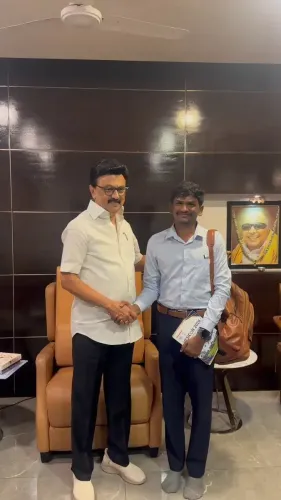
The early-morning arrest of a Cambridge-published academic by plainclothes officers has exploded into a full-blown political confrontation in Tamil Nadu. DMK president M. K. Stalin on Thursday, October 29, 2026 unleashed a scathing broadside against the rival TVK (Tamilaga Vettri Kazhagam) government, calling the detention of economist and author Dr. A. Kalaiyarasan an act of outright fascism — and demanding a public apology from the Chief Minister.
Who is Dr. Kalaiyarasan — and why his arrest is no ordinary case
Stalin spelled out the detained scholar's credentials in forensic detail, and the list is considerable. Dr. A. Kalaiyarasan is an assistant professor at the Madras Institute of Development Studies (MIDS), Chennai's premier social-science research institution. He holds a PhD in Economics from Jawaharlal Nehru University (JNU) and is co-author of 'The Dravidian Model' — a book published by Cambridge University Press in 2021 that placed Tamil Nadu's welfare-driven growth on the global academic map. He has contributed to the Union government's Planning Commission, helped prepare Tamil Nadu's official economic survey, and remains a sitting member of the state's Climate Change Management Authority, chaired by the Chief Minister himself.
Stalin's point was pointed: a man whose name appears on a government-constituted body cannot be arrested by that same government and described as an unknown quantity. 'Saying we didn't know who he was is simply not believable,' he wrote.
The arrest: plainclothes officers, a rented vehicle, no procedure
According to Stalin's post, plainclothes police arrived at Kalaiyarasan's residence in the early hours of Wednesday, October 28, 2026, seized his mobile phone, denied him basic rights, and drove him away in a private rental vehicle. Stalin called the operation 'illegal' on its face — no uniform, no procedure, no transparency. 'This cannot be passed off as ordinary,' he wrote, questioning whether the arrest was authorised at the highest levels of the state administration, including the Chief Minister's office.
The stated grievance against Kalaiyarasan, as Stalin frames it: the professor publicly documented what he described as an unprecedented rise in prices under the TVK government — a critique that directly challenged the administration's economic narrative. Stalin did not mince words on the motive. 'Was it because he told the truth about the price rise Tamil Nadu has never seen before since the TVK government came to power?'
The 'Dravidian Model' turned against its promoters
There is a particular irony at the heart of this row that Stalin exploited with full force. The term 'Dravidian Model' was coined and championed most aggressively by the DMK itself — the framework crediting successive Dravidian parties with building Tamil Nadu's distinctive social welfare architecture since the 1960s. Kalaiyarasan and his co-author gave that framework academic rigour and global reach via Cambridge University Press. Now, Stalin argues, the TVK government has arrested the very scholar who put 'Dravidian governance' on the world stage — because that scholar dared to publish inconvenient numbers.
Stalin also called out the TVK government's allied parties, challenging them to explain their silence: 'Is this the politics with which they claim to oppose fascism?' The jab was aimed squarely at smaller formation leaders who have publicly positioned themselves as anti-authoritarian but have not spoken on the Kalaiyarasan case.
Stalin's demand: a public apology from the Chief Minister
Stalin's closing demand was unambiguous. Tamil Nadu Police and the Chief Minister must publicly apologise to Dr. Kalaiyarasan. He called the arrest a 'fascist act' that surpasses even the BJP in authoritarian conduct — a line calibrated to sting a government that built its identity on opposing Hindutva politics.
Kalaiyarasan himself has no party affiliation. Stalin acknowledged that the professor had freely offered critical analysis of DMK governance during their own tenure as well — making the arrest look less like political rivalry and more, as Stalin put it, like an allergy to knowledge itself. Academic freedom cases rarely stay contained. This one carries a Cambridge imprint, a government committee credential, and a very loud opposition microphone — a combustible combination that Tamil Nadu's courts will likely need to address quickly.
Point of View
Non-partisan academic who co-authored a Cambridge University Press book championed by Tamil Nadu's own Dravidian political tradition is a significant escalation in the state's politics of dissent. Stalin's intervention is both a genuine civil-liberties complaint and a precision political strike — the TVK government is being held to the very standards its Dravidian identity claims to uphold. The broader pattern of state governments using police machinery against vocal critics, particularly economists who produce inconvenient data, has drawn sustained attention in Indian democratic discourse. If courts do not act swiftly, the episode risks becoming a flashpoint for academic associations and opposition blocs to frame the TVK administration as hostile to intellectual freedom — a damaging narrative that no government in Tamil Nadu's education-proud political culture can easily shake off.
NationPress
29 Oct 2026
Frequently Asked Questions
Who is Dr. Kalaiyarasan and why was he arrested?
Dr. A. Kalaiyarasan is an assistant professor at the Madras Institute of Development Studies (MIDS) in Chennai and co-author of 'The Dravidian Model' published by Cambridge University Press. According to DMK president M. K. Stalin's post, he was arrested by plainclothes officers on October 28, 2026, allegedly for publicly highlighting price rises under the TVK government.
What is 'The Dravidian Model' book?
'The Dravidian Model' is an academic book co-authored by Dr. Kalaiyarasan and published by Cambridge University Press in 2021. It analyses Tamil Nadu's welfare-oriented economic development under successive Dravidian parties as a distinct and replicable governance model.
What did MK Stalin demand after the arrest?
M. K. Stalin demanded that Tamil Nadu Police and the Chief Minister publicly apologise to Dr. Kalaiyarasan, and condemned the arrest as illegal and fascist.
What is MIDS Chennai?
MIDS stands for Madras Institute of Development Studies, a leading social-science research institution based in Chennai, Tamil Nadu, where Dr. Kalaiyarasan serves as assistant professor.
What are the concerns about academic freedom in this case?
Critics, including M. K. Stalin, argue that arresting a non-partisan academic for publishing economic criticism sets a dangerous precedent for intellectual freedom in Tamil Nadu. Kalaiyarasan reportedly criticised governments across party lines in the past, making the targeted nature of this arrest particularly alarming to academic and civil-liberties observers.