CM Sukhu backs Rahul Gandhi's pitch for state rights, flags HP's fiscal crisis

Synopsis
Himachal Pradesh CM Sukhu amplified Rahul Gandhi's Chennai youth address, highlighting an 87% fall in Tamil-medium MBBS seats under NEET, 70% VC vacancies in state universities, and Himachal's fiscal crisis from discontinued RDG and restricted borrowing.
Key Takeaways
87% drop in Tamil-medium students' share of MBBS seats cited as a direct consequence of NEET, per Rahul Gandhi at Chennai youth dialogue.
70% of state university Vice-Chancellor posts are vacant, linked to the Governor's role as statutory chancellor in opposition-run states.
Revenue Deficit Grant (RDG) , a transfer Himachal Pradesh has received since 1952 , is being phased out, hitting the hill state's budget hard.
Post- GST revenue architecture and the withdrawal of Additional Borrowing limits have compounded Himachal's fiscal stress.
CM Sukhu called for Centre-state relations grounded in 'the Constitution, equality, and mutual respect,' framing it as a federal, not partisan, principle.
The event — Chhatron ki Goonj — was held in Chennai , deliberately linking South Indian education grievances to a national federalism argument.
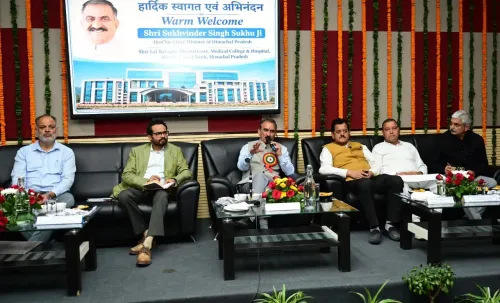
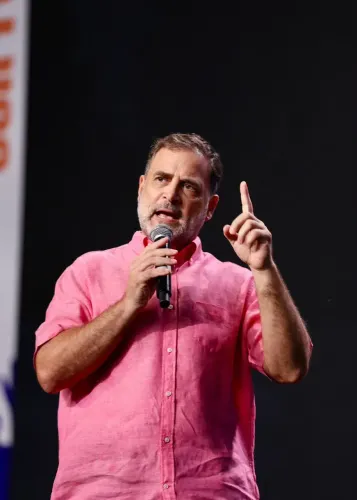
At a youth dialogue in Chennai, Leader of Opposition Rahul Gandhi fired off a pointed salvo at the Centre — and Himachal Pradesh Chief Minister Sukhvinder Singh Sukhu amplified every word of it on Sunday, October 11, 2026, turning a student conversation into a full-spectrum argument for federal equity.
NEET's impact and the 87% drop in Tamil-medium MBBS seats
The sharpest number from the Chennai event: Gandhi cited an 87% fall in the share of Tamil-medium students securing MBBS seats since the introduction of NEET. CM Sukhu, echoing the claim, framed it as evidence that a centralised entrance regime was systematically squeezing out regional-language aspirants — precisely the cohort that rural government schools produce.
The argument cuts to a long-running tension between states, particularly in South India, and the Centre over whether a single all-India medical entrance test levels the playing field or tilts it against students who study in state-board vernacular streams. The 87% figure, as quoted, makes that abstract debate brutally concrete.
Governor's role and the 70% vacancy crisis in state universities
Gandhi also flagged that 70% of state university Vice-Chancellor posts are vacant — a situation he attributed to the role Governors play as statutory chancellors. CM Sukhu endorsed the concern, noting that prolonged VC vacancies paralyse academic governance: senate meetings stall, appointments freeze, and thousands of students are caught in administrative limbo.
The Governor-versus-elected-government friction has played out visibly in multiple non-BJP states in recent years, with courts repeatedly called in to adjudicate appointment disputes. Sukhu's signal is that Himachal Pradesh sees itself as part of that larger pattern.
Himachal Pradesh's three-layered financial squeeze
CM Sukhu laid out a specific, three-part fiscal grievance rooted in Himachal Pradesh's own balance sheet. First: the phasing out of Revenue Deficit Grant (RDG) — a transfer the state has received since 1952 — is hitting the hill state hard. RDG was designed to compensate revenue-deficit states for their structural inability to generate tax income comparable to larger, industrialised plains states.
Second: the post-GST revenue architecture has created fresh stress. When GST subsumed state-level taxes, it was meant to be compensated through a guaranteed revenue-growth mechanism — but as that compensation window has closed, smaller states with narrow tax bases like Himachal have been left exposed.
Third: the withdrawal of Additional Borrowing limits has further tightened the state's fiscal room. Together, Sukhu argues, these three cuts represent a structural rollback of the support architecture that mountain states have historically depended on. His ask is explicit: the Centre must account for Himachal Pradesh's economic geography when designing fiscal transfers.
The federal compact Sukhu wants restored
Beyond the numbers, CM Sukhu articulated a constitutional principle: Centre-state relations must rest on 'the spirit of the Constitution, equality, and mutual respect.' He argued that rising above political differences to honour state rights is not a Congress talking point — it is the foundational logic of India's federal structure.
The event, branded 'Chhatron ki Goonj, Chennai' ('The Resonance of Students, Chennai'), framed youth as the audience and states' rights as the message. That framing matters: it links education access, university governance, and fiscal federalism into a single narrative of Centre encroachment — one that Sukhu is now carrying into the Himachal context.
For a hill state that contributes soldiers, hydropower, and tourist revenue while depending on central transfers to pay salaries, the argument is not abstract. It is a monthly budget reality. Whether the Centre responds with a fiscal review or treats this as campaign positioning will define Himachal Pradesh's financial headroom through the rest of this fiscal year.
Point of View
He threads Himachal Pradesh's very specific fiscal grievances — RDG discontinuation, GST exposure, borrowing caps — into a pan-India federalism narrative that Congress is building ahead of state and national election cycles. The NEET and VC-vacancy arguments serve a dual purpose: they resonate in southern states where Congress is contesting ground, while the fiscal points speak directly to Himachal's own budget crisis, giving Sukhu a domestic audience justification for the post. The framing of Centre-state relations as a constitutional rather than a partisan issue is a deliberate attempt to broaden the coalition of states receptive to this message beyond the Congress fold.
NationPress
11 Oct 2026
Frequently Asked Questions
What did Rahul Gandhi say about NEET at the Chennai youth event?
Rahul Gandhi stated that NEET has caused an 87% fall in the share of Tamil-medium students securing MBBS seats, arguing the centralised entrance exam disadvantages students who study in regional-language government schools.
Why are 70% of state university Vice-Chancellor posts vacant?
Rahul Gandhi attributed the vacancy crisis to the Governor's statutory role as university chancellor in states, where disputes between Governors and elected state governments have stalled VP appointments — a pattern seen across several non-BJP-ruled states.
What is Revenue Deficit Grant (RDG) and why does it matter for Himachal Pradesh?
Revenue Deficit Grant is a central transfer designed to compensate states that structurally cannot generate sufficient tax revenue. Himachal Pradesh has received RDG since 1952; its discontinuation removes a critical fiscal buffer for the hill state.
How has GST affected Himachal Pradesh's finances?
CM Sukhu argues that after the GST compensation window closed, Himachal Pradesh — which has a narrow tax base — lost guaranteed revenue support, compounding stress from the end of RDG and restrictions on additional borrowing.
What is 'Chhatron ki Goonj' and where was it held?
'Chhatron ki Goonj' — meaning 'The Resonance of Students' — is a youth dialogue event held in Chennai, where Rahul Gandhi engaged young people on education, state rights, and democracy.