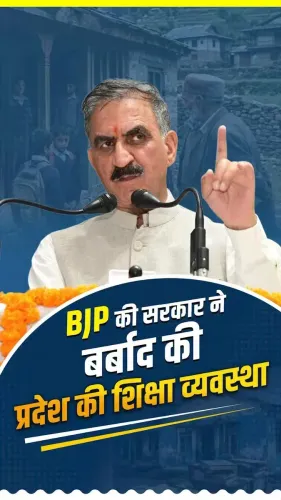
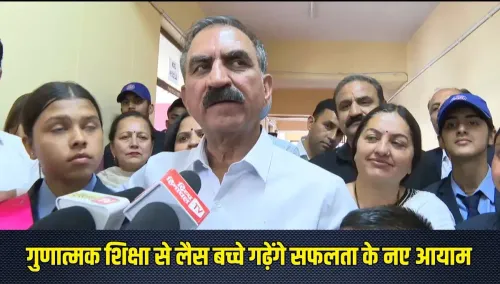
CM Sukhu backs Sonia Gandhi's critique of Modi govt on education
Synopsis
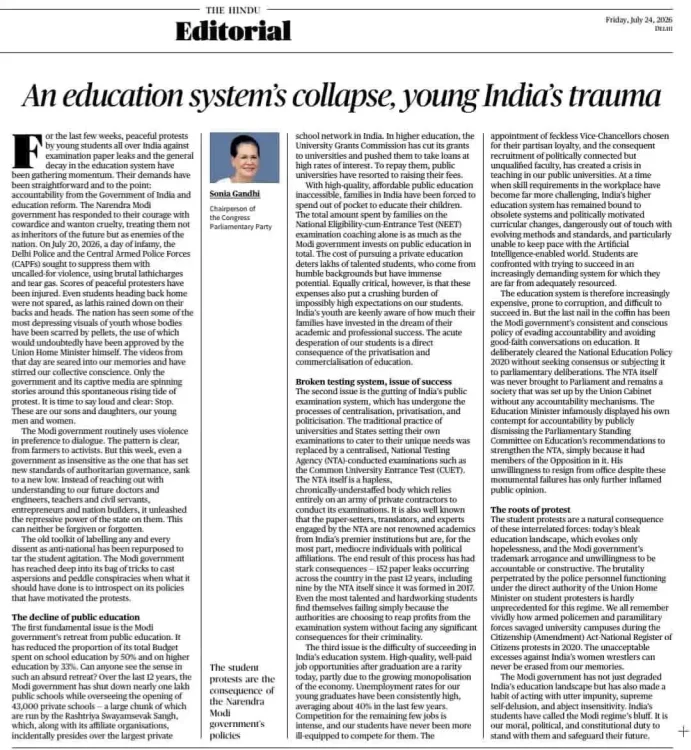
HP Chief Minister Sukhvinder Singh Sukhu amplified a Sonia Gandhi opinion piece on 24 July 2026, accusing the Modi government of weakening India's education system and governing with narcissism and insensitivity, calling it a constitutional duty to stand with students.
Key Takeaways
CM Sukhu shared and endorsed a Sonia Gandhi article on 24 July 2026 criticising the Modi government's education record.
The article accuses the central government of governing 'without accountability, with narcissism and insensitivity.' Sukhu called standing with students a 'moral, political, and constitutional obligation' of the Indian National Congress .
The post comes ahead of the monsoon session of Parliament , where education ministry funding and policy are expected to face opposition scrutiny.
Education is a concurrent subject, and NEP 2020 has been a flashpoint between BJP-led Centre and opposition-governed states including Himachal Pradesh .
Himachal Pradesh Chief Minister Sukhvinder Singh Sukhu on Friday, 24 July 2026, shared and endorsed an opinion piece by Congress Parliamentary Party Chairperson Sonia Gandhi, amplifying her charge that the Modi government has weakened India's education system while governing without accountability, empathy, or transparency.
Context
Sukhu's post references an article authored by Sonia Gandhi and published in a national daily, in which she levels a pointed critique at the Narendra Modi-led central government over its handling of education policy and student grievances. Sharing the piece, Sukhu wrote in Hindi: 'मोदी सरकार ने केवल भारत की शिक्षा व्यवस्था को कमजोर नहीं किया, बल्कि बिना जवाबदेही के, आत्ममुग्धता और असंवेदनशीलता के साथ शासन करने की प्रवृत्ति भी विकसित कर ली है' — translated: 'The Modi government has not only weakened India's education system, but has also developed a tendency to govern without accountability, with narcissism and insensitivity.'
Sukhu added that Indian students have 'exposed the reality of this government,' and asserted that standing with them and protecting their future is a 'moral, political, and constitutional obligation' of the Indian National Congress.
Policy Backdrop
Education is a concurrent subject under the Indian Constitution, meaning both the Centre and states share legislative responsibility — a structure that has historically generated friction between governments of different political persuasions. The National Education Policy (NEP) 2020, introduced by the BJP-led central government, replaced the 1986 National Education Policy and brought sweeping changes including a new 5+3+3+4 school structure, common entrance tests for higher education, and revised language-of-instruction norms.
Opposition-ruled states, including Himachal Pradesh, have raised concerns about the pace of NEP implementation, central funding patterns, and the perceived erosion of state autonomy in curriculum and faculty recruitment — particularly following multiple revisions to University Grants Commission (UGC) regulations after 2014. The Right to Education Act, 2009, enacted during the UPA government, had earlier enshrined elementary education as a fundamental right under Article 21A, a legislative legacy Congress leaders frequently invoke in this debate.
Stakeholders and Impact
At the centre of the political exchange are India's students — particularly those preparing for competitive examinations and enrolled in state universities — who have been vocal about examination irregularities, syllabus changes, and institutional uncertainty. Sonia Gandhi's article frames these grievances as symptomatic of a broader governance deficit at the national level, a framing Sukhu has now carried to his social media audience in Himachal Pradesh.
State universities in opposition-governed states face a dual pressure: compliance with central UGC mandates on one hand, and limited fiscal space on the other, as funding disputes between the Centre and states remain unresolved. Aspiring youth in smaller states like Himachal Pradesh, where government employment remains a primary aspiration, are particularly sensitive to disruptions in examination cycles and policy continuity.
What's Next
The timing of Sukhu's post — and Sonia Gandhi's article — is politically significant ahead of the monsoon session of Parliament, where the Education Ministry's demands for grants and broader policy accountability are expected to come under scrutiny from the opposition benches. Congress is likely to use student concerns as a sustained legislative and public-communication strategy through the session. Whether the BJP-led central government responds with a policy clarification or a counter-narrative on NEP outcomes will shape the next phase of this debate.
Point of View
Invoking the language of rights and duty to claim moral high ground. This fits a broader Congress pattern of using social sector failures — real or perceived — to build an opposition identity distinct from the BJP's development narrative. The move also signals that Congress-governed states intend to coordinate messaging with the central leadership on education, a subject that directly affects their own electoral base.
NationPress
22 Oct 2026
Frequently Asked Questions
What did CM Sukhu say about the Modi government and education?
CM Sukhu said the Modi government has not only weakened India's education system but has also developed a tendency to govern without accountability, narcissism, and insensitivity, while endorsing a Sonia Gandhi article making similar charges.
What is Sonia Gandhi's article about?
Sonia Gandhi's article, referenced in Sukhu's post, critiques the Modi government's handling of India's education system and student grievances, arguing that Congress has a moral, political, and constitutional duty to stand with students.
What is the National Education Policy 2020 and why is it controversial?
NEP 2020 is a central government framework that replaced the 1986 education policy, introducing a new school structure, common entrance tests, and revised language norms. Opposition-ruled states have raised concerns about federal overreach, funding gaps, and rapid implementation.
Why is education a source of centre-state conflict in India?
Education is a concurrent subject under the Indian Constitution, meaning both the Centre and states can legislate on it. This has led to recurring disputes between BJP-led central governments and Congress-governed states over curriculum, funding, and UGC regulations.
What is Congress's position on student issues in India?
Congress has consistently framed student grievances around examinations, NEP rollout, and institutional uncertainty as evidence of governance failures by the BJP at the Centre, positioning itself as the defender of students' futures and educational rights.