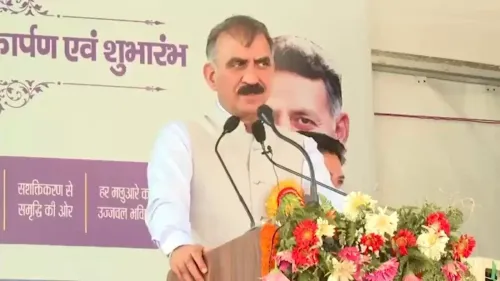
CM Sukhu waives fishermen's penalties, cuts royalty to 1%
Synopsis
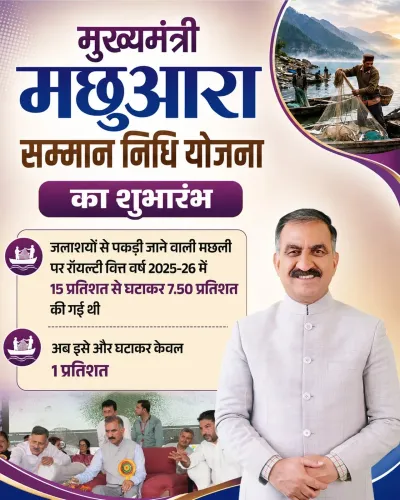
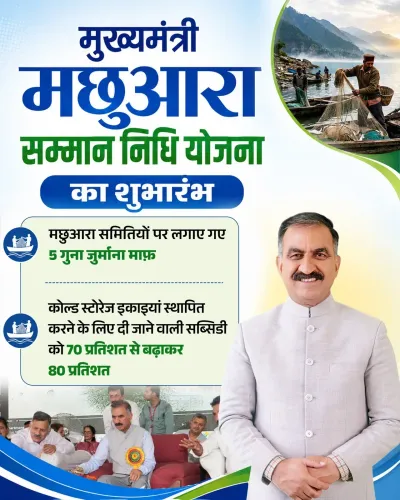
Himachal Pradesh CM Sukhvinder Singh Sukhu announced the waiver of all penalties on the fishing community and confirmed that the royalty on fishermen's income has been progressively reduced from 15% to 1%, delivering cumulative fiscal relief to small-scale inland fishing households.
Key Takeaways
CM Sukhu announced a full waiver of penalties levied on the fishing community in Himachal Pradesh on 12 August 2026 .
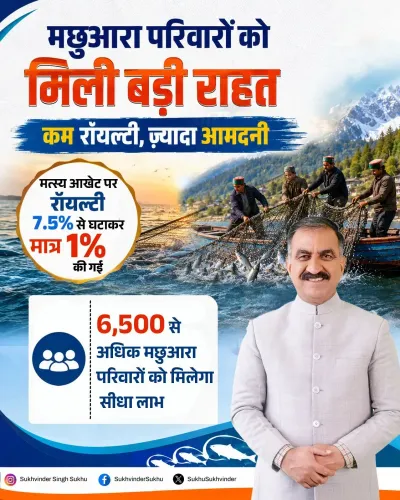
The royalty on fishermen's income has been cut in stages: from 15% to 7% , then from 7% to 1% .
Under the old rate, a fisherman earning ₹1 lakh owed ₹15,000 to the government; the new rate reduces that liability to ₹1,000 .
Sukhu cited income uncertainty — early-morning fishing with no guaranteed catch or fair price — as the primary reason for the relief.
Implementation details, including a formal fisheries department notification and revenue-impact assessment, are yet to be announced.
Before the sun rises over Himachal Pradesh's rivers and reservoirs, fishing families are already on the water — with no guarantee of a catch, a fair price, or even breaking even. Chief Minister Sukhvinder Singh Sukhu announced on Wednesday, 12 August 2026 that his government is waiving all penalties levied on the fishing community, capping a relief drive that has slashed their royalty burden from 15% to just 1% over the past year and a half.
In his post, Sukhu described the moment the issue landed on his desk: fishermen came to him and explained that for every ₹1 lakh earned, ₹15,000 went straight to the government as royalty — before accounting for days when the catch fetched poor prices or went unsold entirely. 'Families who head out at 4 a.m. to fish have no certainty about how much they will catch or whether they will get a fair price,' he wrote. 'If the fish does not sell, they bear the loss.'
From 15% to 1%: how the royalty came down
The relief unfolded in stages. The Himachal Pradesh government first halved the rate — cutting royalty from 15% to 7% — and then reduced it further to 1%. Wednesday's announcement takes the next step: eliminating the additional penalty burden that compounded the royalty charge. Together, the measures represent a near-total unwinding of the fiscal levy on inland fishing income.
Himachal Pradesh's fisheries sector is built around riverine and reservoir-based small-scale operators, households whose daily income swings sharply with weather, season, and market demand. A fixed-percentage royalty on gross income — not profit — hits hardest on low-catch days, effectively penalising fishermen for uncertainty they cannot control.
A pattern of state-level welfare adjustments
The move fits a wider pattern across Indian states, where governments periodically ease royalties and penalties on natural-resource livelihoods — inland fishing, minor forest produce, small-scale mining — to cushion rural households from income volatility. For the Congress-led administration in Shimla, it also signals a deliberate outreach to occupational communities whose welfare concerns rarely make headlines but whose votes and livelihoods matter in a state with a tight political balance.
What comes next is implementation: a formal notification from the state fisheries department, a revenue-impact assessment, and the mechanics of how outstanding penalties will be settled or written off. Those details will determine whether Wednesday's announcement translates cleanly into relief on the ground — or leaves paperwork in its wake.
For the families casting nets at 4 a.m., the arithmetic has already changed. The question now is how fast the paperwork catches up.
Point of View
Then to 1%, now penalty waiver — Sukhu frames his government as responsive rather than reactive, building a welfare record ahead of the next electoral cycle. The royalty-on-gross-income structure was always regressive for small operators, and its near-elimination aligns with a broader Congress strategy of consolidating rural and occupational-community support in Himachal Pradesh. The real test, however, is administrative follow-through: without a gazette notification and a clear penalty-settlement mechanism, the announcement risks remaining a political statement rather than a policy outcome.
NationPress
27 Sept 2026
Frequently Asked Questions
What did CM Sukhu announce for fishermen in Himachal Pradesh?
CM Sukhu announced the waiver of all penalties on the fishing community and confirmed that the royalty on fishermen's income has been reduced from 15% to 1%.
What was the royalty rate on fishermen's income in Himachal Pradesh before?
The royalty was originally 15% of income — meaning ₹15,000 on every ₹1 lakh earned — before the state government reduced it in stages to 7% and then to 1%.
Who benefits from the Himachal Pradesh fishing community royalty relief?
Small-scale inland fishing households dependent on rivers and reservoirs in Himachal Pradesh benefit from the reduced royalty and the penalty waiver announced by the state government.
When did Sukhu announce the penalty waiver for fishermen?
The announcement was made on 12 August 2026 via a post on X by Himachal Pradesh Chief Minister Sukhvinder Singh Sukhu.
What is the current royalty rate for fishermen in Himachal Pradesh?
The current royalty rate is 1% of income, down from the original 15%, following two successive reductions by the Sukhu-led state government.