CM Sukhu cuts fishing royalty from 7.5% to 1% for HP reservoirs
Synopsis
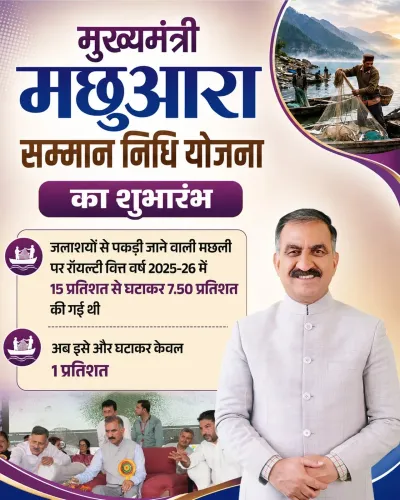
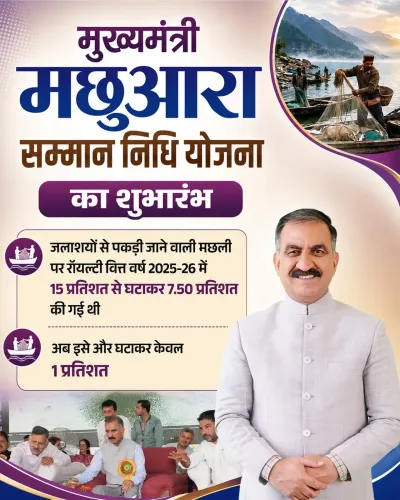
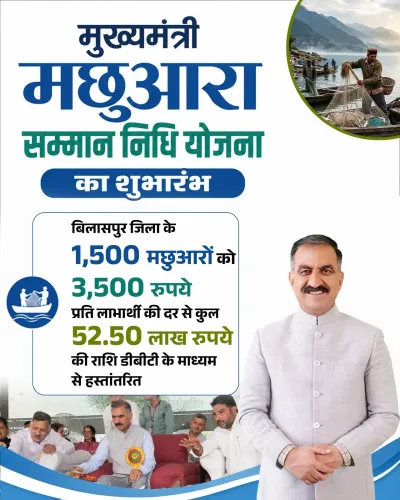
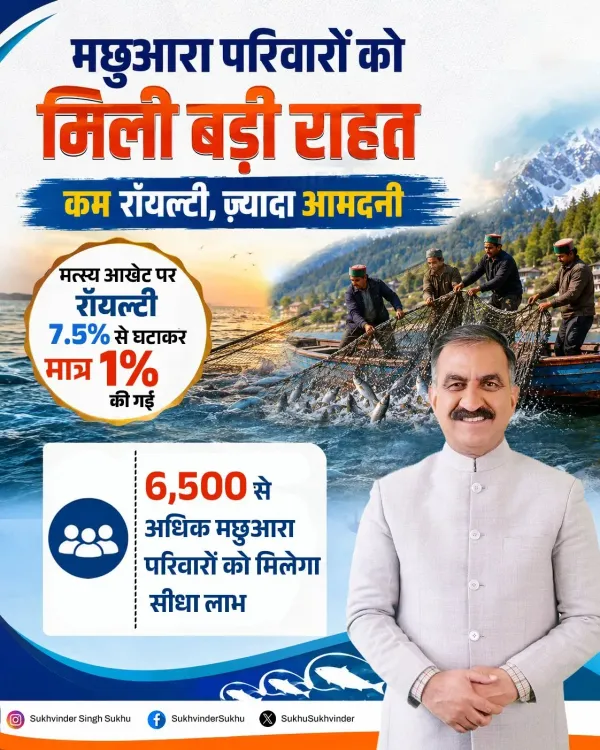
Himachal Pradesh CM Sukhvinder Singh Sukhu has slashed the fish harvesting royalty rate from 7.5 per cent to 1 per cent across five major reservoirs — Gobind Sagar, Pong Dam, Chamera, Ranjit Sagar and Kol Dam — promising direct relief to roughly 6,500 fisher families dependent on inland fisheries.
Key Takeaways
CM Sukhvinder Singh Sukhu announced a cut in the fish harvesting royalty rate from 7.5 per cent to 1 per cent on 11 June 2026 .
The decision covers five reservoirs: Gobind Sagar, Pong Dam, Chamera, Ranjit Sagar , and Kol Dam .
Approximately 6,500 fisher families dependent on these water bodies are expected to benefit directly.
The government described fishermen as 'the backbone of the rural economy' and framed the move as a top livelihood-protection priority.
The Himachal Pradesh Fisheries Department is expected to issue implementation orders following the announcement.
The decision aligns with the broader national framework of the Pradhan Mantri Matsya Sampada Yojana , which supports inland fisheries modernisation.
Himachal Pradesh Chief Minister Sukhvinder Singh Sukhu on Thursday, 11 June 2026, announced a sharp reduction in the royalty rate on fish harvesting across the state's major reservoirs, cutting the levy from 7.5 per cent to 1 per cent — a move the government says will directly benefit around 6,500 fisher families dependent on inland water bodies.
Context
Posting in Hindi on X, CM Sukhu described fishermen as 'gramin arthvyavastha ki reed' — 'the backbone of the rural economy' — and framed the royalty cut as a fulfilment of the government's foremost priority: protecting the livelihoods of fishing communities. The decision applies to fishermen working across five major reservoirs: Gobind Sagar, Pong Dam, Chamera, Ranjit Sagar, and Kol Dam.
The post stated that the reduction would 'strengthen the livelihoods' of the approximately 6,500 fisher families who depend on these water bodies. At the announced rate, the royalty burden on fish catch is now a fraction of what it was, leaving more income in the hands of fishing households.
Policy Backdrop
Gobind Sagar, formed by the Bhakra Dam in Bilaspur district, is one of Himachal Pradesh's largest inland fisheries. Pong Dam — officially Maharana Pratap Sagar — in Kangra district is a Ramsar-listed wetland that supports both fisheries and migratory bird habitats. Together with Chamera, Ranjit Sagar, and Kol Dam, these reservoirs form the backbone of the state's inland fishing economy.
State governments across India periodically revise royalty and cess rates on inland fisheries to ease pressure on traditional livelihood groups. Himachal Pradesh's hydropower reservoirs have historically created regulatory obligations — including royalty payments — for local fishing communities alongside their primary function of power generation. The central government's Pradhan Mantri Matsya Sampada Yojana, launched in 2020, also aimed to modernise fisheries infrastructure and support fisher incomes nationwide, providing a broader policy framework within which state-level adjustments like this one sit.
Stakeholders and Impact
The primary beneficiaries are the roughly 6,500 fisher families spread across the five reservoir catchments. For households where fish harvesting is the principal or sole source of income, a reduction in royalty from 7.5 per cent to 1 per cent represents a significant improvement in net earnings per catch. Rural communities in districts such as Bilaspur, Kangra, Chamba, and Una — where these reservoirs are located — stand to see a measurable uptick in disposable income.
The Himachal Pradesh Fisheries Department will be responsible for implementing the revised rate structure. Downstream effects could include increased investment by fishing families in equipment and storage, and a potential rise in fish production volumes as the reduced levy makes harvesting more economically viable at smaller scales.
What's Next
Formal implementation orders from the Himachal Pradesh Fisheries Department are expected to follow the announcement, translating the policy decision into revised licensing and royalty collection procedures at each reservoir. The impact on household incomes and overall fish production will likely be assessed ahead of the state's next budget session. If the reduction delivers measurable relief, it could set a precedent for further rationalisation of levies on other minor produce sectors in the state's hill economy.
Point of View
Enumerable community — 6,500 families across identifiable reservoirs — the announcement is designed to be both verifiable and politically legible at the grassroots level. The reduction from 7.5 per cent to 1 per cent is steep enough to signal genuine intent rather than incremental tinkering, and it fits a broader pattern of state governments using levy rationalisation as a low-cost, high-visibility tool for rural income support. The real test will be whether implementation follows swiftly and whether the savings translate into measurable income gains before the next electoral cycle.
NationPress
27 Sept 2026
Frequently Asked Questions
What is the new fish harvesting royalty rate in Himachal Pradesh?
The Himachal Pradesh government has reduced the royalty rate on fish harvesting from 7.5 per cent to 1 per cent , as announced by Chief Minister Sukhvinder Singh Sukhu on 11 June 2026.
Which reservoirs are covered by the Himachal Pradesh fishing royalty cut?
The royalty reduction applies to fishing on five reservoirs: Gobind Sagar, Pong Dam (Maharana Pratap Sagar), Chamera, Ranjit Sagar , and Kol Dam .
How many families will benefit from the HP fishing royalty reduction?
According to the Chief Minister's announcement, approximately 6,500 fisher families dependent on the five reservoirs are expected to benefit from the reduced royalty rate.
Why did the Himachal Pradesh government cut the fishing royalty rate?
The government stated that protecting the livelihoods of fishermen — described as 'the backbone of the rural economy' — is its top priority, and the royalty cut is aimed at increasing net incomes for fishing communities.
What is Pradhan Mantri Matsya Sampada Yojana and how does it relate to this decision?
The Pradhan Mantri Matsya Sampada Yojana , launched by the central government in 2020 , is a national scheme to modernise fisheries infrastructure and support fisher incomes; the HP state-level royalty cut complements this broader framework.