Gauhati High Court Judge Calls for Enhanced Coordination Amidst Surge in Cyber Crime in India
Synopsis
Cyber crime is surging in India, with over 86,000 cases reported in 2023. Justice Nelson Sailo of the Gauhati High Court emphasizes the need for stronger cooperation among law enforcement to combat this growing threat. The training program aimed to equip officials with the necessary tools to tackle digital crimes effectively.
Key Takeaways
Cyber crime in India has surged, with over 86,000 cases in 2023.
Justice Nelson Sailo emphasizes the need for stronger collaboration among law enforcement.
The Digital Personal Data Protection Act was enacted to protect data rights.
Common offences include financial fraud and online harassment .
Public awareness is crucial for effective prevention.
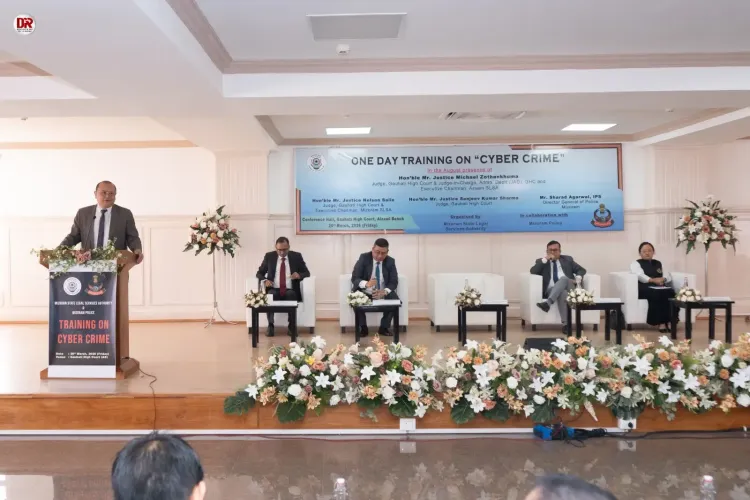
Aizawl, March 20 (NationPress) The incidence of cyber crime in India is on a steep rise, with over 86,000 cases logged in 2023, according to Justice Nelson Sailo of the Gauhati High Court, who spoke at a recent event.
During a one-day training session focused on cyber crime, Justice Sailo recalled how the Supreme Court recognized the "Right to Privacy" as a Fundamental Right under Article 21 of the Indian Constitution back in 2017.
In response to this significant judicial ruling, Parliament introduced the Digital Personal Data Protection Act (DPDP Act) in 2023, aimed at protecting the data rights of individuals and enhancing privacy measures in the digital landscape.
Focusing on the local context, he pointed out that Mizoram has seen 361 reported cyber crime incidents between 2022 and 2026, with five already noted this March.
The judge specified that prevalent crimes include financial fraud, social media impersonation, and online sexual harassment.
Justice Sailo recommended that citizens take preventive steps, such as utilizing antivirus software, refraining from opening or downloading unfamiliar files, and promptly reporting any suspicious behavior to law enforcement.
This training event took place at the Aizawl Bench Conference Hall of the Gauhati High Court and was a collaborative effort between the Mizoram State Legal Services Authority (MSLSA) and the Mizoram Police.
Another judge, Justice Michael Zothankhuma, also participated and shared his own experiences with cyber crime, commending the initiative to host such a necessary training.
He remarked that in our fast-paced and interconnected world, cyber crime has become a global menace, cutting across borders.
Justice Zothankhuma observed that legal frameworks often lag behind technological progress, resulting in gaps that leave room for emerging crimes.
To effectively counter cyber crime, he underscored the importance of robust collaboration among law enforcement agencies, police, and the judiciary.
Additionally, he emphasized that boosting public awareness is crucial for combating cyber crime and encouraged attendees to share the insights gained from the training with others.
The Mizoram Director General of Police, Sharad Agarwal, also addressed the audience, noting the significant challenges posed by the rapid increase in cyber crime for law enforcement.
He pointed out that modern technologies, such as Artificial Intelligence (AI), are frequently exploited for phishing, creating deepfake content, stealing credentials, and disseminating malware.
To tackle these emerging threats, the Mizoram Police has set up a Technical Support Cell and is utilizing digital forensic tools for secure data analysis.
District and Sessions Judge Helen Dawngliani elaborated on various forms of cyber crime during her address.
She pointed out that while technological advancements enhance convenience, they also broaden the scope for criminal activities.
She asserted that maintaining the rule of law in the digital realm necessitates stronger partnerships between law enforcement and the judiciary.
Following the opening session, a series of technical discussions were conducted as part of the training.
The event attracted officials from various sectors, including Home Affairs, Excise and Narcotics, and Finance.
Point of View
It is evident that comprehensive strategies and collaboration among law enforcement, the judiciary, and the public are vital for effectively addressing this pressing concern. The recent training initiative highlights the importance of awareness and preparedness in combating digital threats.
NationPress
26 Sept 2026
Frequently Asked Questions
What is the current state of cyber crime in India?
Cyber crime in India is on the rise, with over 86,000 cases reported in 2023 alone.
What protective measures can individuals take against cyber crime?
Individuals are advised to use antivirus software, avoid opening suspicious files, and report any unusual activities to law enforcement.
How has the Indian government responded to cyber crime?
The Indian government enacted the Digital Personal Data Protection Act in 2023 to safeguard citizens' data rights.
What common types of cyber crime are reported?
Common types of cyber crime include financial fraud, social media impersonation, and online sexual harassment.
Why is public awareness important in combating cyber crime?
Public awareness acts as the first line of defense against cyber crime, enabling individuals to recognize and report suspicious activities.