Tejasvi Surya slams Karnataka govt over Gruha Lakshmi dues, cites HC 'financial constraints' claim
Synopsis
BJP MP Tejasvi Surya has exposed a striking government U-turn: Karnataka's Congress administration told the Assembly in 2025 that technical glitches delayed Gruha Lakshmi payments, but told the High Court in 2026 it was financial constraints. With 1.24 crore women beneficiaries affected and the state defending itself by arguing the assistance isn't a legal right, the row raises hard questions about Karnataka's fiscal health and the viability of its marquee welfare guarantees.
Key Takeaways
BJP MP Tejasvi Surya accused the Karnataka Congress government of contradicting itself over unpaid Gruha Lakshmi instalments on 5 November 2026 .
In December 2025 , then Minister Laxmi Hebbalkar cited technical glitches in the Assembly; in November 2026 , the government cited financial constraints before the Karnataka High Court .
The government acknowledged in court that grants for February and March 2025 were not released due to financial constraints.
The state argued beneficiaries cannot claim Gruha Lakshmi assistance as an enforceable legal right , and sought dismissal of the petition.
Gruha Lakshmi provides ₹2,000 per month to women heads of households and has around 1.24 crore enrolled beneficiaries.
Minister Hebbalkar had earlier apologised in the Assembly for providing an incorrect reply on fund disbursal.
Bharatiya Janata Party (BJP) MP Tejasvi Surya on Thursday, 5 November 2026, launched a sharp attack on the Congress government in Karnataka over unpaid instalments under the Gruha Lakshmi scheme, alleging a glaring contradiction between the government's earlier public statements and its admission before the Karnataka High Court that financial constraints had prevented the release of funds.
The Contradiction at the Centre of the Row
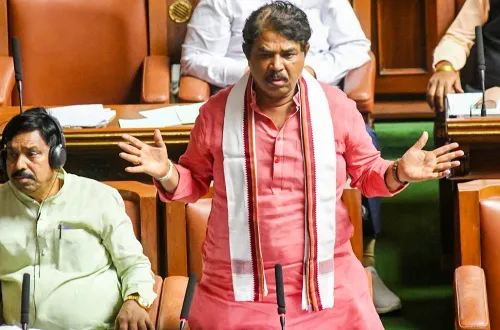
Surya, the Bengaluru South MP, pointed out that in December 2025, then Women and Child Welfare Minister Laxmi Hebbalkar had attributed the non-payment of Gruha Lakshmi dues to technical glitches — a claim made on the floor of the Karnataka Legislative Assembly. However, in November 2026, the same government cited financial constraints before the High Court in its statement of objections to a petition challenging the non-payment.
Posting on social media platform X, Surya wrote: 'In December 2025, then Minister for Women and Child Welfare Laxmi Hebbalkar blamed, on the Assembly floor, technical glitches for unpaid Gruha Lakshmi dues. In November 2026, her own Government cites 'financial constraints' in court, contradicting her statement. Servers never crashed. The State's finances did! Need more proofs that this is a zero-balance, Pauper Sarkara!?'
He also shared the government's statement of objections filed before the High Court, which names the Principal Secretary to the Government, Finance Department, Bengaluru, and others as respondents.
What the Government Told the High Court
In its court submission, the Karnataka government acknowledged that proposals for releasing Gruha Lakshmi instalments for February and March 2025 had been forwarded to the Finance Department, but the grants were not released due to financial constraints, resulting in non-payment for those two months.
The government further argued that the petitioners — led by one R. Ganga and others, who are themselves beneficiaries — had approached the court in the nature of a public interest litigation on behalf of nearly 1.24 crore enrolled beneficiaries.
Defending the programme, the government described Gruha Lakshmi as a benevolent scheme designed to empower women by providing financial support to female heads of households. It contended, however, that implementation was subject to administrative exigencies and that beneficiaries could not claim the assistance as an enforceable legal right. The government also argued that the doctrine of legitimate expectation did not confer an indefeasible right to demand funds when the state faced genuine financial constraints, and sought dismissal of the writ petition on these grounds.
Minister Hebbalkar's Assembly Admission
The row is not new. During the 2025 Assembly session, Minister Laxmi Hebbalkar had apologised on the floor of the House for providing an incorrect reply regarding the disbursal of Gruha Lakshmi funds. She admitted that instalments for two months had not been credited to beneficiaries through Direct Benefit Transfer (DBT), while maintaining that the scheme was being implemented sincerely.
Her admission followed sustained pressure from BJP legislators, who alleged that payments for February and March were pending — contrary to official claims that instalments had been cleared until August. She expressed regret if her earlier reply had hurt members of the House.
About the Gruha Lakshmi Scheme and Its Stakes
Gruha Lakshmi is one of the Congress government's five pre-poll guarantees in Karnataka and provides ₹2,000 per month to women heads of families. The scheme has approximately 1.24 crore enrolled beneficiaries, making the payment gap politically and financially significant.
Notably, this controversy comes amid broader questions about Karnataka's fiscal health, with the opposition arguing that the state's ambitious social guarantees have outpaced its revenue capacity. The High Court's handling of the petition is expected to set a precedent on whether welfare scheme beneficiaries hold enforceable claims on state disbursements.
Point of View
Essentially telling 1.24 crore women that a poll promise is not a binding commitment. If the High Court rules against the government, it could force a fiscal reckoning that extends well beyond Gruha Lakshmi to Karnataka's other four guarantees.
NationPress
5 Nov 2026
Frequently Asked Questions
What is the Gruha Lakshmi scheme in Karnataka?
Gruha Lakshmi is one of the Karnataka Congress government's five pre-poll guarantees, providing ₹2,000 per month to women heads of households. The scheme has approximately 1.24 crore enrolled beneficiaries across the state.
Why did Tejasvi Surya criticise the Karnataka government over Gruha Lakshmi?
BJP MP Tejasvi Surya alleged that the Karnataka government contradicted itself: in December 2025, then Minister Laxmi Hebbalkar cited technical glitches for delayed payments in the Assembly, but in November 2026, the government told the High Court that financial constraints had prevented release of funds for February and March 2025.
What did the Karnataka government submit before the High Court?
The Karnataka government submitted in its statement of objections that proposals for Gruha Lakshmi instalments for February and March 2025 were forwarded to the Finance Department but could not be released due to financial constraints. It also argued that beneficiaries cannot claim welfare assistance as an enforceable legal right.
Who filed the petition in the Karnataka High Court over Gruha Lakshmi?
A petition was filed by R. Ganga and others — who are themselves Gruha Lakshmi beneficiaries — challenging the non-payment of instalments. The case names the Principal Secretary to the Government, Finance Department, Bengaluru, and others as respondents.
What happened in the Karnataka Assembly over Gruha Lakshmi payments?
During the 2025 Assembly session, then Women and Child Welfare Minister Laxmi Hebbalkar apologised for providing an incorrect reply on fund disbursal. She admitted that instalments for two months had not been credited via Direct Benefit Transfer, following BJP allegations that February and March payments were pending despite official claims of clearance until August.