Tejashwi Demands Release of Students Held in Bihar Protests
Synopsis
RJD leader Tejashwi Yadav demanded the immediate release of hundreds of students and opposition legislators detained during Bihar protests on 26 July 2026, called for action against police who fired on demonstrators, and warned of fresh agitation if the government did not act.
Key Takeaways
Tejashwi Yadav posted on 26 July 2026 demanding immediate release of hundreds of students, opposition MLAs, and leaders detained in Bihar.
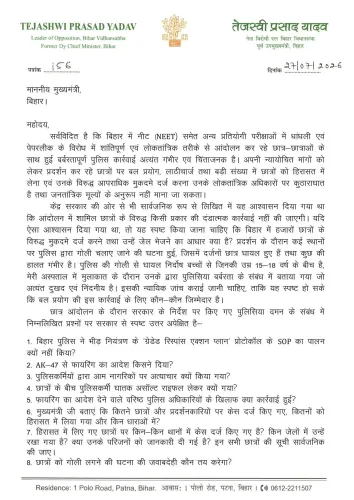
He called for action against Bihar Police personnel accused of firing on student protesters.
Tejashwi sharply attacked the sitting Chief Minister, calling him a person with a 'roadside criminal mentality' who was never directly voted for by the public.
He warned that if student protesters are not released 'at the earliest,' students will return to fresh agitation.
The post invokes Bihar's tradition as the 'mother of democracy,' referencing the state's history of landmark student-led political movements.
RJD is the principal opposition party in Bihar, with Tejashwi serving as Leader of the Opposition in the Bihar Legislative Assembly .
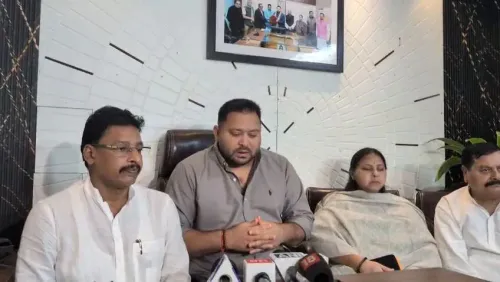
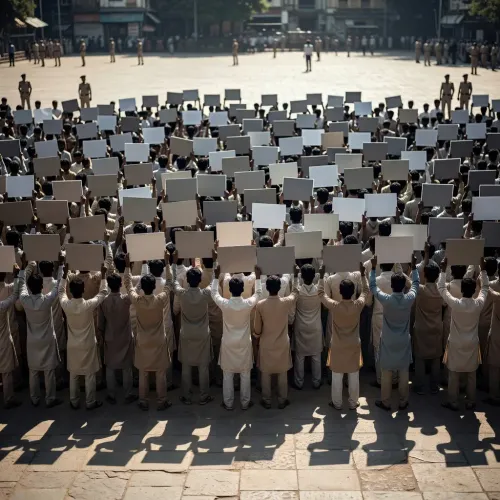
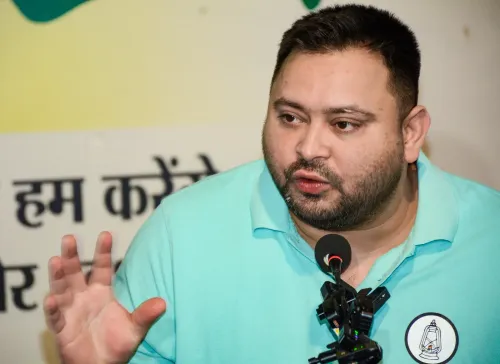
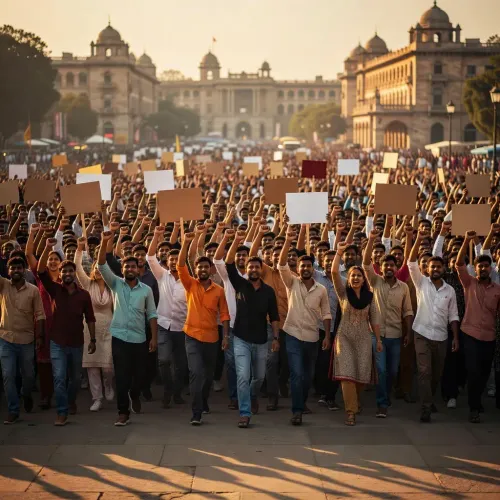
RJD leader Tejashwi Yadav on Sunday, 26 July 2026, demanded the immediate release of hundreds of students, opposition legislators, and political leaders detained during ongoing student demonstrations in Bihar, warning that a fresh wave of agitation would follow if the government failed to act. He also called for action against police personnel accused of firing on protesters.
Context
Posting in Hindi on X, Tejashwi wrote: 'बिहार में छात्र प्रदर्शन के दौरान हिरासत में लिए गए सैंकड़ों छात्रों, विपक्षी विधायकों और नेताओं को तत्काल रिहा करें' — 'Immediately release the hundreds of students, opposition MLAs, and leaders detained during the student protests in Bihar.' He added that police personnel who fired on students must face action.
The post also contained a sharp political attack on the sitting Chief Minister, stating that a person with a 'roadside criminal mentality' had been installed as the head of government in Bihar — 'the mother of democracy' — and that the public had never voted for him by name, work, or identity, and never would.
Policy Backdrop
Bihar has a long history of student-led political upheaval. The landmark 1974 Bihar movement, which began as a student agitation against government corruption, eventually drew in national leader Jayaprakash Narayan and reshaped Indian politics. Opposition leaders have consistently invoked this legacy when challenging the ruling coalition on law-and-order and democratic accountability.
The Rashtriya Janata Dal (RJD), led by the Yadav family, is the principal opposition party in the state and has regularly accused the JD(U)-led government of Chief Minister Nitish Kumar of suppressing dissent through administrative and police machinery. Tejashwi, as Leader of the Opposition in the Bihar Legislative Assembly and a former Deputy Chief Minister, is the most prominent face of this challenge.
Stakeholders and Impact
The immediate stakeholders are the students and opposition figures reportedly in detention, whose release Tejashwi has framed as a non-negotiable democratic demand. He warned directly: 'You cannot suppress the voice of Bihari people through lathis and the state apparatus.'
Bihar Police and the state administration face pressure to respond to the allegations of excessive force. Opposition legislators among the detained add a constitutional dimension to the crisis, as their detention directly affects the functioning of the legislature and the rights of elected representatives.
What's Next
Tejashwi has issued an explicit ultimatum: if student protesters are not released 'at the earliest,' students will return to agitation. Any official response from the Bihar government on the detentions, or the announcement of a judicial or administrative inquiry into the alleged police firing, will be the key development to watch.
Student groups have historically used such moments of political solidarity to broaden their mobilisation. Whether the opposition can sustain pressure and translate street protests into a sustained political campaign ahead of the next electoral cycle will define the longer arc of this confrontation.
Point of View
And a direct assault on the Chief Minister's political legitimacy ahead of what could be a consequential electoral cycle. By invoking Bihar's identity as the 'mother of democracy' and its 1974 student movement legacy, he is placing the current government in the role of the authoritarian forces that movement opposed — a historically resonant framing in Bihar's political culture. The explicit ultimatum about fresh protests signals that the RJD intends to keep the agitation alive as a pressure tool. Whether the ruling coalition responds with conciliation or further firmness will determine whether this becomes a defining law-and-order controversy or fades as a routine opposition salvo.
NationPress
25 Oct 2026
Frequently Asked Questions
Why is Tejashwi Yadav demanding the release of students in Bihar?
Tejashwi Yadav says hundreds of students, opposition MLAs, and political leaders were detained during student protests in Bihar and must be immediately released. He has also called for action against police personnel accused of firing on the demonstrators.
What did Tejashwi Yadav say about Bihar's Chief Minister?
Tejashwi described the Chief Minister as a person with a 'roadside criminal mentality' who was installed in office without ever having received a direct public mandate by name, work, or identity — and said the public would not vote for him in the future either.
What is Tejashwi Yadav's warning if students are not released?
He warned that if student protesters are not released at the earliest, students will return to agitation, signalling an escalation of street protests across Bihar.
What is Bihar's history with student protests?
Bihar has a significant tradition of student-led political movements. The 1974 Bihar movement began as a student agitation against corruption and later expanded under Jayaprakash Narayan, reshaping national politics.
What is Tejashwi Yadav's current political role?
Tejashwi Yadav is the Leader of the Opposition in the Bihar Legislative Assembly and a senior leader of the Rashtriya Janata Dal (RJD). He previously served as Deputy Chief Minister of Bihar.