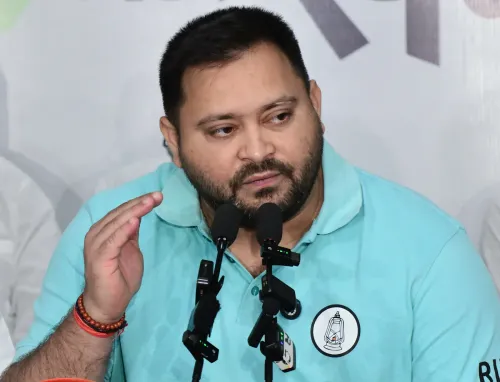
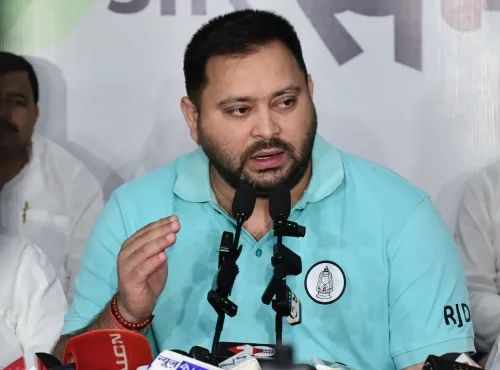
Tejashwi Yadav Demands Accountability Over Bihar Police Firing Deaths
Synopsis
RJD's Tejashwi Yadav alleges a Bihar Police ASI killed two civilians and attempted rape in Madhubani's Babubarhi, citing multiple recent police-conduct cases to charge the state government with systematic law-and-order failure.
Key Takeaways
Ashok Yadav and Phoolo Devi were allegedly shot dead by ASI Chandramohan Singh in Babubarhi, Madhubani after family members resisted an alleged assault.
Two more individuals are reportedly in a critical condition following the incident.
Tejashwi Yadav linked the incident to a broader series of alleged police crimes including killings in Muzaffarpur , Madhubani , and Buxar .
He accused the Bihar government of running a politically motivated 'transfer industry' while protecting district officials in Madhubani.
No formal inquiry or government response had been announced as of the time of this report on November 3, 2026 .
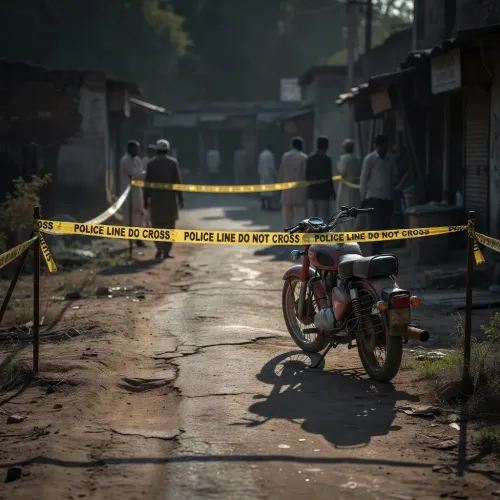
Two civilians are dead and two more critically wounded after a Bihar Police ASI allegedly opened fire inside a family home in Babubarhi, Madhubani — and RJD leader Tejashwi Yadav is turning the incident into a full-throated indictment of the state government's law-and-order record on Tuesday, November 3, 2026.
According to Tejashwi's post, ASI Chandramohan Singh of the Bihar Police entered the home of Ashok Yadav in Babubarhi and allegedly attempted to sexually assault a woman in the family. When relatives raised an alarm and resisted, the ASI allegedly fired from his service revolver, killing Ashok Yadav and Phoolo Devi on the spot. Two others sustained injuries and are in a serious condition.
A Pattern Tejashwi Calls Systematic, Not Isolated
The Leader of the Opposition did not frame the Madhubani incident as a one-off failure. He linked it to a string of recent police-conduct cases: the alleged shooting death of Jagatveer Rai by a sub-inspector in Muzaffarpur, the killing of Roshan Yadav in Madhubani, and the death of Bharat Bhushan Tiwari in Buxar. He also pointed to a rise in custody deaths across the state, presenting the sequence as evidence of institutional collapse rather than individual wrongdoing.
His sharpest line was directed at the Chief Minister himself — whom he called 'hatiyara mukhyamantri' (murderer Chief Minister), a reference to long-standing RJD allegations about criminal cases against the incumbent. 'Ever since a Chief Minister accused of seven murders came to power, the police themselves have become the criminals,' he wrote. 'The guardians have become the predators.'
Transfer Industry and Administrative Accountability
Tejashwi reserved pointed criticism for the administrative response — or its absence. Despite repeated alleged crimes by police personnel in Madhubani, he noted, neither the District Magistrate nor the Superintendent of Police of the district has been transferred. Yet at the state level, officer postings and transfers happen daily, which he characterised as a 'transfer industry' run by the Chief Minister and his family for personal gain.
This argument taps into a well-worn opposition playbook in Bihar politics: connecting individual governance failures to accusations of selective administrative action — protecting local officials who are politically useful while weaponising transfers against others. The charge has been a recurring flashpoint across multiple governments in the state.
What the Government Has Not Yet Said
As of the time of this report, no formal statement or inquiry order from the Bihar government on the Babubarhi shooting or the broader pattern of incidents cited by Tejashwi has been publicly announced. The absence of an official response to a sitting opposition leader's direct, named accusations on a matter of alleged police killings is itself a political data point.
Bihar's opposition has consistently used social media amplification of law-and-order incidents to build a counter-narrative ahead of electoral cycles — and with specific names, a specific village, and a specific accusation against a named officer now in public circulation, the pressure for an official response will be difficult to ignore.
Point of View
Converting a localised police-conduct incident into a statewide governance indictment by aggregating named cases and tying them to a transfer-corruption narrative. The tactic is consistent with RJD's long-term strategy of personalising Bihar's law-and-order failures directly to the Chief Minister rather than to institutional dysfunction. The selective-transfer charge is especially significant: it shifts the debate from crime statistics to administrative intent, a harder accusation for a government to rebut with routine denials. With no official inquiry announced, the government's silence risks letting the opposition frame the entire story.
NationPress
3 Nov 2026
Frequently Asked Questions
What happened in Babubarhi Madhubani according to Tejashwi Yadav?
According to Tejashwi Yadav's post, Bihar Police ASI Chandramohan Singh entered the home of Ashok Yadav in Babubarhi, Madhubani, allegedly attempted to sexually assault a woman, and then opened fire with his service revolver when relatives resisted, killing Ashok Yadav and Phoolo Devi on the spot and leaving two others critically injured.
Who is Tejashwi Yadav and why is he criticising the Bihar government?
Tejashwi Yadav is the senior RJD leader and Leader of the Opposition in the Bihar Legislative Assembly, and former Deputy Chief Minister of Bihar. He is criticising the ruling state government for what he calls a pattern of police misconduct and alleged killings across multiple districts.
What other police incidents did Tejashwi Yadav mention in his post?
He cited the alleged shooting of Jagatveer Rai by a sub-inspector in Muzaffarpur, the killing of Roshan Yadav in Madhubani, the killing of Bharat Bhushan Tiwari in Buxar, and a general rise in custody deaths across Bihar.
What is the 'transfer industry' charge Tejashwi Yadav raised?
Tejashwi alleged that despite repeated police crimes in Madhubani, neither the District Magistrate nor the Superintendent of Police there has been transferred, while the state government conducts daily officer transfers statewide — which he characterised as a politically driven 'transfer industry' run by the Chief Minister and his family.
Has the Bihar government responded to the Madhubani shooting allegations?
As of November 3, 2026, no formal government statement or inquiry order into the Babubarhi incident or related police-conduct cases cited by Tejashwi Yadav had been publicly announced.