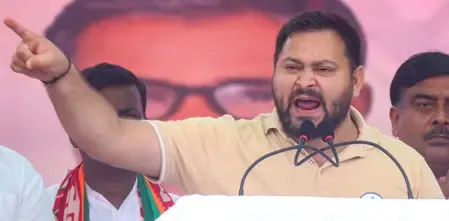
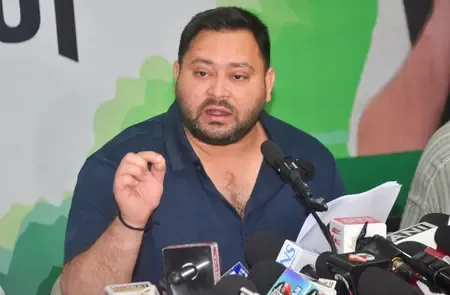
Tejashwi Yadav alleges vote theft, calls BJP-EC nexus 'deadly combination'

Synopsis
RJD leader Tejashwi Yadav has alleged that the BJP and the Election Commission form a 'deadly combination' undermining Indian democracy, citing disclosures by two election commissioners as only the start of a larger unraveling — and pointing to a December 2025 interview as prior proof of his claims.
Key Takeaways
Tejashwi Yadav posted on 27 September 2026 alleging systematic vote theft by the BJP in collusion with the Election Commission of India.
He cited a 6 December 2025 interview with Kapil Sibal as prior, on-record evidence of his prediction.
He described disclosures by two election commissioners as 'only ice breaking,' suggesting larger revelations are still to come.
Yadav alleged that investigative agencies and constitutional institutions were used to facilitate electoral wrongdoing.
The Election Commission of India had not publicly responded to the allegations at the time of publication.
The post comes ahead of the next Bihar assembly elections , making it part of a deliberate opposition narrative-building effort.
Long before Bihar's last election results were declared, RJD leader Tejashwi Yadav was on record with a specific claim — that governments were being manufactured through what he calls 'vote theft.' On Sunday, 27 September 2026, he returned to that charge with fresh ammunition, citing what he describes as disclosures by two election commissioners as proof that a much larger unraveling is only beginning.
In a post in Hindi, Yadav recalled a televised interview on 6 December 2025 with senior advocate and political figure Kapil Sibal, in which he had said: 'Right now, their theft is not coming to the surface, but their exposure will definitely come in the future.' He is now pointing to that remark as vindication.
Two commissioners, one fuse
Yadav frames the alleged disclosures by two election commissioners — the specifics of which remain under public scrutiny — not as the full story but as what he calls 'only ice breaking' (सिर्फ ice breaking है). His argument: the surface has barely cracked. He contends that deeper wrongdoing, carried out through investigative agencies and other constitutional institutions, is still to come to light.
The Election Commission of India, a constitutional body charged with superintending and directing elections across the country, has faced sustained opposition scrutiny for over a decade. Allegations of procedural bias and institutional capture — particularly around electronic voting machine integrity — have been a recurring motif of opposition politics since the early 2010s. Tejashwi's post places his attack squarely within that lineage, while escalating the rhetorical register sharply.
The language of maximum charge
The post does not stop at procedural critique. Yadav describes those sitting inside the BJP and the Election Commission using a cascade of Hindi terms — thieves, swindlers, dacoits, looters, deceivers, schemers, fraudsters, cheats, and manipulators — and calls their combination a 'deadly combination' that has become, in his words, 'भारतीय लोकतंत्र का काल' — 'the death knell of Indian democracy.'
That is combative language by any measure. But stripped of its heat, the underlying political argument is one the opposition has been assembling for years: that a ruling party with deep organisational reach, combined with institutions perceived as pliant, creates a structural advantage that ordinary electoral competition cannot overcome. Yadav is betting that the commissioner-disclosure episode gives that argument a new, datable hook.
Bihar's next election and why timing matters
Bihar assembly elections are due, and opposition positioning ahead of that cycle is now fully underway. The Rashtriya Janata Dal, the party Yadav leads alongside his father Lalu Prasad Yadav, has staked its comeback narrative on the argument that the last Bihar mandate was not a fair verdict. Today's post is part of building that case in public — methodically, with reference to specific dates and prior statements, so that the charge carries weight beyond one news cycle.
The Election Commission has not yet responded publicly to Yadav's latest allegations. Any formal rejoinder, or further disclosures from the commissioners he references, will determine how fast this escalates from a political post into a constitutional flashpoint.
Tejashwi Yadav has placed his prediction on the record twice now — once in December 2025, and again today. If the ice is truly breaking, Bihar's voters will be watching every piece that follows.
Point of View
Dateable disclosure event, giving the claim more evidentiary texture than broad allegations usually carry. By referencing a prior on-record prediction, he frames himself as a whistleblower vindicated rather than a politician improvising. The sharp timing, ahead of Bihar's electoral cycle, suggests the RJD is building a foundational grievance story for the next campaign. Whether the alleged commissioner disclosures develop into a formal legal or parliamentary challenge will determine if this escalates into a genuine constitutional crisis or remains a potent piece of opposition rhetoric.
NationPress
27 Sept 2026
Frequently Asked Questions
What did Tejashwi Yadav allege about the Election Commission?
Tejashwi Yadav alleged that members of the BJP and the Election Commission of India form a 'deadly combination' that has been stealing votes to manufacture electoral victories, and that disclosures by two election commissioners are only the beginning of a larger exposure.
What is the Kapil Sibal interview Tejashwi referred to?
Tejashwi Yadav referred to a televised interview on 6 December 2025 with senior advocate and political figure Kapil Sibal , in which he had predicted that the ruling party's alleged electoral wrongdoing would eventually come to light.
What did the two election commissioners reveal?
The specific nature of the alleged disclosures by two election commissioners is under public scrutiny; Tejashwi Yadav described these revelations as 'only ice breaking,' suggesting he believes more information is forthcoming.
How has the Election Commission responded to Tejashwi's allegations?
The Election Commission of India had not issued a public response to Tejashwi Yadav's latest allegations at the time of publication.
Why is Tejashwi Yadav raising these issues now?
Bihar assembly elections are approaching, and the RJD has consistently argued that the party's previous electoral loss was not a fair verdict. The recent commissioner disclosures have given Yadav a new hook to revive and sharpen that narrative ahead of the next election cycle.